

7.5 Risk Identification (Step 3)
171
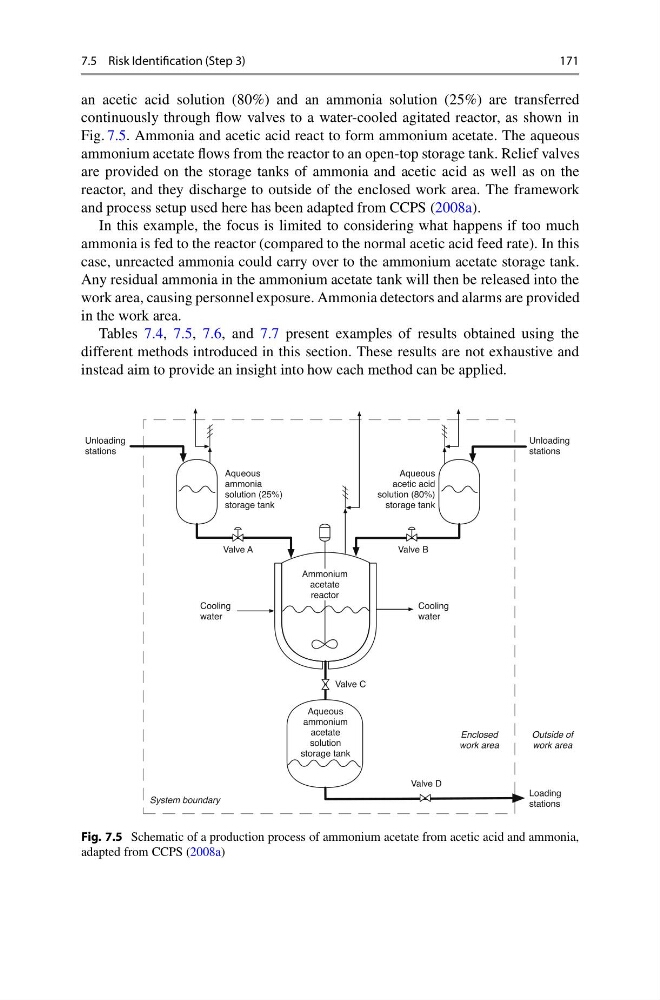
an acetic acid solution (80%) and an ammonia solution (25%) are transferred
continuously through flow valves to a water-cooled agitated reactor, as shown in
Fig. 7.5. Ammonia and acetic acid react to form ammonium acetate. The aqueous
ammonium acetate flows from the reactor to an open-top storage tank. Relief valves
are provided on the storage tanks of ammonia and acetic acid as well as on the
reactor, and they discharge to outside of the enclosed work area. The framework
and process setup used here has been adapted from CCPS (2008a).
In this example, the focus is limited to considering what happens if too much
ammonia is fed to the reactor (compared to the normal acetic acid feed rate). In this
case, unreacted ammonia could carry over to the ammonium acetate storage tank.
Any residual ammonia in the ammonium acetate tank will then be released into the
work area, causing personnel exposure. Ammonia detectors and alarms are provided
in the work area.
Tables 7.4, 7.5, 7.6, and 7.7 present examples of results obtained using the
different methods introduced in this section. These results are not exhaustive and
instead aim to provide an insight into how each method can be applied.
Fig. 7.5 Schematic of a production process of ammonium acetate from acetic acid and ammonia,
adapted from CCPS (2008a)
171
an acetic acid solution (80%) and an ammonia solution (25%) are transferred
continuously through flow valves to a water-cooled agitated reactor, as shown in
Fig. 7.5. Ammonia and acetic acid react to form ammonium acetate. The aqueous
ammonium acetate flows from the reactor to an open-top storage tank. Relief valves
are provided on the storage tanks of ammonia and acetic acid as well as on the
reactor, and they discharge to outside of the enclosed work area. The framework
and process setup used here has been adapted from CCPS (2008a).
In this example, the focus is limited to considering what happens if too much
ammonia is fed to the reactor (compared to the normal acetic acid feed rate). In this
case, unreacted ammonia could carry over to the ammonium acetate storage tank.
Any residual ammonia in the ammonium acetate tank will then be released into the
work area, causing personnel exposure. Ammonia detectors and alarms are provided
in the work area.
Tables 7.4, 7.5, 7.6, and 7.7 present examples of results obtained using the
different methods introduced in this section. These results are not exhaustive and
instead aim to provide an insight into how each method can be applied.
Fig. 7.5 Schematic of a production process of ammonium acetate from acetic acid and ammonia,
adapted from CCPS (2008a)