

170
7 Risk Assessment and Management of Chemical Processes
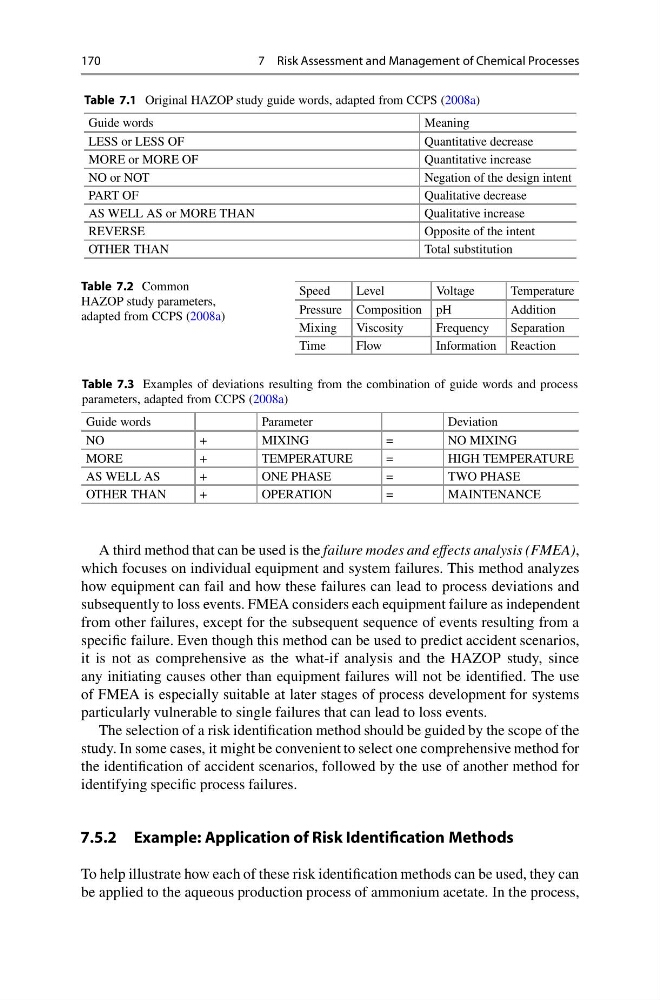
Table 7.1 Original HAZOP study guide words, adapted from CCPS (2008a)
Guide words
Meaning
LESS or LESS OF
Quantitative decrease
MORE or MORE OF
Quantitative increase
NO or NOT
Negation of the design intent
PART OF
Qualitative decrease
AS WELL AS or MORE THAN
Qualitative increase
REVERSE
Opposite of the intent
OTHER THAN
Total substitution
Table 7.2 Common
HAZOP study parameters,
adapted from CCPS (2008a)
Speed
Level
Voltage
Temperature
Pressure Composition pH
Addition
Mixing
Viscosity
Frequency
Separation
Time
Flow
Information Reaction
Table 7.3 Examples of deviations resulting from the combination of guide words and process
parameters, adapted from CCPS (2008a)
Guide words
Parameter
Deviation
NO
+
MIXING
=
NO MIXING
MORE
+
TEMPERATURE
=
HIGH TEMPERATURE
AS WELL AS
+
ONE PHASE
=
TWO PHASE
OTHER THAN
+
OPERATION
=
MAINTENANCE
A third method that can be used is the failure modes and effects analysis (FMEA),
which focuses on individual equipment and system failures. This method analyzes
how equipment can fail and how these failures can lead to process deviations and
subsequently to loss events. FMEA considers each equipment failure as independent
from other failures, except for the subsequent sequence of events resulting from a
specific failure. Even though this method can be used to predict accident scenarios,
it is not as comprehensive as the what-if analysis and the HAZOP study, since
any initiating causes other than equipment failures will not be identified. The use
of FMEA is especially suitable at later stages of process development for systems
particularly vulnerable to single failures that can lead to loss events.
The selection of a risk identification method should be guided by the scope of the
study. In some cases, it might be convenient to select one comprehensive method for
the identification of accident scenarios, followed by the use of another method for
identifying specific process failures.
7.5.2 Example: Application of Risk Identification Methods
To help illustrate how each of these risk identification methods can be used, they can
be applied to the aqueous production process of ammonium acetate. In the process,
7 Risk Assessment and Management of Chemical Processes
Table 7.1 Original HAZOP study guide words, adapted from CCPS (2008a)
Guide words
Meaning
LESS or LESS OF
Quantitative decrease
MORE or MORE OF
Quantitative increase
NO or NOT
Negation of the design intent
PART OF
Qualitative decrease
AS WELL AS or MORE THAN
Qualitative increase
REVERSE
Opposite of the intent
OTHER THAN
Total substitution
Table 7.2 Common
HAZOP study parameters,
adapted from CCPS (2008a)
Speed
Level
Voltage
Temperature
Pressure Composition pH
Addition
Mixing
Viscosity
Frequency
Separation
Time
Flow
Information Reaction
Table 7.3 Examples of deviations resulting from the combination of guide words and process
parameters, adapted from CCPS (2008a)
Guide words
Parameter
Deviation
NO
+
MIXING
=
NO MIXING
MORE
+
TEMPERATURE
=
HIGH TEMPERATURE
AS WELL AS
+
ONE PHASE
=
TWO PHASE
OTHER THAN
+
OPERATION
=
MAINTENANCE
A third method that can be used is the failure modes and effects analysis (FMEA),
which focuses on individual equipment and system failures. This method analyzes
how equipment can fail and how these failures can lead to process deviations and
subsequently to loss events. FMEA considers each equipment failure as independent
from other failures, except for the subsequent sequence of events resulting from a
specific failure. Even though this method can be used to predict accident scenarios,
it is not as comprehensive as the what-if analysis and the HAZOP study, since
any initiating causes other than equipment failures will not be identified. The use
of FMEA is especially suitable at later stages of process development for systems
particularly vulnerable to single failures that can lead to loss events.
The selection of a risk identification method should be guided by the scope of the
study. In some cases, it might be convenient to select one comprehensive method for
the identification of accident scenarios, followed by the use of another method for
identifying specific process failures.
7.5.2 Example: Application of Risk Identification Methods
To help illustrate how each of these risk identification methods can be used, they can
be applied to the aqueous production process of ammonium acetate. In the process,