

7.6 Risk Analysis (Step 4)
175
total rupturing of a reactor vessel (CCPS, 2009). In this subsection, the qualitative
and quantitative approaches to consequence analysis are presented.
7.6.1.1 Qualitative Consequence Analysis
A qualitative consequence analysis can take the form of simple descriptions of
effects on humans, environment, and property. The magnitude of each consequence
can be described through categories using general terms such as “high,” “medium,”
and “low.” Any terminology used in the descriptions should be clearly explained.
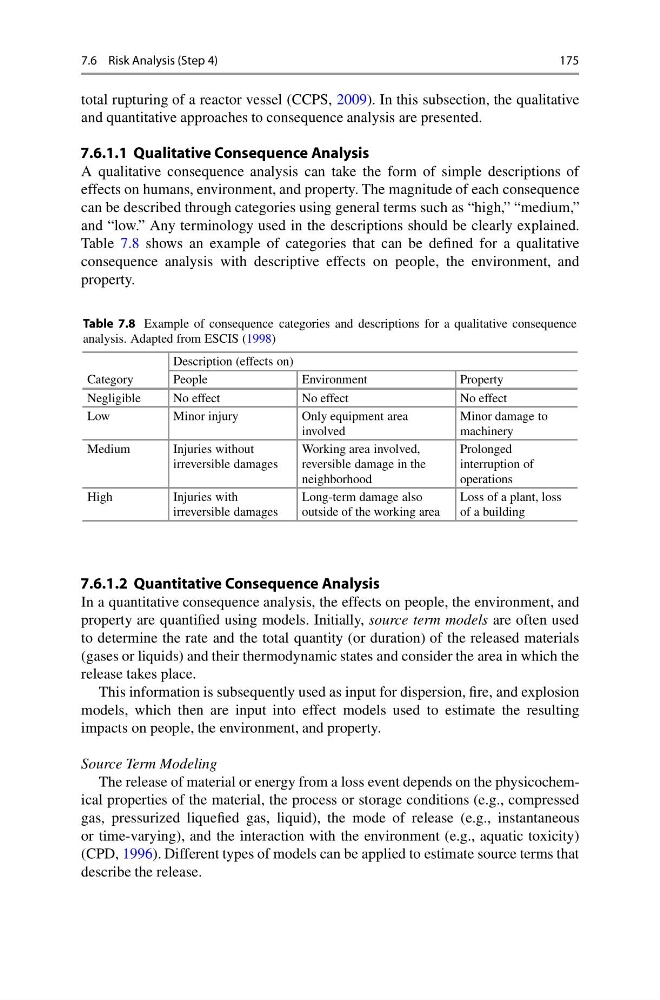
Table 7.8 shows an example of categories that can be defined for a qualitative
consequence analysis with descriptive effects on people, the environment, and
property.
Table 7.8 Example of consequence categories and descriptions for a qualitative consequence
analysis. Adapted from ESCIS (1998)
Description (effects on)
Category
People
Environment
Property
Negligible
No effect
No effect
No effect
Low
Minor injury
Only equipment area
involved
Minor damage to
machinery
Medium
Injuries without
irreversible damages
Working area involved,
reversible damage in the
neighborhood
Prolonged
interruption of
operations
High
Injuries with
irreversible damages
Long-term damage also
outside of the working area
Loss of a plant, loss
of a building
7.6.1.2 Quantitative Consequence Analysis
In a quantitative consequence analysis, the effects on people, the environment, and
property are quantified using models. Initially, source term models are often used
to determine the rate and the total quantity (or duration) of the released materials
(gases or liquids) and their thermodynamic states and consider the area in which the
release takes place.
This information is subsequently used as input for dispersion, fire, and explosion
models, which then are input into effect models used to estimate the resulting
impacts on people, the environment, and property.
Source Term Modeling
The release of material or energy from a loss event depends on the physicochemical properties of the material, the process or storage conditions (e.g., compressed
gas, pressurized liquefied gas, liquid), the mode of release (e.g., instantaneous
or time-varying), and the interaction with the environment (e.g., aquatic toxicity)
(CPD, 1996). Different types of models can be applied to estimate source terms that
describe the release.
175
total rupturing of a reactor vessel (CCPS, 2009). In this subsection, the qualitative
and quantitative approaches to consequence analysis are presented.
7.6.1.1 Qualitative Consequence Analysis
A qualitative consequence analysis can take the form of simple descriptions of
effects on humans, environment, and property. The magnitude of each consequence
can be described through categories using general terms such as “high,” “medium,”
and “low.” Any terminology used in the descriptions should be clearly explained.
Table 7.8 shows an example of categories that can be defined for a qualitative
consequence analysis with descriptive effects on people, the environment, and
property.
Table 7.8 Example of consequence categories and descriptions for a qualitative consequence
analysis. Adapted from ESCIS (1998)
Description (effects on)
Category
People
Environment
Property
Negligible
No effect
No effect
No effect
Low
Minor injury
Only equipment area
involved
Minor damage to
machinery
Medium
Injuries without
irreversible damages
Working area involved,
reversible damage in the
neighborhood
Prolonged
interruption of
operations
High
Injuries with
irreversible damages
Long-term damage also
outside of the working area
Loss of a plant, loss
of a building
7.6.1.2 Quantitative Consequence Analysis
In a quantitative consequence analysis, the effects on people, the environment, and
property are quantified using models. Initially, source term models are often used
to determine the rate and the total quantity (or duration) of the released materials
(gases or liquids) and their thermodynamic states and consider the area in which the
release takes place.
This information is subsequently used as input for dispersion, fire, and explosion
models, which then are input into effect models used to estimate the resulting
impacts on people, the environment, and property.
Source Term Modeling
The release of material or energy from a loss event depends on the physicochemical properties of the material, the process or storage conditions (e.g., compressed
gas, pressurized liquefied gas, liquid), the mode of release (e.g., instantaneous
or time-varying), and the interaction with the environment (e.g., aquatic toxicity)
(CPD, 1996). Different types of models can be applied to estimate source terms that
describe the release.