

7.1 The Aim of Process Risk Assessment
163
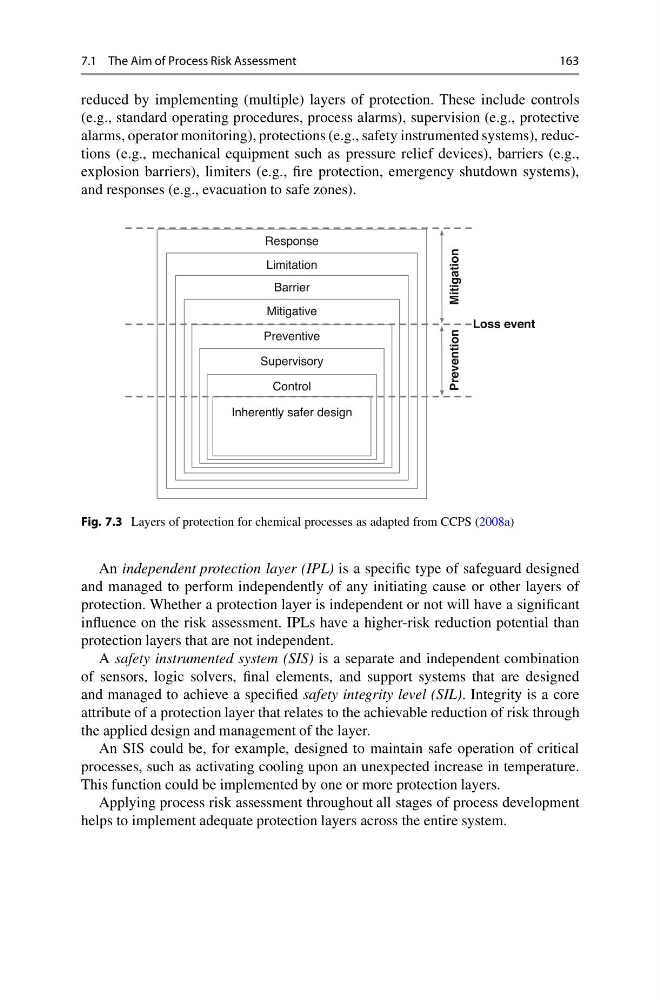
reduced by implementing (multiple) layers of protection. These include controls
(e.g., standard operating procedures, process alarms), supervision (e.g., protective
alarms, operator monitoring), protections (e.g., safety instrumented systems), reductions (e.g., mechanical equipment such as pressure relief devices), barriers (e.g.,
explosion barriers), limiters (e.g., fire protection, emergency shutdown systems),
and responses (e.g., evacuation to safe zones).
Fig. 7.3 Layers of protection for chemical processes as adapted from CCPS (2008a)
An independent protection layer (IPL) is a specific type of safeguard designed
and managed to perform independently of any initiating cause or other layers of
protection. Whether a protection layer is independent or not will have a significant
influence on the risk assessment. IPLs have a higher-risk reduction potential than
protection layers that are not independent.
A safety instrumented system (SIS) is a separate and independent combination
of sensors, logic solvers, final elements, and support systems that are designed
and managed to achieve a specified safety integrity level (SIL). Integrity is a core
attribute of a protection layer that relates to the achievable reduction of risk through
the applied design and management of the layer.
An SIS could be, for example, designed to maintain safe operation of critical
processes, such as activating cooling upon an unexpected increase in temperature.
This function could be implemented by one or more protection layers.
Applying process risk assessment throughout all stages of process development
helps to implement adequate protection layers across the entire system.
163
reduced by implementing (multiple) layers of protection. These include controls
(e.g., standard operating procedures, process alarms), supervision (e.g., protective
alarms, operator monitoring), protections (e.g., safety instrumented systems), reductions (e.g., mechanical equipment such as pressure relief devices), barriers (e.g.,
explosion barriers), limiters (e.g., fire protection, emergency shutdown systems),
and responses (e.g., evacuation to safe zones).
Fig. 7.3 Layers of protection for chemical processes as adapted from CCPS (2008a)
An independent protection layer (IPL) is a specific type of safeguard designed
and managed to perform independently of any initiating cause or other layers of
protection. Whether a protection layer is independent or not will have a significant
influence on the risk assessment. IPLs have a higher-risk reduction potential than
protection layers that are not independent.
A safety instrumented system (SIS) is a separate and independent combination
of sensors, logic solvers, final elements, and support systems that are designed
and managed to achieve a specified safety integrity level (SIL). Integrity is a core
attribute of a protection layer that relates to the achievable reduction of risk through
the applied design and management of the layer.
An SIS could be, for example, designed to maintain safe operation of critical
processes, such as activating cooling upon an unexpected increase in temperature.
This function could be implemented by one or more protection layers.
Applying process risk assessment throughout all stages of process development
helps to implement adequate protection layers across the entire system.