

162
7 Risk Assessment and Management of Chemical Processes
7.1.2.1 Inherent Process Safety
Inherently safe process conditions are achieved when process hazards have been
permanently eliminated or reduced. To do this, process hazards should be identified
during the early stages of process development. As defined by CCPS (2008b), four
strategies for inherently safer design include:
1. Minimization of the material and energy contents in a process or plant
2. Substitution of hazardous materials or processes with non- or less hazardous
alternatives
3. Moderation of hazardous process conditions, such as reduction of process
pressure or temperature
4. Simplification of the design facilities and elimination of unnecessary complexity
Throughout this chapter, it should be kept in mind that inherent process safety is
the primary guideline for chemical process risk assessment.
7.1.2.2 Functional Process Safety
Any process risks that remain after the implementation of inherently safer design
can be further reduced by protection layers, which consist of safeguards not intrinsic
to the process design. This is referred to as functional process safety. The general
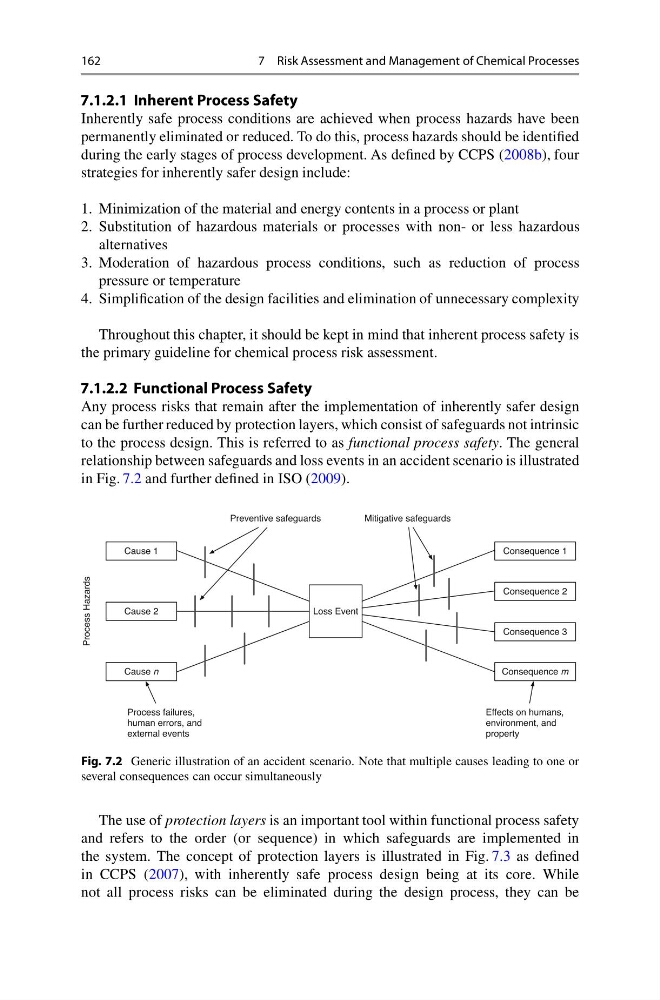
relationship between safeguards and loss events in an accident scenario is illustrated
in Fig. 7.2 and further defined in ISO (2009).
Fig. 7.2 Generic illustration of an accident scenario. Note that multiple causes leading to one or
several consequences can occur simultaneously
The use of protection layers is an important tool within functional process safety
and refers to the order (or sequence) in which safeguards are implemented in
the system. The concept of protection layers is illustrated in Fig. 7.3 as defined
in CCPS (2007), with inherently safe process design being at its core. While
not all process risks can be eliminated during the design process, they can be
7 Risk Assessment and Management of Chemical Processes
7.1.2.1 Inherent Process Safety
Inherently safe process conditions are achieved when process hazards have been
permanently eliminated or reduced. To do this, process hazards should be identified
during the early stages of process development. As defined by CCPS (2008b), four
strategies for inherently safer design include:
1. Minimization of the material and energy contents in a process or plant
2. Substitution of hazardous materials or processes with non- or less hazardous
alternatives
3. Moderation of hazardous process conditions, such as reduction of process
pressure or temperature
4. Simplification of the design facilities and elimination of unnecessary complexity
Throughout this chapter, it should be kept in mind that inherent process safety is
the primary guideline for chemical process risk assessment.
7.1.2.2 Functional Process Safety
Any process risks that remain after the implementation of inherently safer design
can be further reduced by protection layers, which consist of safeguards not intrinsic
to the process design. This is referred to as functional process safety. The general
relationship between safeguards and loss events in an accident scenario is illustrated
in Fig. 7.2 and further defined in ISO (2009).
Fig. 7.2 Generic illustration of an accident scenario. Note that multiple causes leading to one or
several consequences can occur simultaneously
The use of protection layers is an important tool within functional process safety
and refers to the order (or sequence) in which safeguards are implemented in
the system. The concept of protection layers is illustrated in Fig. 7.3 as defined
in CCPS (2007), with inherently safe process design being at its core. While
not all process risks can be eliminated during the design process, they can be