

164
7 Risk Assessment and Management of Chemical Processes
7.2
Procedure of Process Risk Assessment
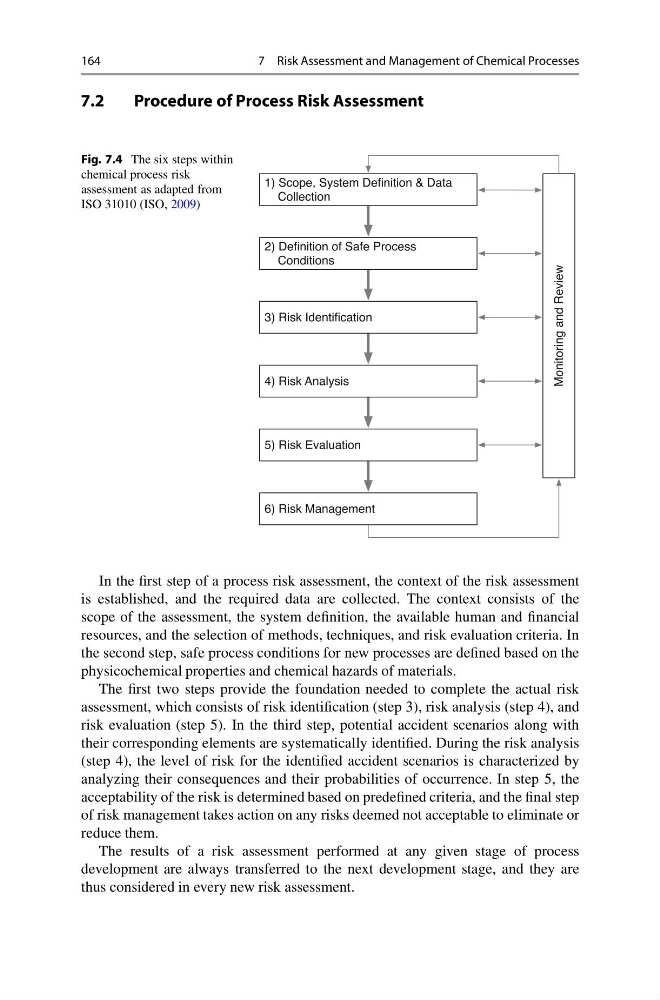
Fig. 7.4 The six steps within
chemical process risk
assessment as adapted from
ISO 31010 (ISO, 2009)
In the first step of a process risk assessment, the context of the risk assessment
is established, and the required data are collected. The context consists of the
scope of the assessment, the system definition, the available human and financial
resources, and the selection of methods, techniques, and risk evaluation criteria. In
the second step, safe process conditions for new processes are defined based on the
physicochemical properties and chemical hazards of materials.
The first two steps provide the foundation needed to complete the actual risk
assessment, which consists of risk identification (step 3), risk analysis (step 4), and
risk evaluation (step 5). In the third step, potential accident scenarios along with
their corresponding elements are systematically identified. During the risk analysis
(step 4), the level of risk for the identified accident scenarios is characterized by
analyzing their consequences and their probabilities of occurrence. In step 5, the
acceptability of the risk is determined based on predefined criteria, and the final step
of risk management takes action on any risks deemed not acceptable to eliminate or
reduce them.
The results of a risk assessment performed at any given stage of process
development are always transferred to the next development stage, and they are
thus considered in every new risk assessment.
7 Risk Assessment and Management of Chemical Processes
7.2
Procedure of Process Risk Assessment
Fig. 7.4 The six steps within
chemical process risk
assessment as adapted from
ISO 31010 (ISO, 2009)
In the first step of a process risk assessment, the context of the risk assessment
is established, and the required data are collected. The context consists of the
scope of the assessment, the system definition, the available human and financial
resources, and the selection of methods, techniques, and risk evaluation criteria. In
the second step, safe process conditions for new processes are defined based on the
physicochemical properties and chemical hazards of materials.
The first two steps provide the foundation needed to complete the actual risk
assessment, which consists of risk identification (step 3), risk analysis (step 4), and
risk evaluation (step 5). In the third step, potential accident scenarios along with
their corresponding elements are systematically identified. During the risk analysis
(step 4), the level of risk for the identified accident scenarios is characterized by
analyzing their consequences and their probabilities of occurrence. In step 5, the
acceptability of the risk is determined based on predefined criteria, and the final step
of risk management takes action on any risks deemed not acceptable to eliminate or
reduce them.
The results of a risk assessment performed at any given stage of process
development are always transferred to the next development stage, and they are
thus considered in every new risk assessment.