

6.8 Example: Risk Assessment of a Reactive Cotton Dye
151
6.8.4 Risk Characterization and Classification (Step 4)
Given the calculated exposure and effect values, a deterministic risk quotient can be
used to characterize the risks of dye use to human health and the environment.
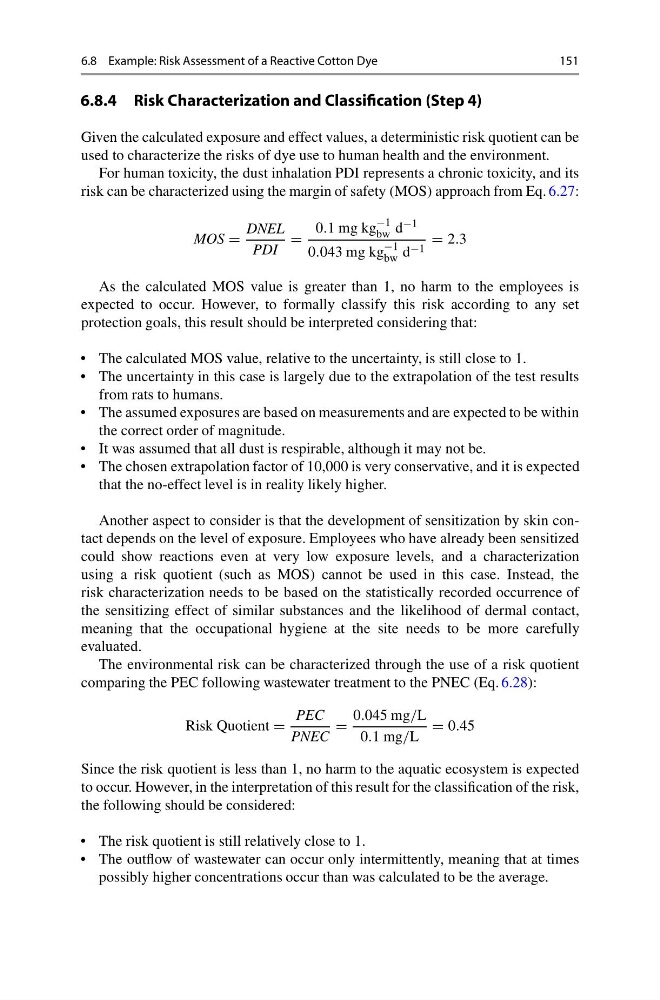
For human toxicity, the dust inhalation PDI represents a chronic toxicity, and its
risk can be characterized using the margin of safety (MOS) approach from Eq. 6.27:
MOS =
DNEL
PDI
=
0.1 mg kg
−1
bw d −1
0.043 mg kg
−1
bw d −1
= 2.3
As the calculated MOS value is greater than 1, no harm to the employees is
expected to occur. However, to formally classify this risk according to any set
protection goals, this result should be interpreted considering that:
• The calculated MOS value, relative to the uncertainty, is still close to 1.
• The uncertainty in this case is largely due to the extrapolation of the test results
from rats to humans.
• The assumed exposures are based on measurements and are expected to be within
the correct order of magnitude.
• It was assumed that all dust is respirable, although it may not be.
• The chosen extrapolation factor of 10,000 is very conservative, and it is expected
that the no-effect level is in reality likely higher.
Another aspect to consider is that the development of sensitization by skin contact depends on the level of exposure. Employees who have already been sensitized
could show reactions even at very low exposure levels, and a characterization
using a risk quotient (such as MOS) cannot be used in this case. Instead, the
risk characterization needs to be based on the statistically recorded occurrence of
the sensitizing effect of similar substances and the likelihood of dermal contact,
meaning that the occupational hygiene at the site needs to be more carefully
evaluated.
The environmental risk can be characterized through the use of a risk quotient
comparing the PEC following wastewater treatment to the PNEC (Eq. 6.28):
Risk Quotient =
PEC
PNEC
=
0.045 mg/L
0.1 mg/L
= 0.45
Since the risk quotient is less than 1, no harm to the aquatic ecosystem is expected
to occur. However, in the interpretation of this result for the classification of the risk,
the following should be considered:
• The risk quotient is still relatively close to 1.
• The outflow of wastewater can occur only intermittently, meaning that at times
possibly higher concentrations occur than was calculated to be the average.
151
6.8.4 Risk Characterization and Classification (Step 4)
Given the calculated exposure and effect values, a deterministic risk quotient can be
used to characterize the risks of dye use to human health and the environment.
For human toxicity, the dust inhalation PDI represents a chronic toxicity, and its
risk can be characterized using the margin of safety (MOS) approach from Eq. 6.27:
MOS =
DNEL
PDI
=
0.1 mg kg
−1
bw d −1
0.043 mg kg
−1
bw d −1
= 2.3
As the calculated MOS value is greater than 1, no harm to the employees is
expected to occur. However, to formally classify this risk according to any set
protection goals, this result should be interpreted considering that:
• The calculated MOS value, relative to the uncertainty, is still close to 1.
• The uncertainty in this case is largely due to the extrapolation of the test results
from rats to humans.
• The assumed exposures are based on measurements and are expected to be within
the correct order of magnitude.
• It was assumed that all dust is respirable, although it may not be.
• The chosen extrapolation factor of 10,000 is very conservative, and it is expected
that the no-effect level is in reality likely higher.
Another aspect to consider is that the development of sensitization by skin contact depends on the level of exposure. Employees who have already been sensitized
could show reactions even at very low exposure levels, and a characterization
using a risk quotient (such as MOS) cannot be used in this case. Instead, the
risk characterization needs to be based on the statistically recorded occurrence of
the sensitizing effect of similar substances and the likelihood of dermal contact,
meaning that the occupational hygiene at the site needs to be more carefully
evaluated.
The environmental risk can be characterized through the use of a risk quotient
comparing the PEC following wastewater treatment to the PNEC (Eq. 6.28):
Risk Quotient =
PEC
PNEC
=
0.045 mg/L
0.1 mg/L
= 0.45
Since the risk quotient is less than 1, no harm to the aquatic ecosystem is expected
to occur. However, in the interpretation of this result for the classification of the risk,
the following should be considered:
• The risk quotient is still relatively close to 1.
• The outflow of wastewater can occur only intermittently, meaning that at times
possibly higher concentrations occur than was calculated to be the average.