

150
6 Risk Assessment and Management of Chemical Products
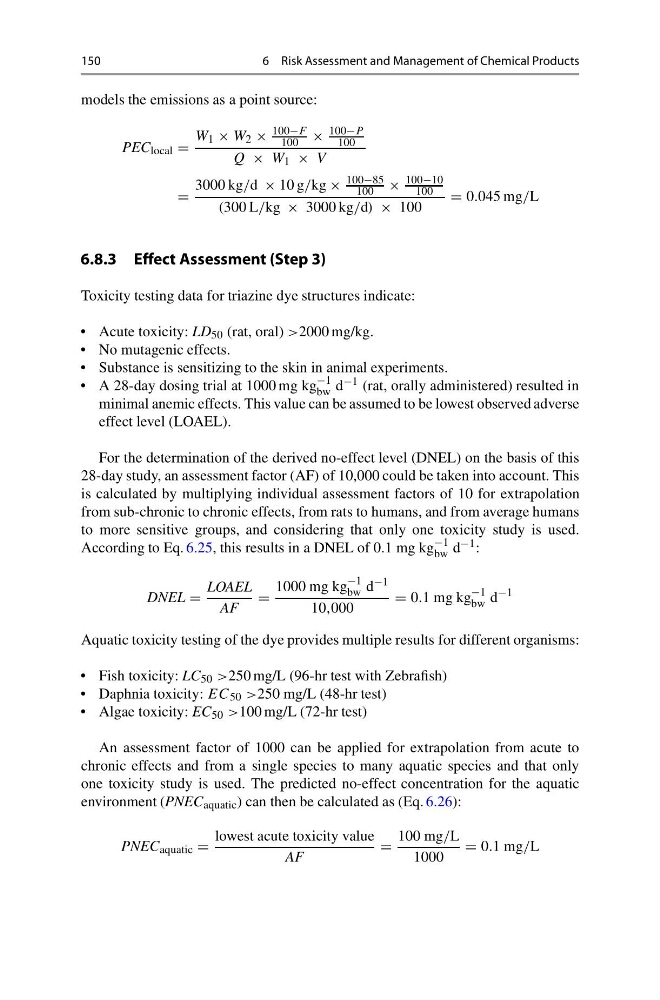
models the emissions as a point source:
PEC local =
W 1 × W 2 ×
100−F
100 ×
100−P
100
Q × W 1 × V
=
3000 kg/d × 10 g/kg ×
100−85
100 ×
100−10
100
(300 L/kg × 3000 kg/d) × 100
= 0.045 mg/L
6.8.3 Effect Assessment (Step 3)
Toxicity testing data for triazine dye structures indicate:
• Acute toxicity: LD 50 (rat, oral) >2000 mg/kg.
• No mutagenic effects.
• Substance is sensitizing to the skin in animal experiments.
• A 28-day dosing trial at 1000 mg kg
−1
bw d −1 (rat, orally administered) resulted in
minimal anemic effects. This value can be assumed to be lowest observed adverse
effect level (LOAEL).
For the determination of the derived no-effect level (DNEL) on the basis of this
28-day study, an assessment factor (AF) of 10,000 could be taken into account. This
is calculated by multiplying individual assessment factors of 10 for extrapolation
from sub-chronic to chronic effects, from rats to humans, and from average humans
to more sensitive groups, and considering that only one toxicity study is used.
According to Eq. 6.25, this results in a DNEL of 0.1 mg kg
−1
bw d −1 :
DNEL =
LOAEL
AF
=
1000 mg kg
−1
bw d −1
10,000
= 0.1 mg kg
−1
bw d
−1
Aquatic toxicity testing of the dye provides multiple results for different organisms:
• Fish toxicity: LC 50 >250 mg/L (96-hr test with Zebrafish)
• Daphnia toxicity: EC 50 >250 mg/L (48-hr test)
• Algae toxicity: EC 50 >100 mg/L (72-hr test)
An assessment factor of 1000 can be applied for extrapolation from acute to
chronic effects and from a single species to many aquatic species and that only
one toxicity study is used. The predicted no-effect concentration for the aquatic
environment (PNEC aquatic ) can then be calculated as (Eq. 6.26):
PNEC aquatic =
lowest acute toxicity value
AF
=
100 mg/L
1000
= 0.1 mg/L
6 Risk Assessment and Management of Chemical Products
models the emissions as a point source:
PEC local =
W 1 × W 2 ×
100−F
100 ×
100−P
100
Q × W 1 × V
=
3000 kg/d × 10 g/kg ×
100−85
100 ×
100−10
100
(300 L/kg × 3000 kg/d) × 100
= 0.045 mg/L
6.8.3 Effect Assessment (Step 3)
Toxicity testing data for triazine dye structures indicate:
• Acute toxicity: LD 50 (rat, oral) >2000 mg/kg.
• No mutagenic effects.
• Substance is sensitizing to the skin in animal experiments.
• A 28-day dosing trial at 1000 mg kg
−1
bw d −1 (rat, orally administered) resulted in
minimal anemic effects. This value can be assumed to be lowest observed adverse
effect level (LOAEL).
For the determination of the derived no-effect level (DNEL) on the basis of this
28-day study, an assessment factor (AF) of 10,000 could be taken into account. This
is calculated by multiplying individual assessment factors of 10 for extrapolation
from sub-chronic to chronic effects, from rats to humans, and from average humans
to more sensitive groups, and considering that only one toxicity study is used.
According to Eq. 6.25, this results in a DNEL of 0.1 mg kg
−1
bw d −1 :
DNEL =
LOAEL
AF
=
1000 mg kg
−1
bw d −1
10,000
= 0.1 mg kg
−1
bw d
−1
Aquatic toxicity testing of the dye provides multiple results for different organisms:
• Fish toxicity: LC 50 >250 mg/L (96-hr test with Zebrafish)
• Daphnia toxicity: EC 50 >250 mg/L (48-hr test)
• Algae toxicity: EC 50 >100 mg/L (72-hr test)
An assessment factor of 1000 can be applied for extrapolation from acute to
chronic effects and from a single species to many aquatic species and that only
one toxicity study is used. The predicted no-effect concentration for the aquatic
environment (PNEC aquatic ) can then be calculated as (Eq. 6.26):
PNEC aquatic =
lowest acute toxicity value
AF
=
100 mg/L
1000
= 0.1 mg/L