

6.7 Risk Management (Step 5)
147
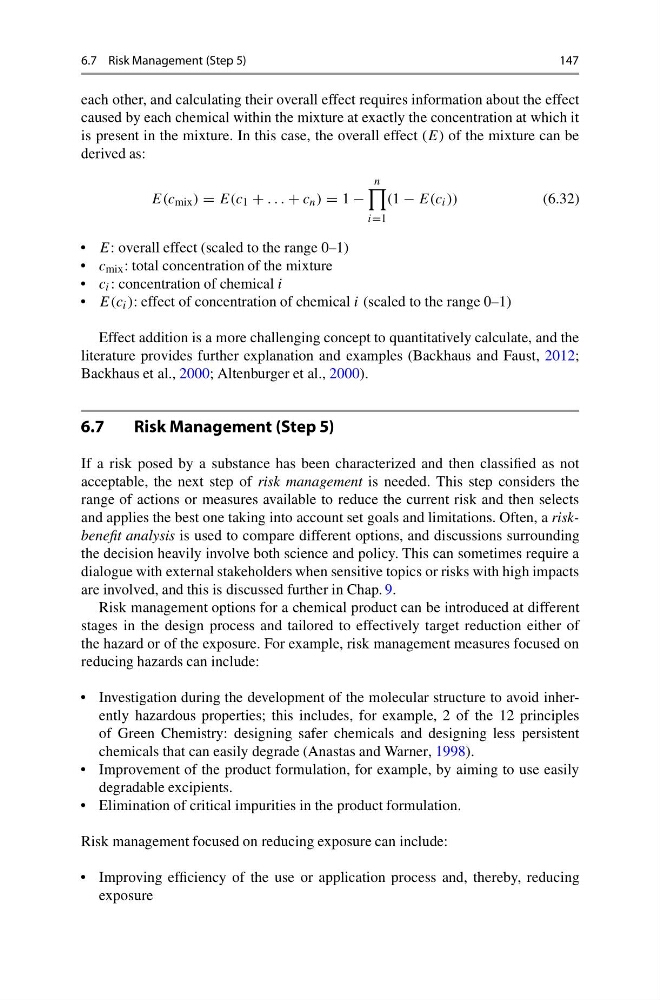
each other, and calculating their overall effect requires information about the effect
caused by each chemical within the mixture at exactly the concentration at which it
is present in the mixture. In this case, the overall effect (E) of the mixture can be
derived as:
E(c mix ) = E(c 1 + . . . + c n ) = 1 −
n
i=1
(1 − E(c i ))
(6.32)
• E: overall effect (scaled to the range 0–1)
• c mix : total concentration of the mixture
• c i : concentration of chemical i
• E(c i ): effect of concentration of chemical i (scaled to the range 0–1)
Effect addition is a more challenging concept to quantitatively calculate, and the
literature provides further explanation and examples (Backhaus and Faust, 2012;
Backhaus et al., 2000; Altenburger et al., 2000).
6.7
Risk Management (Step 5)
If a risk posed by a substance has been characterized and then classified as not
acceptable, the next step of risk management is needed. This step considers the
range of actions or measures available to reduce the current risk and then selects
and applies the best one taking into account set goals and limitations. Often, a riskbenefit analysis is used to compare different options, and discussions surrounding
the decision heavily involve both science and policy. This can sometimes require a
dialogue with external stakeholders when sensitive topics or risks with high impacts
are involved, and this is discussed further in Chap. 9.
Risk management options for a chemical product can be introduced at different
stages in the design process and tailored to effectively target reduction either of
the hazard or of the exposure. For example, risk management measures focused on
reducing hazards can include:
• Investigation during the development of the molecular structure to avoid inherently hazardous properties; this includes, for example, 2 of the 12 principles
of Green Chemistry: designing safer chemicals and designing less persistent
chemicals that can easily degrade (Anastas and Warner, 1998).
• Improvement of the product formulation, for example, by aiming to use easily
degradable excipients.
• Elimination of critical impurities in the product formulation.
Risk management focused on reducing exposure can include:
• Improving efficiency of the use or application process and, thereby, reducing
exposure
147
each other, and calculating their overall effect requires information about the effect
caused by each chemical within the mixture at exactly the concentration at which it
is present in the mixture. In this case, the overall effect (E) of the mixture can be
derived as:
E(c mix ) = E(c 1 + . . . + c n ) = 1 −
n
i=1
(1 − E(c i ))
(6.32)
• E: overall effect (scaled to the range 0–1)
• c mix : total concentration of the mixture
• c i : concentration of chemical i
• E(c i ): effect of concentration of chemical i (scaled to the range 0–1)
Effect addition is a more challenging concept to quantitatively calculate, and the
literature provides further explanation and examples (Backhaus and Faust, 2012;
Backhaus et al., 2000; Altenburger et al., 2000).
6.7
Risk Management (Step 5)
If a risk posed by a substance has been characterized and then classified as not
acceptable, the next step of risk management is needed. This step considers the
range of actions or measures available to reduce the current risk and then selects
and applies the best one taking into account set goals and limitations. Often, a riskbenefit analysis is used to compare different options, and discussions surrounding
the decision heavily involve both science and policy. This can sometimes require a
dialogue with external stakeholders when sensitive topics or risks with high impacts
are involved, and this is discussed further in Chap. 9.
Risk management options for a chemical product can be introduced at different
stages in the design process and tailored to effectively target reduction either of
the hazard or of the exposure. For example, risk management measures focused on
reducing hazards can include:
• Investigation during the development of the molecular structure to avoid inherently hazardous properties; this includes, for example, 2 of the 12 principles
of Green Chemistry: designing safer chemicals and designing less persistent
chemicals that can easily degrade (Anastas and Warner, 1998).
• Improvement of the product formulation, for example, by aiming to use easily
degradable excipients.
• Elimination of critical impurities in the product formulation.
Risk management focused on reducing exposure can include:
• Improving efficiency of the use or application process and, thereby, reducing
exposure