

148
6 Risk Assessment and Management of Chemical Products
• Having a suitable commercial form and packaging of the product
• Developing and enforcing product recycling and disposal regulations
• Providing comprehensive product information and training to users (e.g., personal protection devices as well as control and emergency measures)
• From a long-term perspective, initiating the search for alternative products
according to the concept of Green Chemistry
After implementing any risk reduction measures, a final, recurring aspect of
risk management is to set up a plan to monitor and review the actions taken. This
should include a set process over a defined space and time frame that checks the
effectiveness of the risk reduction measures and alerts to any new adverse impacts
on human health and the environment in the future.
6.8
Example: Risk Assessment of a Reactive Cotton Dye
Finally, the five steps introduced for product risk assessment are applied here to an
illustrative example of a cotton dye.
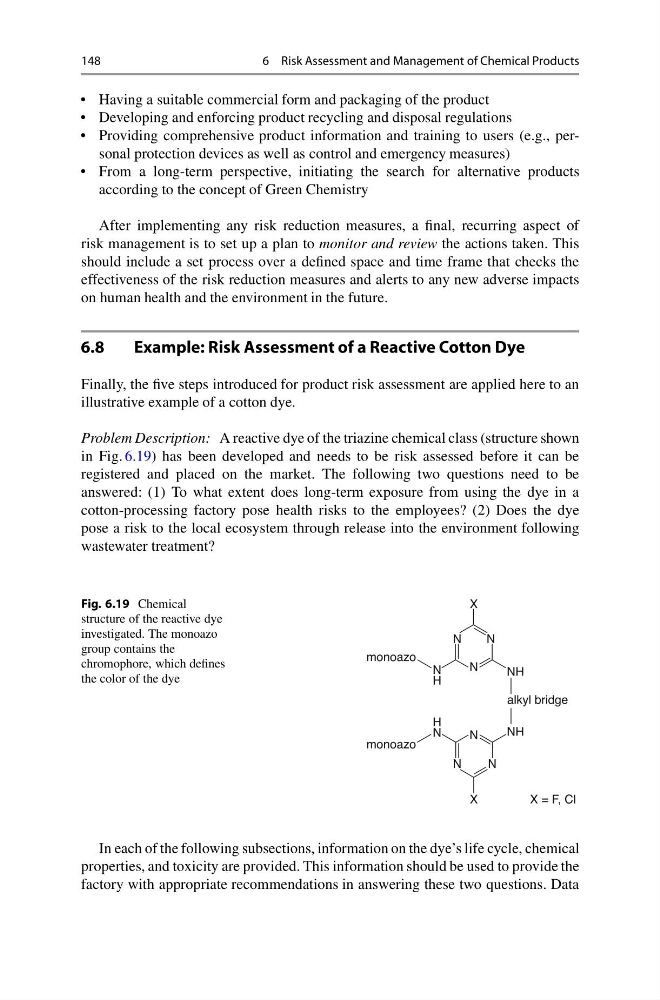
Problem Description: A reactive dye of the triazine chemical class (structure shown
in Fig. 6.19) has been developed and needs to be risk assessed before it can be
registered and placed on the market. The following two questions need to be
answered: (1) To what extent does long-term exposure from using the dye in a
cotton-processing factory pose health risks to the employees? (2) Does the dye
pose a risk to the local ecosystem through release into the environment following
wastewater treatment?
Fig. 6.19 Chemical
structure of the reactive dye
investigated. The monoazo
group contains the
chromophore, which defines
the color of the dye
In each of the following subsections, information on the dye’s life cycle, chemical
properties, and toxicity are provided. This information should be used to provide the
factory with appropriate recommendations in answering these two questions. Data
6 Risk Assessment and Management of Chemical Products
• Having a suitable commercial form and packaging of the product
• Developing and enforcing product recycling and disposal regulations
• Providing comprehensive product information and training to users (e.g., personal protection devices as well as control and emergency measures)
• From a long-term perspective, initiating the search for alternative products
according to the concept of Green Chemistry
After implementing any risk reduction measures, a final, recurring aspect of
risk management is to set up a plan to monitor and review the actions taken. This
should include a set process over a defined space and time frame that checks the
effectiveness of the risk reduction measures and alerts to any new adverse impacts
on human health and the environment in the future.
6.8
Example: Risk Assessment of a Reactive Cotton Dye
Finally, the five steps introduced for product risk assessment are applied here to an
illustrative example of a cotton dye.
Problem Description: A reactive dye of the triazine chemical class (structure shown
in Fig. 6.19) has been developed and needs to be risk assessed before it can be
registered and placed on the market. The following two questions need to be
answered: (1) To what extent does long-term exposure from using the dye in a
cotton-processing factory pose health risks to the employees? (2) Does the dye
pose a risk to the local ecosystem through release into the environment following
wastewater treatment?
Fig. 6.19 Chemical
structure of the reactive dye
investigated. The monoazo
group contains the
chromophore, which defines
the color of the dye
In each of the following subsections, information on the dye’s life cycle, chemical
properties, and toxicity are provided. This information should be used to provide the
factory with appropriate recommendations in answering these two questions. Data