

146
6 Risk Assessment and Management of Chemical Products
Concentration addition can therefore be applied, for example, for compounds that
have many congeners such as polychlorinated dibenzodioxins and dibenzofurans
(PCDD/Fs). Each congener acts in the same way and at the same site of action, but
each has a different toxic potency. Toxic equivalency factors (TEFs) can be defined
to describe each congener’s potency as a fraction of the most potent congener. The
total concentration of congeners in a mixture can then be defined in terms of toxic
equivalents of the most potent congener:
c total =
n
i=1
c i × TEF i
(6.30)
• c total : total concentration of the mixture in terms of equivalents of the most potent
congener
• c i : concentration of chemical i in the mixture
• TEF i : toxic equivalency factor of chemical i
For example, for three chemicals with a similar mode and site of action, the
mixture toxicity of acetone, 1-butanol, and chloroform can be calculated under
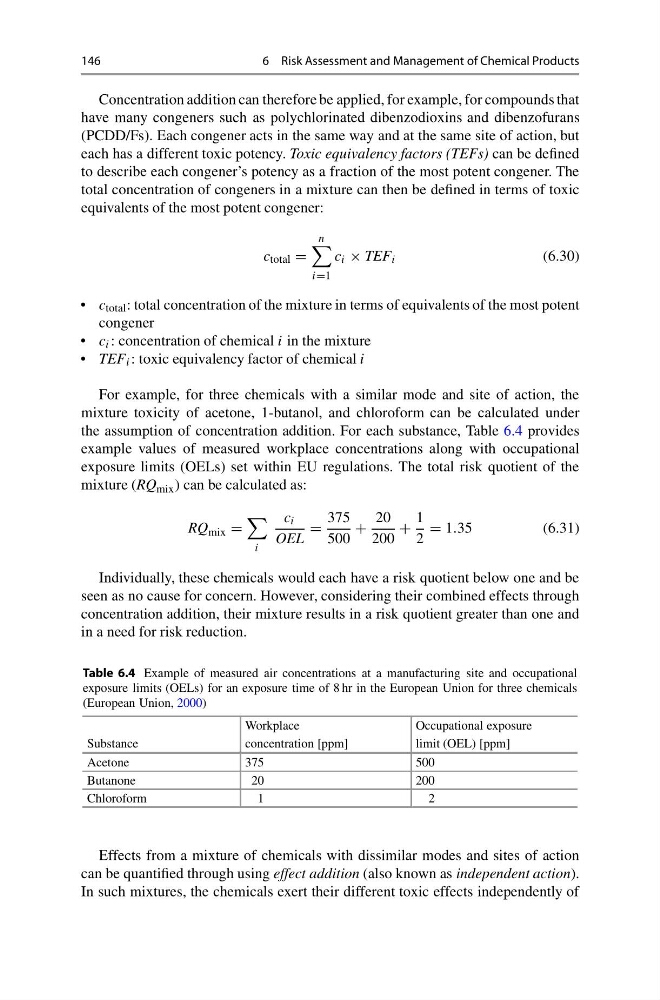
the assumption of concentration addition. For each substance, Table 6.4 provides
example values of measured workplace concentrations along with occupational
exposure limits (OELs) set within EU regulations. The total risk quotient of the
mixture (RQ mix ) can be calculated as:
RQ mix =
i
c i
OEL
=
375
500
+
20
200
+
1
2
= 1.35
(6.31)
Individually, these chemicals would each have a risk quotient below one and be
seen as no cause for concern. However, considering their combined effects through
concentration addition, their mixture results in a risk quotient greater than one and
in a need for risk reduction.
Table 6.4 Example of measured air concentrations at a manufacturing site and occupational
exposure limits (OELs) for an exposure time of 8 hr in the European Union for three chemicals
(European Union, 2000)
Workplace
Occupational exposure
Substance
concentration [ppm]
limit (OEL) [ppm]
Acetone
375
500
Butanone
20
200
Chloroform
1
2
Effects from a mixture of chemicals with dissimilar modes and sites of action
can be quantified through using effect addition (also known as independent action).
In such mixtures, the chemicals exert their different toxic effects independently of
6 Risk Assessment and Management of Chemical Products
Concentration addition can therefore be applied, for example, for compounds that
have many congeners such as polychlorinated dibenzodioxins and dibenzofurans
(PCDD/Fs). Each congener acts in the same way and at the same site of action, but
each has a different toxic potency. Toxic equivalency factors (TEFs) can be defined
to describe each congener’s potency as a fraction of the most potent congener. The
total concentration of congeners in a mixture can then be defined in terms of toxic
equivalents of the most potent congener:
c total =
n
i=1
c i × TEF i
(6.30)
• c total : total concentration of the mixture in terms of equivalents of the most potent
congener
• c i : concentration of chemical i in the mixture
• TEF i : toxic equivalency factor of chemical i
For example, for three chemicals with a similar mode and site of action, the
mixture toxicity of acetone, 1-butanol, and chloroform can be calculated under
the assumption of concentration addition. For each substance, Table 6.4 provides
example values of measured workplace concentrations along with occupational
exposure limits (OELs) set within EU regulations. The total risk quotient of the
mixture (RQ mix ) can be calculated as:
RQ mix =
i
c i
OEL
=
375
500
+
20
200
+
1
2
= 1.35
(6.31)
Individually, these chemicals would each have a risk quotient below one and be
seen as no cause for concern. However, considering their combined effects through
concentration addition, their mixture results in a risk quotient greater than one and
in a need for risk reduction.
Table 6.4 Example of measured air concentrations at a manufacturing site and occupational
exposure limits (OELs) for an exposure time of 8 hr in the European Union for three chemicals
(European Union, 2000)
Workplace
Occupational exposure
Substance
concentration [ppm]
limit (OEL) [ppm]
Acetone
375
500
Butanone
20
200
Chloroform
1
2
Effects from a mixture of chemicals with dissimilar modes and sites of action
can be quantified through using effect addition (also known as independent action).
In such mixtures, the chemicals exert their different toxic effects independently of