

6.6 Risk Characterization and Classification (Step 4)
145
sufficient number of empirical data points. The effect data need to represent relevant
species from the environmental compartment under review. If these data are not
available and the distributions are instead derived from inadequate data or general
assumptions, the probabilistic approach may create a false impression of scientific
rigor and accuracy. There are a few previous studies that serve as good examples
of applying probabilistic approaches to the risk assessment of chemicals in the
environment. These include a publication by Scheringer et al. (2002) assessing the
pesticide methyl parathion, a study by Klaine et al. (1996) assessing the biocide
dibromonitrilopropionamide (DBNPA), and another by Solomon et al. (1996)
assessing the herbicide atrazine.
6.6.4 Mixture Toxicity
Both humans and the environment are exposed to numerous different substances
simultaneously. However, chemical risk assessment has classically used a chemicalby-chemical approach focused on investigating the effects caused by each substance
individually. Much less is known about the possible overall effects that exposure to
several different, toxic substances at once might have. This combination of toxic
effects is known as mixture toxicity. Exposure to multiple chemicals in a mixture
can generally result in three different types of changes to the resulting overall toxic
effect. Consider a mixture with the two chemicals A and B. Each chemical has its
own, individual toxic effect, and when mixed together, they can interact in three
different ways to influence the overall toxic effect resulting from exposure:
• Additive: overall effect = effect of A + effect of B
• Synergistic: overall effect > effect of A + effect of B
• Antagonistic: overall effect < effect of A + effect of B
Of these three, synergistic effects are clearly very important to carefully consider.
The risk posed by chemical mixtures is an active area of research within the fields
of toxicology and risk assessment (Rotter et al., 2018; Bornehag et al., 2019).
The overall effects caused by a mixture of chemicals that each have a similar
mode and site of action can be quantified using concentration addition (Backhaus
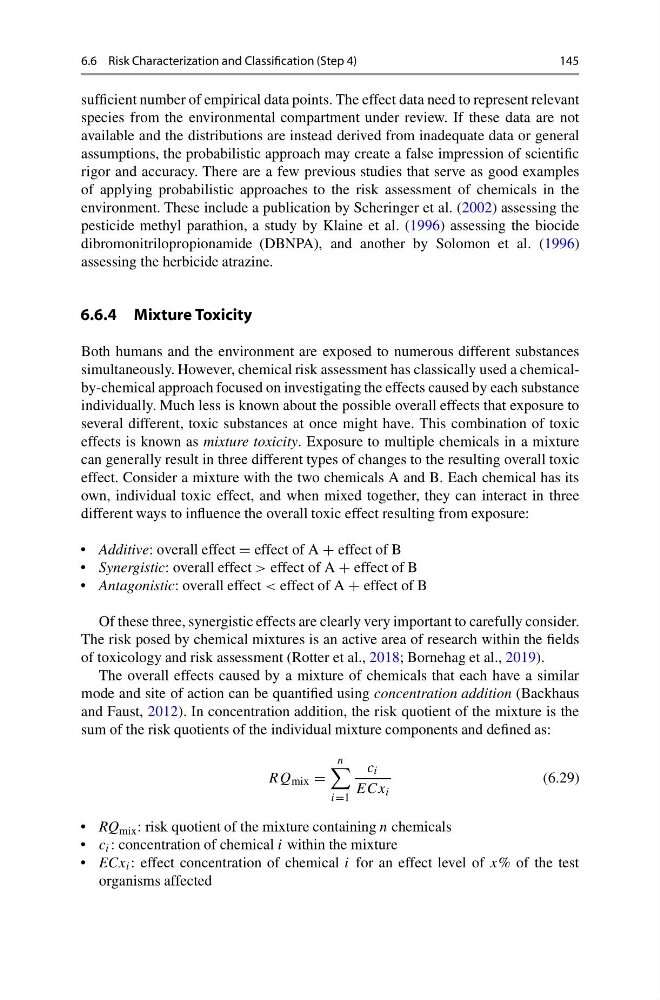
and Faust, 2012). In concentration addition, the risk quotient of the mixture is the
sum of the risk quotients of the individual mixture components and defined as:
RQ mix =
n
i=1
c i
ECx i
(6.29)
• RQ mix : risk quotient of the mixture containing n chemicals
• c i : concentration of chemical i within the mixture
• ECx i : effect concentration of chemical i for an effect level of x% of the test
organisms affected
145
sufficient number of empirical data points. The effect data need to represent relevant
species from the environmental compartment under review. If these data are not
available and the distributions are instead derived from inadequate data or general
assumptions, the probabilistic approach may create a false impression of scientific
rigor and accuracy. There are a few previous studies that serve as good examples
of applying probabilistic approaches to the risk assessment of chemicals in the
environment. These include a publication by Scheringer et al. (2002) assessing the
pesticide methyl parathion, a study by Klaine et al. (1996) assessing the biocide
dibromonitrilopropionamide (DBNPA), and another by Solomon et al. (1996)
assessing the herbicide atrazine.
6.6.4 Mixture Toxicity
Both humans and the environment are exposed to numerous different substances
simultaneously. However, chemical risk assessment has classically used a chemicalby-chemical approach focused on investigating the effects caused by each substance
individually. Much less is known about the possible overall effects that exposure to
several different, toxic substances at once might have. This combination of toxic
effects is known as mixture toxicity. Exposure to multiple chemicals in a mixture
can generally result in three different types of changes to the resulting overall toxic
effect. Consider a mixture with the two chemicals A and B. Each chemical has its
own, individual toxic effect, and when mixed together, they can interact in three
different ways to influence the overall toxic effect resulting from exposure:
• Additive: overall effect = effect of A + effect of B
• Synergistic: overall effect > effect of A + effect of B
• Antagonistic: overall effect < effect of A + effect of B
Of these three, synergistic effects are clearly very important to carefully consider.
The risk posed by chemical mixtures is an active area of research within the fields
of toxicology and risk assessment (Rotter et al., 2018; Bornehag et al., 2019).
The overall effects caused by a mixture of chemicals that each have a similar
mode and site of action can be quantified using concentration addition (Backhaus
and Faust, 2012). In concentration addition, the risk quotient of the mixture is the
sum of the risk quotients of the individual mixture components and defined as:
RQ mix =
n
i=1
c i
ECx i
(6.29)
• RQ mix : risk quotient of the mixture containing n chemicals
• c i : concentration of chemical i within the mixture
• ECx i : effect concentration of chemical i for an effect level of x% of the test
organisms affected