

144
6 Risk Assessment and Management of Chemical Products
Since adverse environmental effects are often studied for a particular environmental compartment or species of test animal, several different risk quotients can
be calculated, e.g., for surface water, groundwater, different soil types, worm- and
fish-eating birds and mammals, microorganisms in sewage treatment plants, etc.
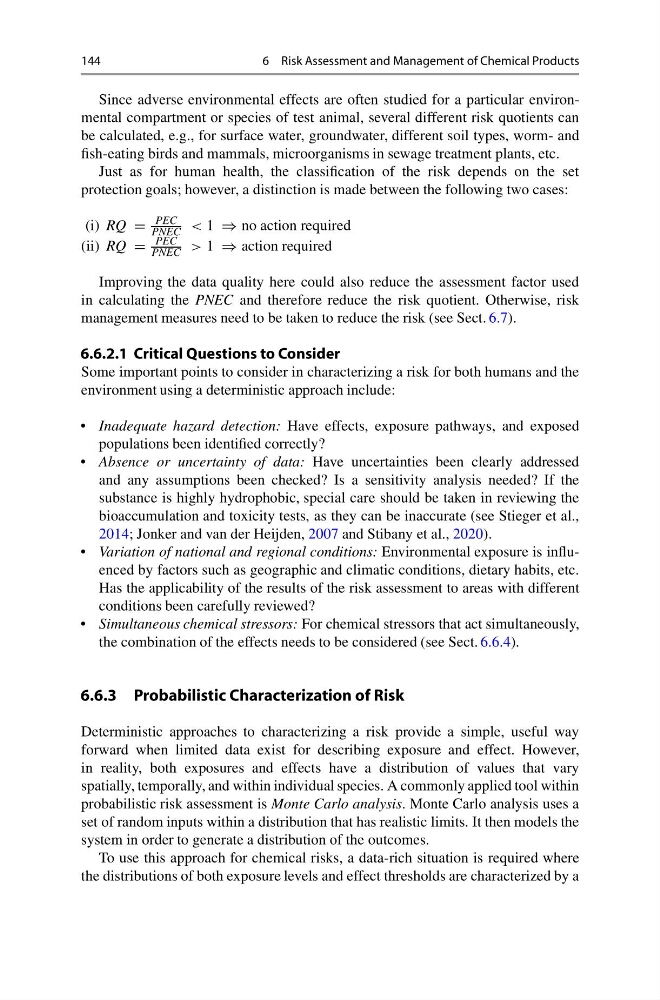
Just as for human health, the classification of the risk depends on the set
protection goals; however, a distinction is made between the following two cases:
(i) RQ =
PEC
PNEC < 1 ⇒ no action required
(ii) RQ =
PEC
PNEC > 1 ⇒ action required
Improving the data quality here could also reduce the assessment factor used
in calculating the PNEC and therefore reduce the risk quotient. Otherwise, risk
management measures need to be taken to reduce the risk (see Sect. 6.7).
6.6.2.1 Critical Questions to Consider
Some important points to consider in characterizing a risk for both humans and the
environment using a deterministic approach include:
• Inadequate hazard detection: Have effects, exposure pathways, and exposed
populations been identified correctly?
• Absence or uncertainty of data: Have uncertainties been clearly addressed
and any assumptions been checked? Is a sensitivity analysis needed? If the
substance is highly hydrophobic, special care should be taken in reviewing the
bioaccumulation and toxicity tests, as they can be inaccurate (see Stieger et al.,
2014; Jonker and van der Heijden, 2007 and Stibany et al., 2020).
• Variation of national and regional conditions: Environmental exposure is influenced by factors such as geographic and climatic conditions, dietary habits, etc.
Has the applicability of the results of the risk assessment to areas with different
conditions been carefully reviewed?
• Simultaneous chemical stressors: For chemical stressors that act simultaneously,
the combination of the effects needs to be considered (see Sect. 6.6.4).
6.6.3 Probabilistic Characterization of Risk
Deterministic approaches to characterizing a risk provide a simple, useful way
forward when limited data exist for describing exposure and effect. However,
in reality, both exposures and effects have a distribution of values that vary
spatially, temporally, and within individual species. A commonly applied tool within
probabilistic risk assessment is Monte Carlo analysis. Monte Carlo analysis uses a
set of random inputs within a distribution that has realistic limits. It then models the
system in order to generate a distribution of the outcomes.
To use this approach for chemical risks, a data-rich situation is required where
the distributions of both exposure levels and effect thresholds are characterized by a
6 Risk Assessment and Management of Chemical Products
Since adverse environmental effects are often studied for a particular environmental compartment or species of test animal, several different risk quotients can
be calculated, e.g., for surface water, groundwater, different soil types, worm- and
fish-eating birds and mammals, microorganisms in sewage treatment plants, etc.
Just as for human health, the classification of the risk depends on the set
protection goals; however, a distinction is made between the following two cases:
(i) RQ =
PEC
PNEC < 1 ⇒ no action required
(ii) RQ =
PEC
PNEC > 1 ⇒ action required
Improving the data quality here could also reduce the assessment factor used
in calculating the PNEC and therefore reduce the risk quotient. Otherwise, risk
management measures need to be taken to reduce the risk (see Sect. 6.7).
6.6.2.1 Critical Questions to Consider
Some important points to consider in characterizing a risk for both humans and the
environment using a deterministic approach include:
• Inadequate hazard detection: Have effects, exposure pathways, and exposed
populations been identified correctly?
• Absence or uncertainty of data: Have uncertainties been clearly addressed
and any assumptions been checked? Is a sensitivity analysis needed? If the
substance is highly hydrophobic, special care should be taken in reviewing the
bioaccumulation and toxicity tests, as they can be inaccurate (see Stieger et al.,
2014; Jonker and van der Heijden, 2007 and Stibany et al., 2020).
• Variation of national and regional conditions: Environmental exposure is influenced by factors such as geographic and climatic conditions, dietary habits, etc.
Has the applicability of the results of the risk assessment to areas with different
conditions been carefully reviewed?
• Simultaneous chemical stressors: For chemical stressors that act simultaneously,
the combination of the effects needs to be considered (see Sect. 6.6.4).
6.6.3 Probabilistic Characterization of Risk
Deterministic approaches to characterizing a risk provide a simple, useful way
forward when limited data exist for describing exposure and effect. However,
in reality, both exposures and effects have a distribution of values that vary
spatially, temporally, and within individual species. A commonly applied tool within
probabilistic risk assessment is Monte Carlo analysis. Monte Carlo analysis uses a
set of random inputs within a distribution that has realistic limits. It then models the
system in order to generate a distribution of the outcomes.
To use this approach for chemical risks, a data-rich situation is required where
the distributions of both exposure levels and effect thresholds are characterized by a