

6.6 Risk Characterization and Classification (Step 4)
143
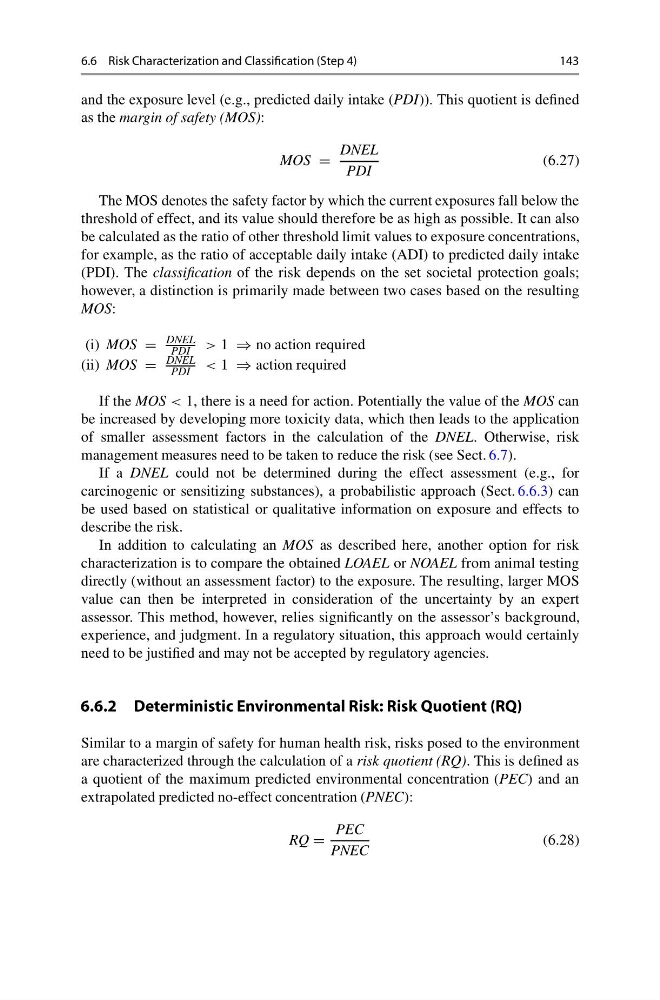
and the exposure level (e.g., predicted daily intake (PDI)). This quotient is defined
as the margin of safety (MOS):
MOS =
DNEL
PDI
(6.27)
The MOS denotes the safety factor by which the current exposures fall below the
threshold of effect, and its value should therefore be as high as possible. It can also
be calculated as the ratio of other threshold limit values to exposure concentrations,
for example, as the ratio of acceptable daily intake (ADI) to predicted daily intake
(PDI). The classification of the risk depends on the set societal protection goals;
however, a distinction is primarily made between two cases based on the resulting
MOS:
(i) MOS =
DNEL
PDI > 1 ⇒ no action required
(ii) MOS =
DNEL
PDI < 1 ⇒ action required
If the MOS < 1, there is a need for action. Potentially the value of the MOS can
be increased by developing more toxicity data, which then leads to the application
of smaller assessment factors in the calculation of the DNEL. Otherwise, risk
management measures need to be taken to reduce the risk (see Sect. 6.7).
If a DNEL could not be determined during the effect assessment (e.g., for
carcinogenic or sensitizing substances), a probabilistic approach (Sect. 6.6.3) can
be used based on statistical or qualitative information on exposure and effects to
describe the risk.
In addition to calculating an MOS as described here, another option for risk
characterization is to compare the obtained LOAEL or NOAEL from animal testing
directly (without an assessment factor) to the exposure. The resulting, larger MOS
value can then be interpreted in consideration of the uncertainty by an expert
assessor. This method, however, relies significantly on the assessor’s background,
experience, and judgment. In a regulatory situation, this approach would certainly
need to be justified and may not be accepted by regulatory agencies.
6.6.2 Deterministic Environmental Risk: Risk Quotient (RQ)
Similar to a margin of safety for human health risk, risks posed to the environment
are characterized through the calculation of a risk quotient (RQ). This is defined as
a quotient of the maximum predicted environmental concentration (PEC) and an
extrapolated predicted no-effect concentration (PNEC):
RQ =
PEC
PNEC
(6.28)
143
and the exposure level (e.g., predicted daily intake (PDI)). This quotient is defined
as the margin of safety (MOS):
MOS =
DNEL
PDI
(6.27)
The MOS denotes the safety factor by which the current exposures fall below the
threshold of effect, and its value should therefore be as high as possible. It can also
be calculated as the ratio of other threshold limit values to exposure concentrations,
for example, as the ratio of acceptable daily intake (ADI) to predicted daily intake
(PDI). The classification of the risk depends on the set societal protection goals;
however, a distinction is primarily made between two cases based on the resulting
MOS:
(i) MOS =
DNEL
PDI > 1 ⇒ no action required
(ii) MOS =
DNEL
PDI < 1 ⇒ action required
If the MOS < 1, there is a need for action. Potentially the value of the MOS can
be increased by developing more toxicity data, which then leads to the application
of smaller assessment factors in the calculation of the DNEL. Otherwise, risk
management measures need to be taken to reduce the risk (see Sect. 6.7).
If a DNEL could not be determined during the effect assessment (e.g., for
carcinogenic or sensitizing substances), a probabilistic approach (Sect. 6.6.3) can
be used based on statistical or qualitative information on exposure and effects to
describe the risk.
In addition to calculating an MOS as described here, another option for risk
characterization is to compare the obtained LOAEL or NOAEL from animal testing
directly (without an assessment factor) to the exposure. The resulting, larger MOS
value can then be interpreted in consideration of the uncertainty by an expert
assessor. This method, however, relies significantly on the assessor’s background,
experience, and judgment. In a regulatory situation, this approach would certainly
need to be justified and may not be accepted by regulatory agencies.
6.6.2 Deterministic Environmental Risk: Risk Quotient (RQ)
Similar to a margin of safety for human health risk, risks posed to the environment
are characterized through the calculation of a risk quotient (RQ). This is defined as
a quotient of the maximum predicted environmental concentration (PEC) and an
extrapolated predicted no-effect concentration (PNEC):
RQ =
PEC
PNEC
(6.28)