

6.5 Effect Assessment (Step 3)
137
chemicals that interfere with the body’s natural endocrine system, which regulates
the production of hormones. One or more of the many functions in the body
controlled by hormones could be adversely affected by EDCs. Research on EDCs
has challenged the classical assumption of “the dose makes the poison,” which
means that higher doses generally lead to stronger effects, by identifying substances
that do not follow this type of relationship. Instead, some EDCs might cause
stronger (or other) effects through exposure at lower concentrations than at higher
concentrations.
EDCs can act either by (1) binding to a hormone receptor and causing hormonal
action (agonism); (2) by binding to a receptor and, thereby, blocking a natural
hormone and preventing action (antagonism); or by (3) interfering with important
enzymes involved in hormone function. Various methods exist to test or screen
for EDCs, with a common example being a test for interaction with receptors
for the estrogen hormone. Screening methods also exist to use a chemical’s
structural data to predict its endocrine-disrupting potential by comparing it to the
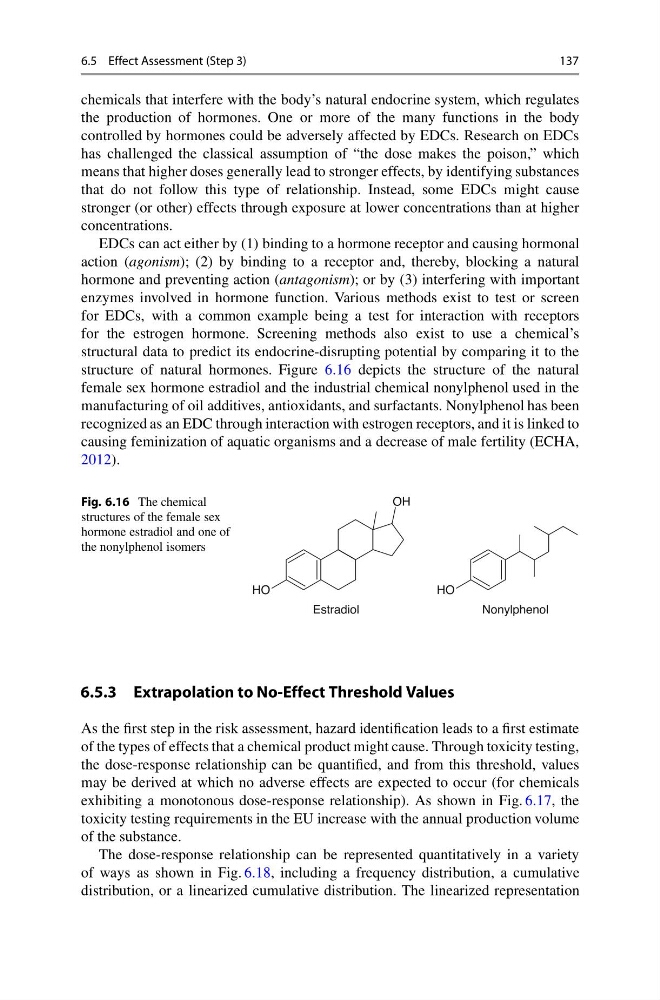
structure of natural hormones. Figure 6.16 depicts the structure of the natural
female sex hormone estradiol and the industrial chemical nonylphenol used in the
manufacturing of oil additives, antioxidants, and surfactants. Nonylphenol has been
recognized as an EDC through interaction with estrogen receptors, and it is linked to
causing feminization of aquatic organisms and a decrease of male fertility (ECHA,
2012).
Fig. 6.16 The chemical
structures of the female sex
hormone estradiol and one of
the nonylphenol isomers
6.5.3 Extrapolation to No-Effect Threshold Values
As the first step in the risk assessment, hazard identification leads to a first estimate
of the types of effects that a chemical product might cause. Through toxicity testing,
the dose-response relationship can be quantified, and from this threshold, values
may be derived at which no adverse effects are expected to occur (for chemicals
exhibiting a monotonous dose-response relationship). As shown in Fig. 6.17, the
toxicity testing requirements in the EU increase with the annual production volume
of the substance.
The dose-response relationship can be represented quantitatively in a variety
of ways as shown in Fig. 6.18, including a frequency distribution, a cumulative
distribution, or a linearized cumulative distribution. The linearized representation
137
chemicals that interfere with the body’s natural endocrine system, which regulates
the production of hormones. One or more of the many functions in the body
controlled by hormones could be adversely affected by EDCs. Research on EDCs
has challenged the classical assumption of “the dose makes the poison,” which
means that higher doses generally lead to stronger effects, by identifying substances
that do not follow this type of relationship. Instead, some EDCs might cause
stronger (or other) effects through exposure at lower concentrations than at higher
concentrations.
EDCs can act either by (1) binding to a hormone receptor and causing hormonal
action (agonism); (2) by binding to a receptor and, thereby, blocking a natural
hormone and preventing action (antagonism); or by (3) interfering with important
enzymes involved in hormone function. Various methods exist to test or screen
for EDCs, with a common example being a test for interaction with receptors
for the estrogen hormone. Screening methods also exist to use a chemical’s
structural data to predict its endocrine-disrupting potential by comparing it to the
structure of natural hormones. Figure 6.16 depicts the structure of the natural
female sex hormone estradiol and the industrial chemical nonylphenol used in the
manufacturing of oil additives, antioxidants, and surfactants. Nonylphenol has been
recognized as an EDC through interaction with estrogen receptors, and it is linked to
causing feminization of aquatic organisms and a decrease of male fertility (ECHA,
2012).
Fig. 6.16 The chemical
structures of the female sex
hormone estradiol and one of
the nonylphenol isomers
6.5.3 Extrapolation to No-Effect Threshold Values
As the first step in the risk assessment, hazard identification leads to a first estimate
of the types of effects that a chemical product might cause. Through toxicity testing,
the dose-response relationship can be quantified, and from this threshold, values
may be derived at which no adverse effects are expected to occur (for chemicals
exhibiting a monotonous dose-response relationship). As shown in Fig. 6.17, the
toxicity testing requirements in the EU increase with the annual production volume
of the substance.
The dose-response relationship can be represented quantitatively in a variety
of ways as shown in Fig. 6.18, including a frequency distribution, a cumulative
distribution, or a linearized cumulative distribution. The linearized representation