

136
6 Risk Assessment and Management of Chemical Products
(known as the mechanism), which causes an adverse effect through a mode of action
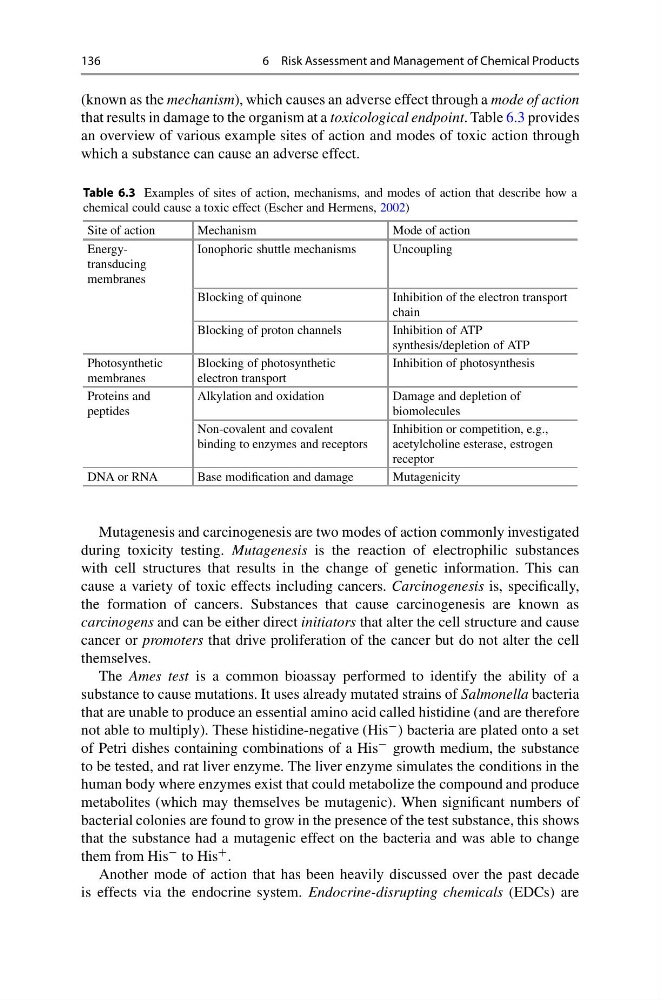
that results in damage to the organism at a toxicological endpoint. Table 6.3 provides
an overview of various example sites of action and modes of toxic action through
which a substance can cause an adverse effect.
Table 6.3 Examples of sites of action, mechanisms, and modes of action that describe how a
chemical could cause a toxic effect (Escher and Hermens, 2002)
Site of action
Mechanism
Mode of action
Energytransducing
membranes
Ionophoric shuttle mechanisms
Uncoupling
Blocking of quinone
Inhibition of the electron transport
chain
Blocking of proton channels
Inhibition of ATP
synthesis/depletion of ATP
Photosynthetic
membranes
Blocking of photosynthetic
electron transport
Inhibition of photosynthesis
Proteins and
peptides
Alkylation and oxidation
Damage and depletion of
biomolecules
Non-covalent and covalent
binding to enzymes and receptors
Inhibition or competition, e.g.,
acetylcholine esterase, estrogen
receptor
DNA or RNA
Base modification and damage
Mutagenicity
Mutagenesis and carcinogenesis are two modes of action commonly investigated
during toxicity testing. Mutagenesis is the reaction of electrophilic substances
with cell structures that results in the change of genetic information. This can
cause a variety of toxic effects including cancers. Carcinogenesis is, specifically,
the formation of cancers. Substances that cause carcinogenesis are known as
carcinogens and can be either direct initiators that alter the cell structure and cause
cancer or promoters that drive proliferation of the cancer but do not alter the cell
themselves.
The Ames test is a common bioassay performed to identify the ability of a
substance to cause mutations. It uses already mutated strains of Salmonella bacteria
that are unable to produce an essential amino acid called histidine (and are therefore
not able to multiply). These histidine-negative (His − ) bacteria are plated onto a set
of Petri dishes containing combinations of a His − growth medium, the substance
to be tested, and rat liver enzyme. The liver enzyme simulates the conditions in the
human body where enzymes exist that could metabolize the compound and produce
metabolites (which may themselves be mutagenic). When significant numbers of
bacterial colonies are found to grow in the presence of the test substance, this shows
that the substance had a mutagenic effect on the bacteria and was able to change
them from His − to His + .
Another mode of action that has been heavily discussed over the past decade
is effects via the endocrine system. Endocrine-disrupting chemicals (EDCs) are
6 Risk Assessment and Management of Chemical Products
(known as the mechanism), which causes an adverse effect through a mode of action
that results in damage to the organism at a toxicological endpoint. Table 6.3 provides
an overview of various example sites of action and modes of toxic action through
which a substance can cause an adverse effect.
Table 6.3 Examples of sites of action, mechanisms, and modes of action that describe how a
chemical could cause a toxic effect (Escher and Hermens, 2002)
Site of action
Mechanism
Mode of action
Energytransducing
membranes
Ionophoric shuttle mechanisms
Uncoupling
Blocking of quinone
Inhibition of the electron transport
chain
Blocking of proton channels
Inhibition of ATP
synthesis/depletion of ATP
Photosynthetic
membranes
Blocking of photosynthetic
electron transport
Inhibition of photosynthesis
Proteins and
peptides
Alkylation and oxidation
Damage and depletion of
biomolecules
Non-covalent and covalent
binding to enzymes and receptors
Inhibition or competition, e.g.,
acetylcholine esterase, estrogen
receptor
DNA or RNA
Base modification and damage
Mutagenicity
Mutagenesis and carcinogenesis are two modes of action commonly investigated
during toxicity testing. Mutagenesis is the reaction of electrophilic substances
with cell structures that results in the change of genetic information. This can
cause a variety of toxic effects including cancers. Carcinogenesis is, specifically,
the formation of cancers. Substances that cause carcinogenesis are known as
carcinogens and can be either direct initiators that alter the cell structure and cause
cancer or promoters that drive proliferation of the cancer but do not alter the cell
themselves.
The Ames test is a common bioassay performed to identify the ability of a
substance to cause mutations. It uses already mutated strains of Salmonella bacteria
that are unable to produce an essential amino acid called histidine (and are therefore
not able to multiply). These histidine-negative (His − ) bacteria are plated onto a set
of Petri dishes containing combinations of a His − growth medium, the substance
to be tested, and rat liver enzyme. The liver enzyme simulates the conditions in the
human body where enzymes exist that could metabolize the compound and produce
metabolites (which may themselves be mutagenic). When significant numbers of
bacterial colonies are found to grow in the presence of the test substance, this shows
that the substance had a mutagenic effect on the bacteria and was able to change
them from His − to His + .
Another mode of action that has been heavily discussed over the past decade
is effects via the endocrine system. Endocrine-disrupting chemicals (EDCs) are