

6.5 Effect Assessment (Step 3)
135
Advances in the development of physiologically based pharmacokinetic models
(PBPK models) have helped to better understand the toxicokinetics of chemicals
in the body and estimate internal exposures and fates of metabolites (Karrer et al.,
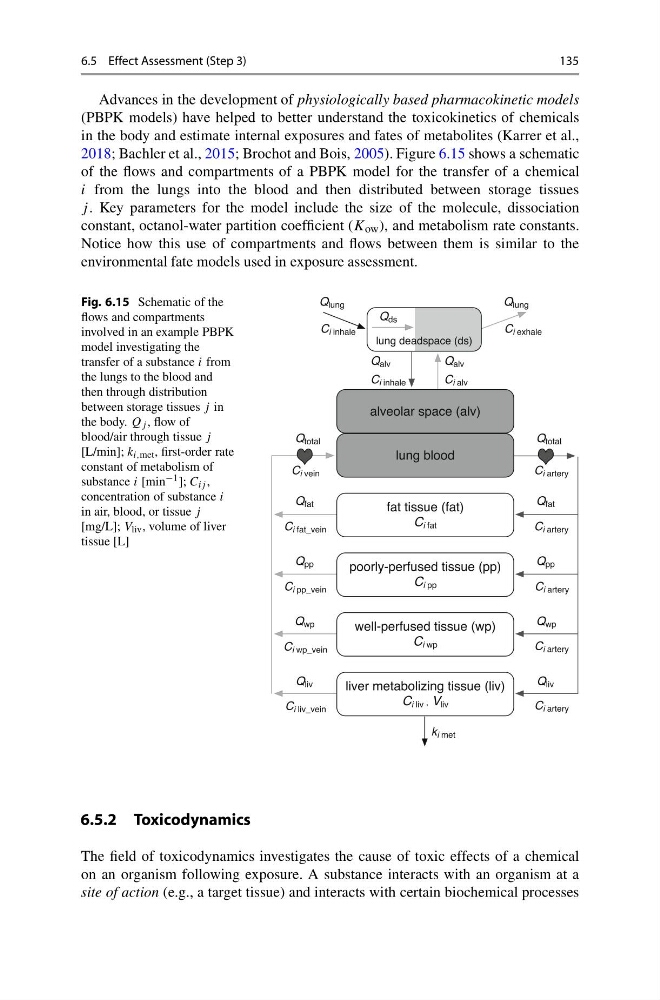
2018; Bachler et al., 2015; Brochot and Bois, 2005). Figure 6.15 shows a schematic
of the flows and compartments of a PBPK model for the transfer of a chemical
i from the lungs into the blood and then distributed between storage tissues
j . Key parameters for the model include the size of the molecule, dissociation
constant, octanol-water partition coefficient (K ow ), and metabolism rate constants.
Notice how this use of compartments and flows between them is similar to the
environmental fate models used in exposure assessment.
Fig. 6.15 Schematic of the
flows and compartments
involved in an example PBPK
model investigating the
transfer of a substance i from
the lungs to the blood and
then through distribution
between storage tissues j in
the body. Q j , flow of
blood/air through tissue j
[L/min]; k i,met , first-order rate
constant of metabolism of
substance i [min −1 ]; C ij ,
concentration of substance i
in air, blood, or tissue j
[mg/L]; V liv , volume of liver
tissue [L]
6.5.2 Toxicodynamics
The field of toxicodynamics investigates the cause of toxic effects of a chemical
on an organism following exposure. A substance interacts with an organism at a
site of action (e.g., a target tissue) and interacts with certain biochemical processes
135
Advances in the development of physiologically based pharmacokinetic models
(PBPK models) have helped to better understand the toxicokinetics of chemicals
in the body and estimate internal exposures and fates of metabolites (Karrer et al.,
2018; Bachler et al., 2015; Brochot and Bois, 2005). Figure 6.15 shows a schematic
of the flows and compartments of a PBPK model for the transfer of a chemical
i from the lungs into the blood and then distributed between storage tissues
j . Key parameters for the model include the size of the molecule, dissociation
constant, octanol-water partition coefficient (K ow ), and metabolism rate constants.
Notice how this use of compartments and flows between them is similar to the
environmental fate models used in exposure assessment.
Fig. 6.15 Schematic of the
flows and compartments
involved in an example PBPK
model investigating the
transfer of a substance i from
the lungs to the blood and
then through distribution
between storage tissues j in
the body. Q j , flow of
blood/air through tissue j
[L/min]; k i,met , first-order rate
constant of metabolism of
substance i [min −1 ]; C ij ,
concentration of substance i
in air, blood, or tissue j
[mg/L]; V liv , volume of liver
tissue [L]
6.5.2 Toxicodynamics
The field of toxicodynamics investigates the cause of toxic effects of a chemical
on an organism following exposure. A substance interacts with an organism at a
site of action (e.g., a target tissue) and interacts with certain biochemical processes