

134
6 Risk Assessment and Management of Chemical Products
chemicals that are sold at amounts greater than 1000 t per year in the EU are required
to be tested more extensively than those that are only sold at an amount of 10 t per
year (ECHA, 2018).
In the interest of animal welfare, numerous standards have emerged to guide the
appropriate testing methods to meet regulatory requirements, such as those developed by the Organisation for Economic Co-operation and Development (OECD)
(OECD, 2019). Generally, in vivo testing should not be considered until all other
relevant, available data and methods have been reviewed.
The next three subsections introduce the use of toxicokinetics (Sect. 6.5.1) and
toxicodynamics (Sect. 6.5.2) in defining the dose-response relationship and then
extrapolating these results to a no-effect level adequate for protecting humans and
the environment (Sect. 6.5.3).
6.5.1 Toxicokinetics
Following exposure to a chemical, toxicokinetics studies the rate at which it is
absorbed, distributed, metabolized, and excreted (ADME) by an organism. This
describes the relation between the external and internal exposure to a chemical and,
more specifically, defines the internal dose of a chemical as a function of space and
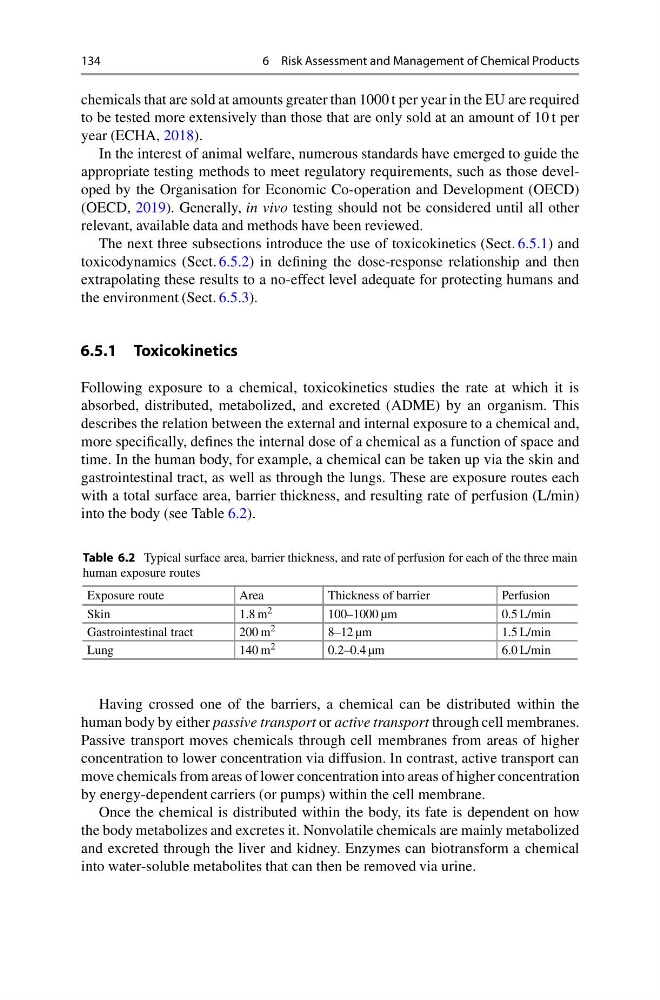
time. In the human body, for example, a chemical can be taken up via the skin and
gastrointestinal tract, as well as through the lungs. These are exposure routes each
with a total surface area, barrier thickness, and resulting rate of perfusion (L/min)
into the body (see Table 6.2).
Table 6.2 Typical surface area, barrier thickness, and rate of perfusion for each of the three main
human exposure routes
Exposure route
Area
Thickness of barrier
Perfusion
Skin
1.8 m 2
100–1000 µm
0.5 L/min
Gastrointestinal tract
200 m 2
8–12 µm
1.5 L/min
Lung
140 m 2
0.2–0.4 µm
6.0 L/min
Having crossed one of the barriers, a chemical can be distributed within the
human body by either passive transport or active transport through cell membranes.
Passive transport moves chemicals through cell membranes from areas of higher
concentration to lower concentration via diffusion. In contrast, active transport can
move chemicals from areas of lower concentration into areas of higher concentration
by energy-dependent carriers (or pumps) within the cell membrane.
Once the chemical is distributed within the body, its fate is dependent on how
the body metabolizes and excretes it. Nonvolatile chemicals are mainly metabolized
and excreted through the liver and kidney. Enzymes can biotransform a chemical
into water-soluble metabolites that can then be removed via urine.
6 Risk Assessment and Management of Chemical Products
chemicals that are sold at amounts greater than 1000 t per year in the EU are required
to be tested more extensively than those that are only sold at an amount of 10 t per
year (ECHA, 2018).
In the interest of animal welfare, numerous standards have emerged to guide the
appropriate testing methods to meet regulatory requirements, such as those developed by the Organisation for Economic Co-operation and Development (OECD)
(OECD, 2019). Generally, in vivo testing should not be considered until all other
relevant, available data and methods have been reviewed.
The next three subsections introduce the use of toxicokinetics (Sect. 6.5.1) and
toxicodynamics (Sect. 6.5.2) in defining the dose-response relationship and then
extrapolating these results to a no-effect level adequate for protecting humans and
the environment (Sect. 6.5.3).
6.5.1 Toxicokinetics
Following exposure to a chemical, toxicokinetics studies the rate at which it is
absorbed, distributed, metabolized, and excreted (ADME) by an organism. This
describes the relation between the external and internal exposure to a chemical and,
more specifically, defines the internal dose of a chemical as a function of space and
time. In the human body, for example, a chemical can be taken up via the skin and
gastrointestinal tract, as well as through the lungs. These are exposure routes each
with a total surface area, barrier thickness, and resulting rate of perfusion (L/min)
into the body (see Table 6.2).
Table 6.2 Typical surface area, barrier thickness, and rate of perfusion for each of the three main
human exposure routes
Exposure route
Area
Thickness of barrier
Perfusion
Skin
1.8 m 2
100–1000 µm
0.5 L/min
Gastrointestinal tract
200 m 2
8–12 µm
1.5 L/min
Lung
140 m 2
0.2–0.4 µm
6.0 L/min
Having crossed one of the barriers, a chemical can be distributed within the
human body by either passive transport or active transport through cell membranes.
Passive transport moves chemicals through cell membranes from areas of higher
concentration to lower concentration via diffusion. In contrast, active transport can
move chemicals from areas of lower concentration into areas of higher concentration
by energy-dependent carriers (or pumps) within the cell membrane.
Once the chemical is distributed within the body, its fate is dependent on how
the body metabolizes and excretes it. Nonvolatile chemicals are mainly metabolized
and excreted through the liver and kidney. Enzymes can biotransform a chemical
into water-soluble metabolites that can then be removed via urine.