

118
6 Risk Assessment and Management of Chemical Products
metabolic system of the body, the process of metabolism and excretion takes place
on different time scales from rapid to (very) slow.
An example of rapid elimination from the human body is phthalates, which have
been extensively used as plasticizers in plastics such as polyvinyl chloride (PVC).
Phthalates are diesters of phthalic acid, such as di-(ethylhexyl) phthalate (DEHP) or
dibutyl phthalate (DBP). In the human body, one of the ester bonds is hydrolyzed so
that the phthalate monoesters are formed, which are then readily excreted via urine;
for the heavier phthalates, also glucuronide conjugates are formed before excretion
(Frederiksen et al., 2007). Elimination half-lives of phthalates in humans are on the
order of several hours (Koch and Angerer, 2007; Koch et al., 2012).
Much slower metabolism and elimination is found for highly persistent chemicals such as polychlorinated biphenyls (PCBs), in particular the highly chlorinated
PCB congeners. The metabolism of PCBs in the human body is complex and only
partly understood (Grimm et al., 2015). Ritter et al. (2011) determined elimination
half-lives of PCBs from extensive data sets of PCB levels measured in human blood
and adipose tissue (without consideration of the mechanisms of PCB metabolism)
and found elimination half-lives from 2.6 years (PCB-52) to 15.5 years (PCB170). Their analysis of PCB concentrations in human tissue shows that there
is an important distinction between apparent and intrinsic elimination half-lives.
Apparent half-lives can be determined from the time trends of PCBs in individuals,
but if exposure to PCBs of these individuals continues (which is generally the case
because of remaining PCB background contamination), the time trend will be (very)
shallow and the apparent elimination half-lives very long. Only when the effect
of ongoing exposure is removed from the data the intrinsic elimination half-lives,
which describe the time scale of the actual elimination process, can be determined.
(The half-lives reported by Ritter et al. (2011) are intrinsic elimination half-lives.)
In pharmacokinetic models like the one presented in the next subsection, intrinsic
elimination half-lives are needed as input parameters.
6.4.1.3 Example: Exposure via the Diet
To provide an example of human exposure modeling, the dietary (oral) and
inhalation exposures to a hydrophobic chemical such as DDT or PCBs are calculated
by means of simple, one-compartment pharmacokinetic models.
Through such a model, the oral exposure of a chemical via the diet can
be converted into the concentration of the chemical stored in the body’s lipids.
Calculating this requires knowing the oral dose and the body’s elimination rate
constant of the chemical.
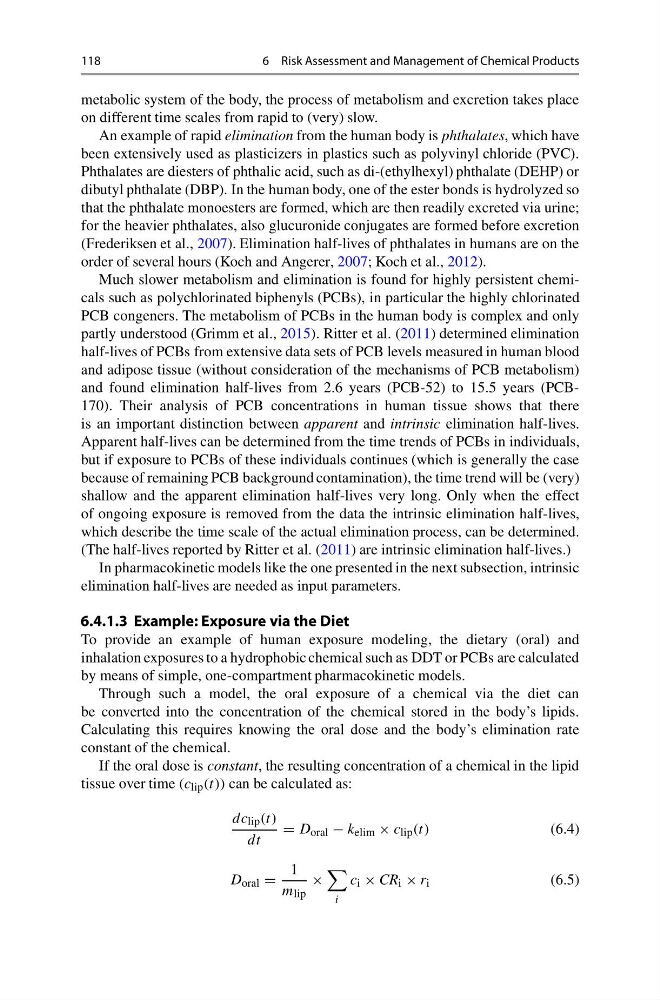
If the oral dose is constant, the resulting concentration of a chemical in the lipid
tissue over time (c lip (t)) can be calculated as:
dc lip (t)
dt
= D oral − k elim × c lip (t)
(6.4)
D oral =
1
m lip
×
i
c i × CR i × r i
(6.5)
6 Risk Assessment and Management of Chemical Products
metabolic system of the body, the process of metabolism and excretion takes place
on different time scales from rapid to (very) slow.
An example of rapid elimination from the human body is phthalates, which have
been extensively used as plasticizers in plastics such as polyvinyl chloride (PVC).
Phthalates are diesters of phthalic acid, such as di-(ethylhexyl) phthalate (DEHP) or
dibutyl phthalate (DBP). In the human body, one of the ester bonds is hydrolyzed so
that the phthalate monoesters are formed, which are then readily excreted via urine;
for the heavier phthalates, also glucuronide conjugates are formed before excretion
(Frederiksen et al., 2007). Elimination half-lives of phthalates in humans are on the
order of several hours (Koch and Angerer, 2007; Koch et al., 2012).
Much slower metabolism and elimination is found for highly persistent chemicals such as polychlorinated biphenyls (PCBs), in particular the highly chlorinated
PCB congeners. The metabolism of PCBs in the human body is complex and only
partly understood (Grimm et al., 2015). Ritter et al. (2011) determined elimination
half-lives of PCBs from extensive data sets of PCB levels measured in human blood
and adipose tissue (without consideration of the mechanisms of PCB metabolism)
and found elimination half-lives from 2.6 years (PCB-52) to 15.5 years (PCB170). Their analysis of PCB concentrations in human tissue shows that there
is an important distinction between apparent and intrinsic elimination half-lives.
Apparent half-lives can be determined from the time trends of PCBs in individuals,
but if exposure to PCBs of these individuals continues (which is generally the case
because of remaining PCB background contamination), the time trend will be (very)
shallow and the apparent elimination half-lives very long. Only when the effect
of ongoing exposure is removed from the data the intrinsic elimination half-lives,
which describe the time scale of the actual elimination process, can be determined.
(The half-lives reported by Ritter et al. (2011) are intrinsic elimination half-lives.)
In pharmacokinetic models like the one presented in the next subsection, intrinsic
elimination half-lives are needed as input parameters.
6.4.1.3 Example: Exposure via the Diet
To provide an example of human exposure modeling, the dietary (oral) and
inhalation exposures to a hydrophobic chemical such as DDT or PCBs are calculated
by means of simple, one-compartment pharmacokinetic models.
Through such a model, the oral exposure of a chemical via the diet can
be converted into the concentration of the chemical stored in the body’s lipids.
Calculating this requires knowing the oral dose and the body’s elimination rate
constant of the chemical.
If the oral dose is constant, the resulting concentration of a chemical in the lipid
tissue over time (c lip (t)) can be calculated as:
dc lip (t)
dt
= D oral − k elim × c lip (t)
(6.4)
D oral =
1
m lip
×
i
c i × CR i × r i
(6.5)