

6.4 Exposure Assessment (Step 2)
117
• PDI j : Predicted daily intake for exposure route j [ng kg
−1
bw d −1 ].
• D j : Dose for exposure route j [ng kg
−1
bw d −1 ].
• m bw : Human body weight [kg]; a default value of 70 kg is often used.
• c ij : Concentration of chemical in contact medium i through exposure route j .
Units are [ng/g food] for oral intake, [ng/m 3 air] for inhalation, and [ng/m 2 skin]
for dermal contact.
• CR i,oral : Oral intake, for example, according to population-specific diet [g
food/d].
• CR i,inhalation : Inhalation rate [m 3 air/hr] × exposure time [hr/d] (average inhalation rate: ca. 0.8 m 3 /hr).
• CR i,dermal : Dermal contact area [m 2 skin] × exposure frequency [d −1 ] (the
maximum contact area of skin is ca. 2 m 2 ).
• r ij : Chemical-specific uptake efficiency by contact medium i and exposure route
j [–]; 0 ≤ r ≤ 1.
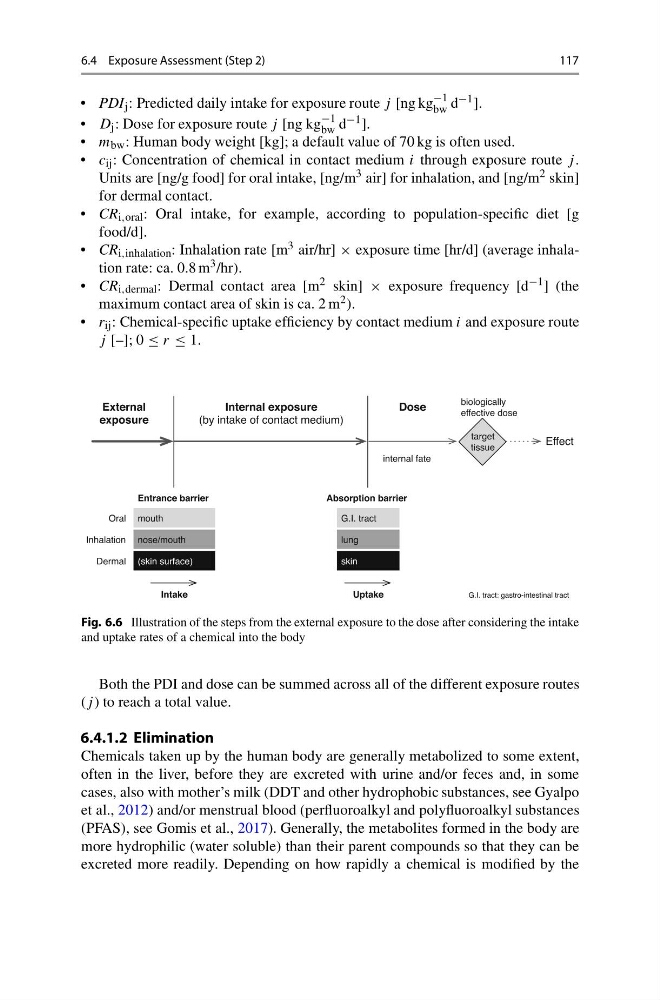
Fig. 6.6 Illustration of the steps from the external exposure to the dose after considering the intake
and uptake rates of a chemical into the body
Both the PDI and dose can be summed across all of the different exposure routes
(j ) to reach a total value.
6.4.1.2 Elimination
Chemicals taken up by the human body are generally metabolized to some extent,
often in the liver, before they are excreted with urine and/or feces and, in some
cases, also with mother’s milk (DDT and other hydrophobic substances, see Gyalpo
et al., 2012) and/or menstrual blood (perfluoroalkyl and polyfluoroalkyl substances
(PFAS), see Gomis et al., 2017). Generally, the metabolites formed in the body are
more hydrophilic (water soluble) than their parent compounds so that they can be
excreted more readily. Depending on how rapidly a chemical is modified by the
117
• PDI j : Predicted daily intake for exposure route j [ng kg
−1
bw d −1 ].
• D j : Dose for exposure route j [ng kg
−1
bw d −1 ].
• m bw : Human body weight [kg]; a default value of 70 kg is often used.
• c ij : Concentration of chemical in contact medium i through exposure route j .
Units are [ng/g food] for oral intake, [ng/m 3 air] for inhalation, and [ng/m 2 skin]
for dermal contact.
• CR i,oral : Oral intake, for example, according to population-specific diet [g
food/d].
• CR i,inhalation : Inhalation rate [m 3 air/hr] × exposure time [hr/d] (average inhalation rate: ca. 0.8 m 3 /hr).
• CR i,dermal : Dermal contact area [m 2 skin] × exposure frequency [d −1 ] (the
maximum contact area of skin is ca. 2 m 2 ).
• r ij : Chemical-specific uptake efficiency by contact medium i and exposure route
j [–]; 0 ≤ r ≤ 1.
Fig. 6.6 Illustration of the steps from the external exposure to the dose after considering the intake
and uptake rates of a chemical into the body
Both the PDI and dose can be summed across all of the different exposure routes
(j ) to reach a total value.
6.4.1.2 Elimination
Chemicals taken up by the human body are generally metabolized to some extent,
often in the liver, before they are excreted with urine and/or feces and, in some
cases, also with mother’s milk (DDT and other hydrophobic substances, see Gyalpo
et al., 2012) and/or menstrual blood (perfluoroalkyl and polyfluoroalkyl substances
(PFAS), see Gomis et al., 2017). Generally, the metabolites formed in the body are
more hydrophilic (water soluble) than their parent compounds so that they can be
excreted more readily. Depending on how rapidly a chemical is modified by the