

94
5 Life Cycle Assessment of Chemical Products and Processes
were assumed to be released into urban air. The characterization factor for the
ecotoxicity of CO 2 is set to be 0.
Because CED is the cumulative energy demand to produce the foaming agents
and no additional energy is involved in the emission from the insulation during the
use phase, it is set to be 0.
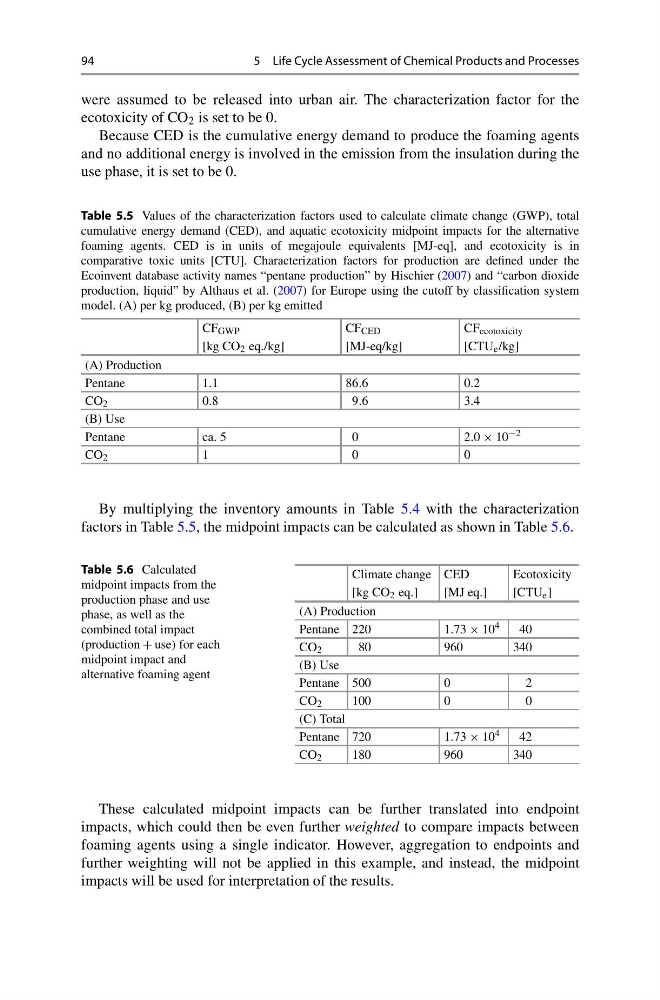
Table 5.5 Values of the characterization factors used to calculate climate change (GWP), total
cumulative energy demand (CED), and aquatic ecotoxicity midpoint impacts for the alternative
foaming agents. CED is in units of megajoule equivalents [MJ-eq], and ecotoxicity is in
comparative toxic units [CTU]. Characterization factors for production are defined under the
Ecoinvent database activity names “pentane production” by Hischier (2007) and “carbon dioxide
production, liquid” by Althaus et al. (2007) for Europe using the cutoff by classification system
model. (A) per kg produced, (B) per kg emitted
CF GWP
CF CED
CF ecotoxicity
[kg CO 2 eq./kg]
[MJ-eq/kg]
[CTU e /kg]
(A) Production
Pentane
1.1
86.6
0.2
CO 2
0.8
9.6
3.4
(B) Use
Pentane
ca. 5
0
2.0 × 10 −2
CO 2
1
0
0
By multiplying the inventory amounts in Table 5.4 with the characterization
factors in Table 5.5, the midpoint impacts can be calculated as shown in Table 5.6.
Table 5.6 Calculated
midpoint impacts from the
production phase and use
phase, as well as the
combined total impact
(production + use) for each
midpoint impact and
alternative foaming agent
Climate change CED
Ecotoxicity
[kg CO 2 eq.]
[MJ eq.]
[CTU e ]
(A) Production
Pentane 220
1.73 × 10 4
40
CO 2
80
960
340
(B) Use
Pentane 500
0
2
CO 2
100
0
0
(C) Total
Pentane 720
1.73 × 10 4
42
CO 2
180
960
340
These calculated midpoint impacts can be further translated into endpoint
impacts, which could then be even further weighted to compare impacts between
foaming agents using a single indicator. However, aggregation to endpoints and
further weighting will not be applied in this example, and instead, the midpoint
impacts will be used for interpretation of the results.
5 Life Cycle Assessment of Chemical Products and Processes
were assumed to be released into urban air. The characterization factor for the
ecotoxicity of CO 2 is set to be 0.
Because CED is the cumulative energy demand to produce the foaming agents
and no additional energy is involved in the emission from the insulation during the
use phase, it is set to be 0.
Table 5.5 Values of the characterization factors used to calculate climate change (GWP), total
cumulative energy demand (CED), and aquatic ecotoxicity midpoint impacts for the alternative
foaming agents. CED is in units of megajoule equivalents [MJ-eq], and ecotoxicity is in
comparative toxic units [CTU]. Characterization factors for production are defined under the
Ecoinvent database activity names “pentane production” by Hischier (2007) and “carbon dioxide
production, liquid” by Althaus et al. (2007) for Europe using the cutoff by classification system
model. (A) per kg produced, (B) per kg emitted
CF GWP
CF CED
CF ecotoxicity
[kg CO 2 eq./kg]
[MJ-eq/kg]
[CTU e /kg]
(A) Production
Pentane
1.1
86.6
0.2
CO 2
0.8
9.6
3.4
(B) Use
Pentane
ca. 5
0
2.0 × 10 −2
CO 2
1
0
0
By multiplying the inventory amounts in Table 5.4 with the characterization
factors in Table 5.5, the midpoint impacts can be calculated as shown in Table 5.6.
Table 5.6 Calculated
midpoint impacts from the
production phase and use
phase, as well as the
combined total impact
(production + use) for each
midpoint impact and
alternative foaming agent
Climate change CED
Ecotoxicity
[kg CO 2 eq.]
[MJ eq.]
[CTU e ]
(A) Production
Pentane 220
1.73 × 10 4
40
CO 2
80
960
340
(B) Use
Pentane 500
0
2
CO 2
100
0
0
(C) Total
Pentane 720
1.73 × 10 4
42
CO 2
180
960
340
These calculated midpoint impacts can be further translated into endpoint
impacts, which could then be even further weighted to compare impacts between
foaming agents using a single indicator. However, aggregation to endpoints and
further weighting will not be applied in this example, and instead, the midpoint
impacts will be used for interpretation of the results.