

5.7 Example: Comparing Insulation Foaming Agents
95
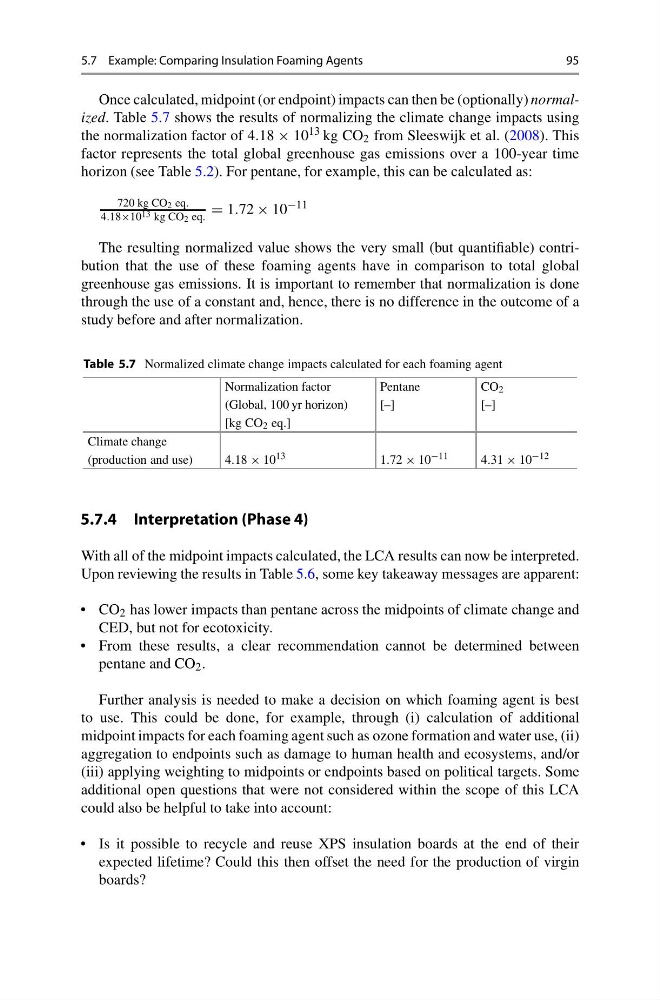
Once calculated, midpoint (or endpoint) impacts can then be (optionally) normalized. Table 5.7 shows the results of normalizing the climate change impacts using
the normalization factor of 4.18 × 10 13 kg CO 2 from Sleeswijk et al. (2008). This
factor represents the total global greenhouse gas emissions over a 100-year time
horizon (see Table 5.2). For pentane, for example, this can be calculated as:
720 kg CO 2 eq.
4.18×10 13 kg CO 2 eq.
= 1.72 × 10 −11
The resulting normalized value shows the very small (but quantifiable) contribution that the use of these foaming agents have in comparison to total global
greenhouse gas emissions. It is important to remember that normalization is done
through the use of a constant and, hence, there is no difference in the outcome of a
study before and after normalization.
Table 5.7 Normalized climate change impacts calculated for each foaming agent
Normalization factor
Pentane
CO 2
(Global, 100 yr horizon)
[–]
[–]
[kg CO 2 eq.]
Climate change
(production and use)
4.18 × 10 13
1.72 × 10 −11
4.31 × 10 −12
5.7.4 Interpretation (Phase 4)
With all of the midpoint impacts calculated, the LCA results can now be interpreted.
Upon reviewing the results in Table 5.6, some key takeaway messages are apparent:
• CO 2 has lower impacts than pentane across the midpoints of climate change and
CED, but not for ecotoxicity.
• From these results, a clear recommendation cannot be determined between
pentane and CO 2 .
Further analysis is needed to make a decision on which foaming agent is best
to use. This could be done, for example, through (i) calculation of additional
midpoint impacts for each foaming agent such as ozone formation and water use, (ii)
aggregation to endpoints such as damage to human health and ecosystems, and/or
(iii) applying weighting to midpoints or endpoints based on political targets. Some
additional open questions that were not considered within the scope of this LCA
could also be helpful to take into account:
• Is it possible to recycle and reuse XPS insulation boards at the end of their
expected lifetime? Could this then offset the need for the production of virgin
boards?
95
Once calculated, midpoint (or endpoint) impacts can then be (optionally) normalized. Table 5.7 shows the results of normalizing the climate change impacts using
the normalization factor of 4.18 × 10 13 kg CO 2 from Sleeswijk et al. (2008). This
factor represents the total global greenhouse gas emissions over a 100-year time
horizon (see Table 5.2). For pentane, for example, this can be calculated as:
720 kg CO 2 eq.
4.18×10 13 kg CO 2 eq.
= 1.72 × 10 −11
The resulting normalized value shows the very small (but quantifiable) contribution that the use of these foaming agents have in comparison to total global
greenhouse gas emissions. It is important to remember that normalization is done
through the use of a constant and, hence, there is no difference in the outcome of a
study before and after normalization.
Table 5.7 Normalized climate change impacts calculated for each foaming agent
Normalization factor
Pentane
CO 2
(Global, 100 yr horizon)
[–]
[–]
[kg CO 2 eq.]
Climate change
(production and use)
4.18 × 10 13
1.72 × 10 −11
4.31 × 10 −12
5.7.4 Interpretation (Phase 4)
With all of the midpoint impacts calculated, the LCA results can now be interpreted.
Upon reviewing the results in Table 5.6, some key takeaway messages are apparent:
• CO 2 has lower impacts than pentane across the midpoints of climate change and
CED, but not for ecotoxicity.
• From these results, a clear recommendation cannot be determined between
pentane and CO 2 .
Further analysis is needed to make a decision on which foaming agent is best
to use. This could be done, for example, through (i) calculation of additional
midpoint impacts for each foaming agent such as ozone formation and water use, (ii)
aggregation to endpoints such as damage to human health and ecosystems, and/or
(iii) applying weighting to midpoints or endpoints based on political targets. Some
additional open questions that were not considered within the scope of this LCA
could also be helpful to take into account:
• Is it possible to recycle and reuse XPS insulation boards at the end of their
expected lifetime? Could this then offset the need for the production of virgin
boards?