

5.7 Example: Comparing Insulation Foaming Agents
93
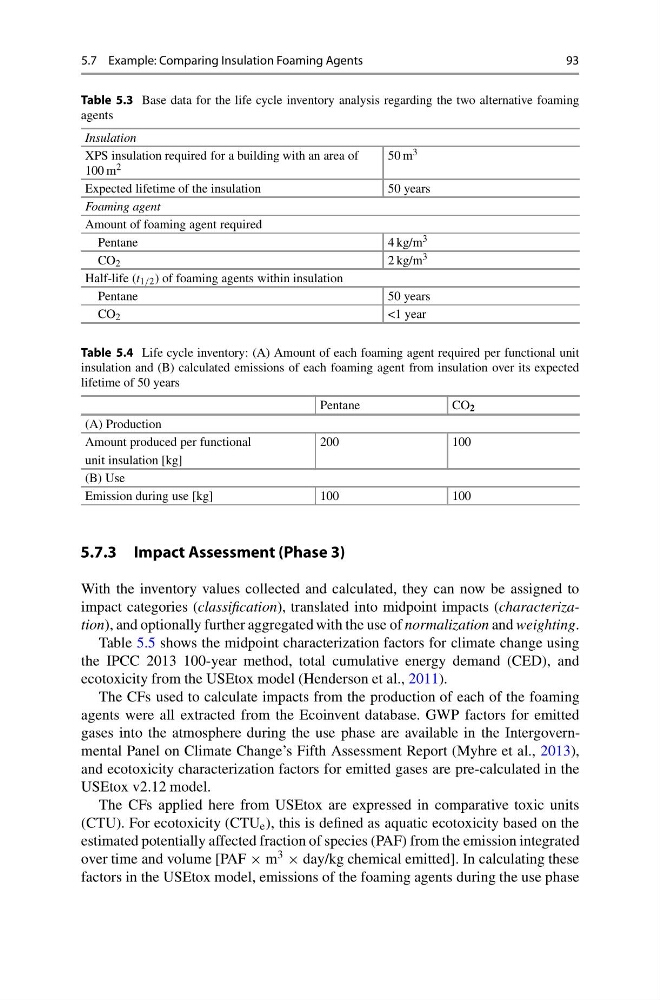
Table 5.3 Base data for the life cycle inventory analysis regarding the two alternative foaming
agents
Insulation
XPS insulation required for a building with an area of
100 m 2
50 m 3
Expected lifetime of the insulation
50 years
Foaming agent
Amount of foaming agent required
Pentane
4 kg/m 3
CO 2
2 kg/m 3
Half-life (t 1/2 ) of foaming agents within insulation
Pentane
50 years
CO 2
<1 year
Table 5.4 Life cycle inventory: (A) Amount of each foaming agent required per functional unit
insulation and (B) calculated emissions of each foaming agent from insulation over its expected
lifetime of 50 years
Pentane
CO 2
(A) Production
Amount produced per functional
200
100
unit insulation [kg]
(B) Use
Emission during use [kg]
100
100
5.7.3 Impact Assessment (Phase 3)
With the inventory values collected and calculated, they can now be assigned to
impact categories (classification), translated into midpoint impacts (characterization), and optionally further aggregated with the use of normalization and weighting.
Table 5.5 shows the midpoint characterization factors for climate change using
the IPCC 2013 100-year method, total cumulative energy demand (CED), and
ecotoxicity from the USEtox model (Henderson et al., 2011).
The CFs used to calculate impacts from the production of each of the foaming
agents were all extracted from the Ecoinvent database. GWP factors for emitted
gases into the atmosphere during the use phase are available in the Intergovernmental Panel on Climate Change’s Fifth Assessment Report (Myhre et al., 2013),
and ecotoxicity characterization factors for emitted gases are pre-calculated in the
USEtox v2.12 model.
The CFs applied here from USEtox are expressed in comparative toxic units
(CTU). For ecotoxicity (CTU e ), this is defined as aquatic ecotoxicity based on the
estimated potentially affected fraction of species (PAF) from the emission integrated
over time and volume [PAF × m 3 × day/kg chemical emitted]. In calculating these
factors in the USEtox model, emissions of the foaming agents during the use phase
93
Table 5.3 Base data for the life cycle inventory analysis regarding the two alternative foaming
agents
Insulation
XPS insulation required for a building with an area of
100 m 2
50 m 3
Expected lifetime of the insulation
50 years
Foaming agent
Amount of foaming agent required
Pentane
4 kg/m 3
CO 2
2 kg/m 3
Half-life (t 1/2 ) of foaming agents within insulation
Pentane
50 years
CO 2
<1 year
Table 5.4 Life cycle inventory: (A) Amount of each foaming agent required per functional unit
insulation and (B) calculated emissions of each foaming agent from insulation over its expected
lifetime of 50 years
Pentane
CO 2
(A) Production
Amount produced per functional
200
100
unit insulation [kg]
(B) Use
Emission during use [kg]
100
100
5.7.3 Impact Assessment (Phase 3)
With the inventory values collected and calculated, they can now be assigned to
impact categories (classification), translated into midpoint impacts (characterization), and optionally further aggregated with the use of normalization and weighting.
Table 5.5 shows the midpoint characterization factors for climate change using
the IPCC 2013 100-year method, total cumulative energy demand (CED), and
ecotoxicity from the USEtox model (Henderson et al., 2011).
The CFs used to calculate impacts from the production of each of the foaming
agents were all extracted from the Ecoinvent database. GWP factors for emitted
gases into the atmosphere during the use phase are available in the Intergovernmental Panel on Climate Change’s Fifth Assessment Report (Myhre et al., 2013),
and ecotoxicity characterization factors for emitted gases are pre-calculated in the
USEtox v2.12 model.
The CFs applied here from USEtox are expressed in comparative toxic units
(CTU). For ecotoxicity (CTU e ), this is defined as aquatic ecotoxicity based on the
estimated potentially affected fraction of species (PAF) from the emission integrated
over time and volume [PAF × m 3 × day/kg chemical emitted]. In calculating these
factors in the USEtox model, emissions of the foaming agents during the use phase