

taken into account. Therefore, except for very few exceptions, the in situ coating of
oxide particles is possible only by using the microwave plasma process. A set-up for
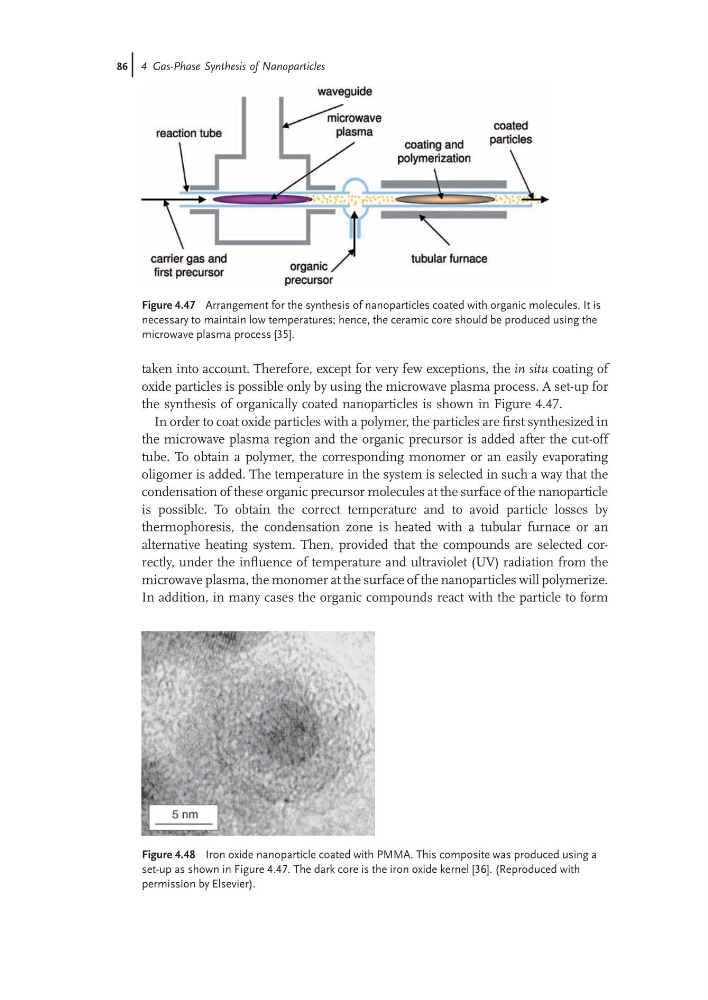
the synthesis of organically coated nanoparticles is shown in Figure 4.47.
In order to coat oxide particles with a polymer, the particles are first synthesized in
the microwave plasma region and the organic precursor is added after the cut-off
tube. To obtain a polymer, the corresponding monomer or an easily evaporating
oligomer is added. The temperature in the system is selected in such a way that the
condensation of these organic precursor molecules at the surface of the nanoparticle
is possible. To obtain the correct temperature and to avoid particle losses by
thermophoresis, the condensation zone is heated with a tubular furnace or an
alternative heating system. Then, provided that the compounds are selected correctly, under the influence of temperature and ultraviolet (UV) radiation from the
microwave plasma, the monomer at the surface of the nanoparticles will polymerize.
In addition, in many cases the organic compounds react with the particle to form
Figure 4.47 Arrangement for the synthesis of nanoparticles coated with organic molecules. It is
necessary to maintain low temperatures; hence, the ceramic core should be produced using the
microwave plasma process [35].
Figure 4.48 Iron oxide nanoparticle coated with PMMA. This composite was produced using a
set-up as shown in Figure 4.47. The dark core is the iron oxide kernel [36]. (Reproduced with
permission by Elsevier).
86j 4 Gas-Phase Synthesis of Nanoparticles
oxide particles is possible only by using the microwave plasma process. A set-up for
the synthesis of organically coated nanoparticles is shown in Figure 4.47.
In order to coat oxide particles with a polymer, the particles are first synthesized in
the microwave plasma region and the organic precursor is added after the cut-off
tube. To obtain a polymer, the corresponding monomer or an easily evaporating
oligomer is added. The temperature in the system is selected in such a way that the
condensation of these organic precursor molecules at the surface of the nanoparticle
is possible. To obtain the correct temperature and to avoid particle losses by
thermophoresis, the condensation zone is heated with a tubular furnace or an
alternative heating system. Then, provided that the compounds are selected correctly, under the influence of temperature and ultraviolet (UV) radiation from the
microwave plasma, the monomer at the surface of the nanoparticles will polymerize.
In addition, in many cases the organic compounds react with the particle to form
Figure 4.47 Arrangement for the synthesis of nanoparticles coated with organic molecules. It is
necessary to maintain low temperatures; hence, the ceramic core should be produced using the
microwave plasma process [35].
Figure 4.48 Iron oxide nanoparticle coated with PMMA. This composite was produced using a
set-up as shown in Figure 4.47. The dark core is the iron oxide kernel [36]. (Reproduced with
permission by Elsevier).
86j 4 Gas-Phase Synthesis of Nanoparticles