

Figure 4.46; here, the dark dots present at the surface of the particle consist of
platinum particles with diameters ranging between 2 and 3 nm. The decorated
particles in Figure 4.46 were produced using the microwave plasma process, with
platinum carbonyl chloride (Pt(CO)Cl 2 ) as the precursor. Materials such as transition metal oxide particles decorated with platinum or gold have been proven to serve
as highly active catalysts that begin to function at relatively low temperatures.
In addition to coating oxide nanoparticles with an inorganic material, their coating
with organic compounds is of major importance. Such coating may be performed
with a polymer or a functional organic molecule (e.g., a luminescent compound).
The coating of particles with organic matter requires temperatures that are sufficiently low so as not to destroy the molecules. The stability of the organic
compounds in the oxidizing atmosphere, when coating an oxide, must also be
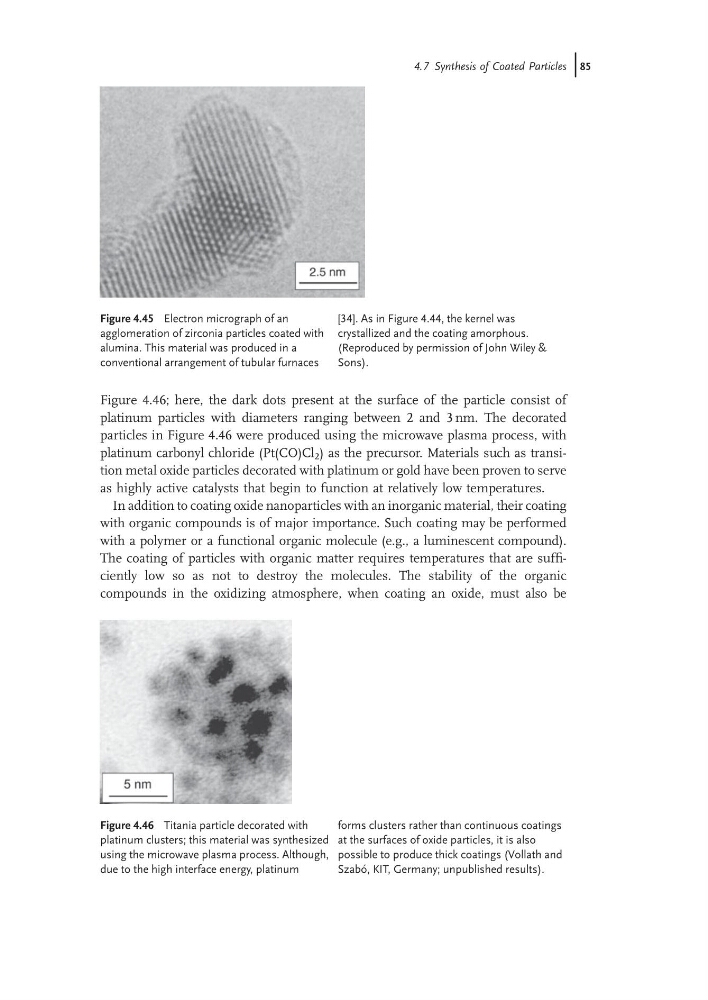
Figure 4.45 Electron micrograph of an
agglomeration of zirconia particles coated with
alumina. This material was produced in a
conventional arrangement of tubular furnaces
[34]. As in Figure 4.44, the kernel was
crystallized and the coating amorphous.
(Reproduced by permission of John Wiley &
Sons).
Figure 4.46 Titania particle decorated with
platinum clusters; this material was synthesized
using the microwave plasma process. Although,
due to the high interface energy, platinum
forms clusters rather than continuous coatings
at the surfaces of oxide particles, it is also
possible to produce thick coatings (Vollath and
Szab o, KIT, Germany; unpublished results).
4.7 Synthesis of Coated Particles j85
platinum particles with diameters ranging between 2 and 3 nm. The decorated
particles in Figure 4.46 were produced using the microwave plasma process, with
platinum carbonyl chloride (Pt(CO)Cl 2 ) as the precursor. Materials such as transition metal oxide particles decorated with platinum or gold have been proven to serve
as highly active catalysts that begin to function at relatively low temperatures.
In addition to coating oxide nanoparticles with an inorganic material, their coating
with organic compounds is of major importance. Such coating may be performed
with a polymer or a functional organic molecule (e.g., a luminescent compound).
The coating of particles with organic matter requires temperatures that are sufficiently low so as not to destroy the molecules. The stability of the organic
compounds in the oxidizing atmosphere, when coating an oxide, must also be
Figure 4.45 Electron micrograph of an
agglomeration of zirconia particles coated with
alumina. This material was produced in a
conventional arrangement of tubular furnaces
[34]. As in Figure 4.44, the kernel was
crystallized and the coating amorphous.
(Reproduced by permission of John Wiley &
Sons).
Figure 4.46 Titania particle decorated with
platinum clusters; this material was synthesized
using the microwave plasma process. Although,
due to the high interface energy, platinum
forms clusters rather than continuous coatings
at the surfaces of oxide particles, it is also
possible to produce thick coatings (Vollath and
Szab o, KIT, Germany; unpublished results).
4.7 Synthesis of Coated Particles j85