

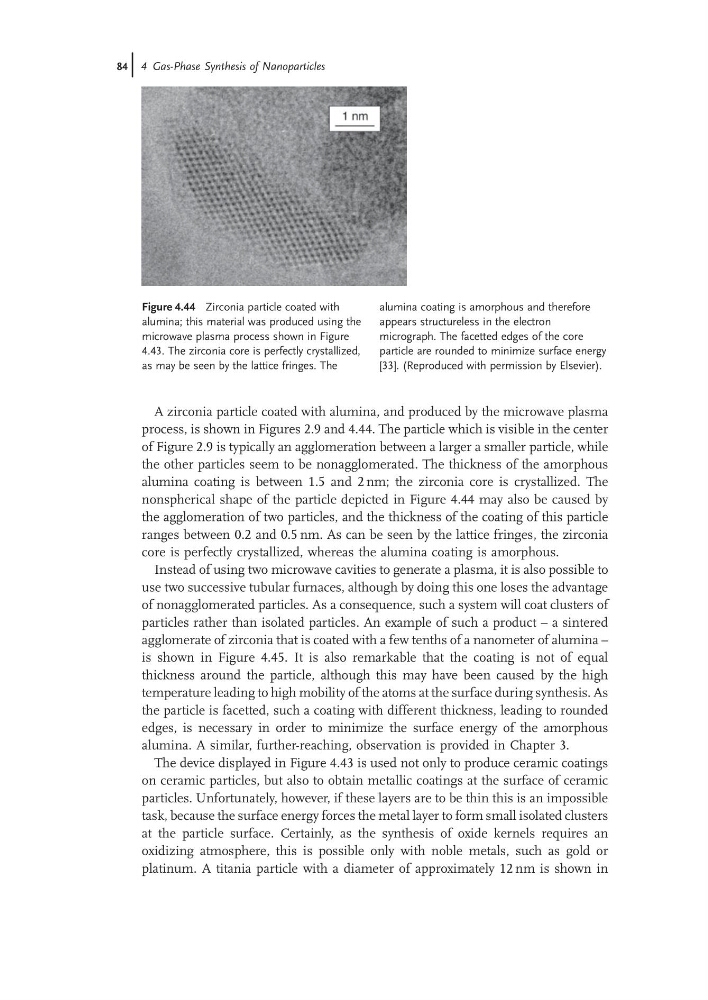
A zirconia particle coated with alumina, and produced by the microwave plasma
process, is shown in Figures 2.9 and 4.44. The particle which is visible in the center
of Figure 2.9 is typically an agglomeration between a larger a smaller particle, while
the other particles seem to be nonagglomerated. The thickness of the amorphous
alumina coating is between 1.5 and 2 nm; the zirconia core is crystallized. The
nonspherical shape of the particle depicted in Figure 4.44 may also be caused by
the agglomeration of two particles, and the thickness of the coating of this particle
ranges between 0.2 and 0.5 nm. As can be seen by the lattice fringes, the zirconia
core is perfectly crystallized, whereas the alumina coating is amorphous.
Instead of using two microwave cavities to generate a plasma, it is also possible to
use two successive tubular furnaces, although by doing this one loses the advantage
of nonagglomerated particles. As a consequence, such a system will coat clusters of
particles rather than isolated particles. An example of such a product – a sintered
agglomerate of zirconia that is coated with a few tenths of a nanometer of alumina –
is shown in Figure 4.45. It is also remarkable that the coating is not of equal
thickness around the particle, although this may have been caused by the high
temperature leading to high mobility of the atoms at the surface during synthesis. As
the particle is facetted, such a coating with different thickness, leading to rounded
edges, is necessary in order to minimize the surface energy of the amorphous
alumina. A similar, further-reaching, observation is provided in Chapter 3.
The device displayed in Figure 4.43 is used not only to produce ceramic coatings
on ceramic particles, but also to obtain metallic coatings at the surface of ceramic
particles. Unfortunately, however, if these layers are to be thin this is an impossible
task, because the surface energy forces the metal layer to form small isolated clusters
at the particle surface. Certainly, as the synthesis of oxide kernels requires an
oxidizing atmosphere, this is possible only with noble metals, such as gold or
platinum. A titania particle with a diameter of approximately 12 nm is shown in
Figure 4.44 Zirconia particle coated with
alumina; this material was produced using the
microwave plasma process shown in Figure
4.43. The zirconia core is perfectly crystallized,
as may be seen by the lattice fringes. The
alumina coating is amorphous and therefore
appears structureless in the electron
micrograph. The facetted edges of the core
particle are rounded to minimize surface energy
[33]. (Reproduced with permission by Elsevier).
84j 4 Gas-Phase Synthesis of Nanoparticles
process, is shown in Figures 2.9 and 4.44. The particle which is visible in the center
of Figure 2.9 is typically an agglomeration between a larger a smaller particle, while
the other particles seem to be nonagglomerated. The thickness of the amorphous
alumina coating is between 1.5 and 2 nm; the zirconia core is crystallized. The
nonspherical shape of the particle depicted in Figure 4.44 may also be caused by
the agglomeration of two particles, and the thickness of the coating of this particle
ranges between 0.2 and 0.5 nm. As can be seen by the lattice fringes, the zirconia
core is perfectly crystallized, whereas the alumina coating is amorphous.
Instead of using two microwave cavities to generate a plasma, it is also possible to
use two successive tubular furnaces, although by doing this one loses the advantage
of nonagglomerated particles. As a consequence, such a system will coat clusters of
particles rather than isolated particles. An example of such a product – a sintered
agglomerate of zirconia that is coated with a few tenths of a nanometer of alumina –
is shown in Figure 4.45. It is also remarkable that the coating is not of equal
thickness around the particle, although this may have been caused by the high
temperature leading to high mobility of the atoms at the surface during synthesis. As
the particle is facetted, such a coating with different thickness, leading to rounded
edges, is necessary in order to minimize the surface energy of the amorphous
alumina. A similar, further-reaching, observation is provided in Chapter 3.
The device displayed in Figure 4.43 is used not only to produce ceramic coatings
on ceramic particles, but also to obtain metallic coatings at the surface of ceramic
particles. Unfortunately, however, if these layers are to be thin this is an impossible
task, because the surface energy forces the metal layer to form small isolated clusters
at the particle surface. Certainly, as the synthesis of oxide kernels requires an
oxidizing atmosphere, this is possible only with noble metals, such as gold or
platinum. A titania particle with a diameter of approximately 12 nm is shown in
Figure 4.44 Zirconia particle coated with
alumina; this material was produced using the
microwave plasma process shown in Figure
4.43. The zirconia core is perfectly crystallized,
as may be seen by the lattice fringes. The
alumina coating is amorphous and therefore
appears structureless in the electron
micrograph. The facetted edges of the core
particle are rounded to minimize surface energy
[33]. (Reproduced with permission by Elsevier).
84j 4 Gas-Phase Synthesis of Nanoparticles