

equal sign. Additionally, the temperature in the coating step must be sufficiently low
so as not to destroy the matter used for coating. This condition is of particular
importance when the coating consists of organic compounds.
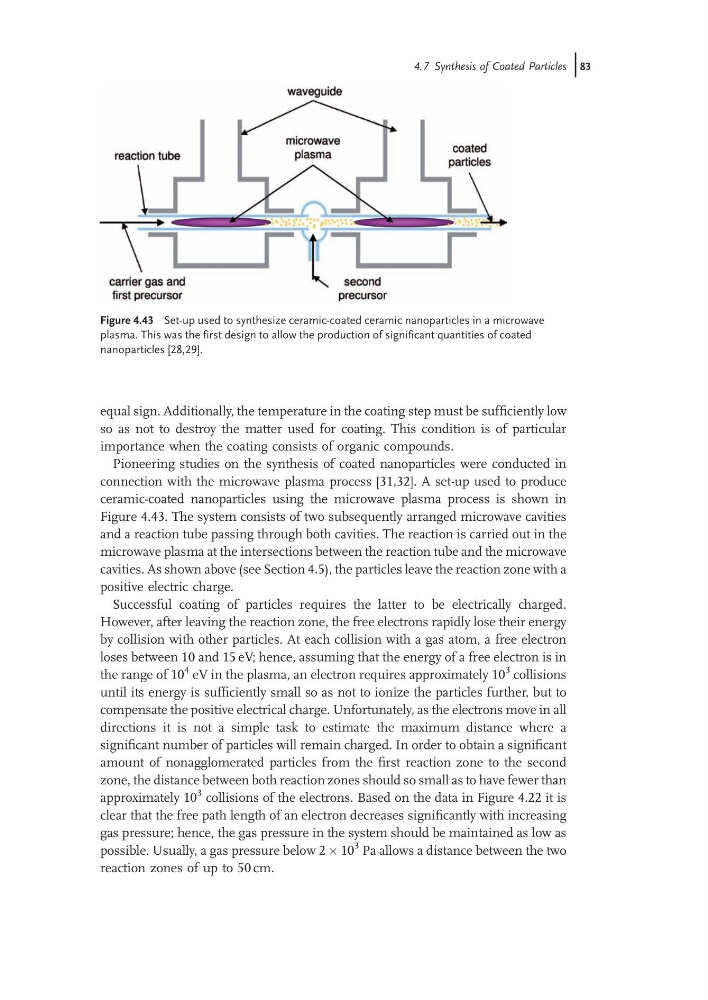
Pioneering studies on the synthesis of coated nanoparticles were conducted in
connection with the microwave plasma process [31,32]. A set-up used to produce
ceramic-coated nanoparticles using the microwave plasma process is shown in
Figure 4.43. The system consists of two subsequently arranged microwave cavities
and a reaction tube passing through both cavities. The reaction is carried out in the
microwave plasma at the intersections between the reaction tube and the microwave
cavities. As shown above (see Section 4.5), the particles leave the reaction zone with a
positive electric charge.
Successful coating of particles requires the latter to be electrically charged.
However, after leaving the reaction zone, the free electrons rapidly lose their energy
by collision with other particles. At each collision with a gas atom, a free electron
loses between 10 and 15 eV; hence, assuming that the energy of a free electron is in
the range of 10
4 eV in the plasma, an electron requires approximately 10
3 collisions
until its energy is sufficiently small so as not to ionize the particles further, but to
compensate the positive electrical charge. Unfortunately, as the electrons move in all
directions it is not a simple task to estimate the maximum distance where a
significant number of particles will remain charged. In order to obtain a significant
amount of nonagglomerated particles from the first reaction zone to the second
zone, the distance between both reaction zones should so small as to have fewer than
approximately 10
3 collisions of the electrons. Based on the data in Figure 4.22 it is
clear that the free path length of an electron decreases significantly with increasing
gas pressure; hence, the gas pressure in the system should be maintained as low as
possible. Usually, a gas pressure below 2 Â 10
3 Pa allows a distance between the two
reaction zones of up to 50 cm.
Figure 4.43 Set-up used to synthesize ceramic-coated ceramic nanoparticles in a microwave
plasma. This was the first design to allow the production of significant quantities of coated
nanoparticles [28,29].
4.7 Synthesis of Coated Particles j83
so as not to destroy the matter used for coating. This condition is of particular
importance when the coating consists of organic compounds.
Pioneering studies on the synthesis of coated nanoparticles were conducted in
connection with the microwave plasma process [31,32]. A set-up used to produce
ceramic-coated nanoparticles using the microwave plasma process is shown in
Figure 4.43. The system consists of two subsequently arranged microwave cavities
and a reaction tube passing through both cavities. The reaction is carried out in the
microwave plasma at the intersections between the reaction tube and the microwave
cavities. As shown above (see Section 4.5), the particles leave the reaction zone with a
positive electric charge.
Successful coating of particles requires the latter to be electrically charged.
However, after leaving the reaction zone, the free electrons rapidly lose their energy
by collision with other particles. At each collision with a gas atom, a free electron
loses between 10 and 15 eV; hence, assuming that the energy of a free electron is in
the range of 10
4 eV in the plasma, an electron requires approximately 10
3 collisions
until its energy is sufficiently small so as not to ionize the particles further, but to
compensate the positive electrical charge. Unfortunately, as the electrons move in all
directions it is not a simple task to estimate the maximum distance where a
significant number of particles will remain charged. In order to obtain a significant
amount of nonagglomerated particles from the first reaction zone to the second
zone, the distance between both reaction zones should so small as to have fewer than
approximately 10
3 collisions of the electrons. Based on the data in Figure 4.22 it is
clear that the free path length of an electron decreases significantly with increasing
gas pressure; hence, the gas pressure in the system should be maintained as low as
possible. Usually, a gas pressure below 2 Â 10
3 Pa allows a distance between the two
reaction zones of up to 50 cm.
Figure 4.43 Set-up used to synthesize ceramic-coated ceramic nanoparticles in a microwave
plasma. This was the first design to allow the production of significant quantities of coated
nanoparticles [28,29].
4.7 Synthesis of Coated Particles j83