

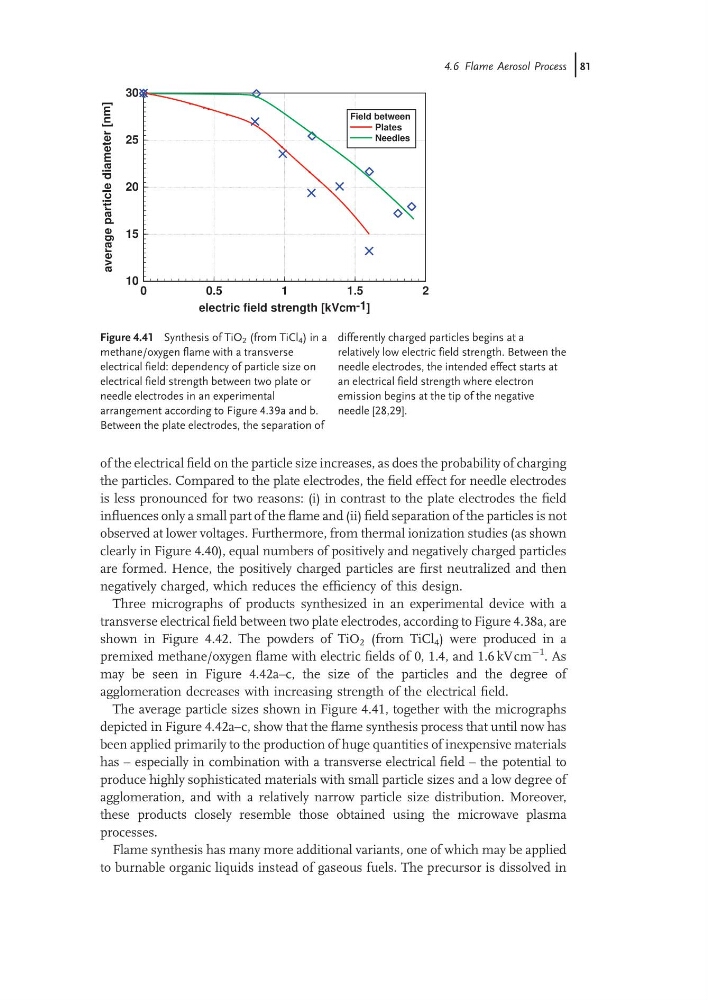
of the electrical field on the particle size increases, as does the probability of charging
the particles. Compared to the plate electrodes, the field effect for needle electrodes
is less pronounced for two reasons: (i) in contrast to the plate electrodes the field
influences only a small part of the flame and (ii) field separation of the particles is not
observed at lower voltages. Furthermore, from thermal ionization studies (as shown
clearly in Figure 4.40), equal numbers of positively and negatively charged particles
are formed. Hence, the positively charged particles are first neutralized and then
negatively charged, which reduces the efficiency of this design.
Three micrographs of products synthesized in an experimental device with a
transverse electrical field between two plate electrodes, according to Figure 4.38a, are
shown in Figure 4.42. The powders of TiO 2 (from TiCl 4 ) were produced in a
premixed methane/oxygen flame with electric fields of 0, 1.4, and 1.6 kV cm
À1
. As
may be seen in Figure 4.42a–c, the size of the particles and the degree of
agglomeration decreases with increasing strength of the electrical field.
The average particle sizes shown in Figure 4.41, together with the micrographs
depicted in Figure 4.42a–c, show that the flame synthesis process that until now has
been applied primarily to the production of huge quantities of inexpensive materials
has – especially in combination with a transverse electrical field – the potential to
produce highly sophisticated materials with small particle sizes and a low degree of
agglomeration, and with a relatively narrow particle size distribution. Moreover,
these products closely resemble those obtained using the microwave plasma
processes.
Flame synthesis has many more additional variants, one of which may be applied
to burnable organic liquids instead of gaseous fuels. The precursor is dissolved in
0
0.5
1
1.5
2
electric field strength [kVcm -1 ]
10
15
20
25
30
average
particle
diameter
[nm]
Field between
Plates
Needles
Figure 4.41 Synthesis of TiO 2 (from TiCl 4 ) in a
methane/oxygen flame with a transverse
electrical field: dependency of particle size on
electrical field strength between two plate or
needle electrodes in an experimental
arrangement according to Figure 4.39a and b.
Between the plate electrodes, the separation of
differently charged particles begins at a
relatively low electric field strength. Between the
needle electrodes, the intended effect starts at
an electrical field strength where electron
emission begins at the tip of the negative
needle [28,29].
4.6 Flame Aerosol Process j81
the particles. Compared to the plate electrodes, the field effect for needle electrodes
is less pronounced for two reasons: (i) in contrast to the plate electrodes the field
influences only a small part of the flame and (ii) field separation of the particles is not
observed at lower voltages. Furthermore, from thermal ionization studies (as shown
clearly in Figure 4.40), equal numbers of positively and negatively charged particles
are formed. Hence, the positively charged particles are first neutralized and then
negatively charged, which reduces the efficiency of this design.
Three micrographs of products synthesized in an experimental device with a
transverse electrical field between two plate electrodes, according to Figure 4.38a, are
shown in Figure 4.42. The powders of TiO 2 (from TiCl 4 ) were produced in a
premixed methane/oxygen flame with electric fields of 0, 1.4, and 1.6 kV cm
À1
. As
may be seen in Figure 4.42a–c, the size of the particles and the degree of
agglomeration decreases with increasing strength of the electrical field.
The average particle sizes shown in Figure 4.41, together with the micrographs
depicted in Figure 4.42a–c, show that the flame synthesis process that until now has
been applied primarily to the production of huge quantities of inexpensive materials
has – especially in combination with a transverse electrical field – the potential to
produce highly sophisticated materials with small particle sizes and a low degree of
agglomeration, and with a relatively narrow particle size distribution. Moreover,
these products closely resemble those obtained using the microwave plasma
processes.
Flame synthesis has many more additional variants, one of which may be applied
to burnable organic liquids instead of gaseous fuels. The precursor is dissolved in
0
0.5
1
1.5
2
electric field strength [kVcm -1 ]
10
15
20
25
30
average
particle
diameter
[nm]
Field between
Plates
Needles
Figure 4.41 Synthesis of TiO 2 (from TiCl 4 ) in a
methane/oxygen flame with a transverse
electrical field: dependency of particle size on
electrical field strength between two plate or
needle electrodes in an experimental
arrangement according to Figure 4.39a and b.
Between the plate electrodes, the separation of
differently charged particles begins at a
relatively low electric field strength. Between the
needle electrodes, the intended effect starts at
an electrical field strength where electron
emission begins at the tip of the negative
needle [28,29].
4.6 Flame Aerosol Process j81