

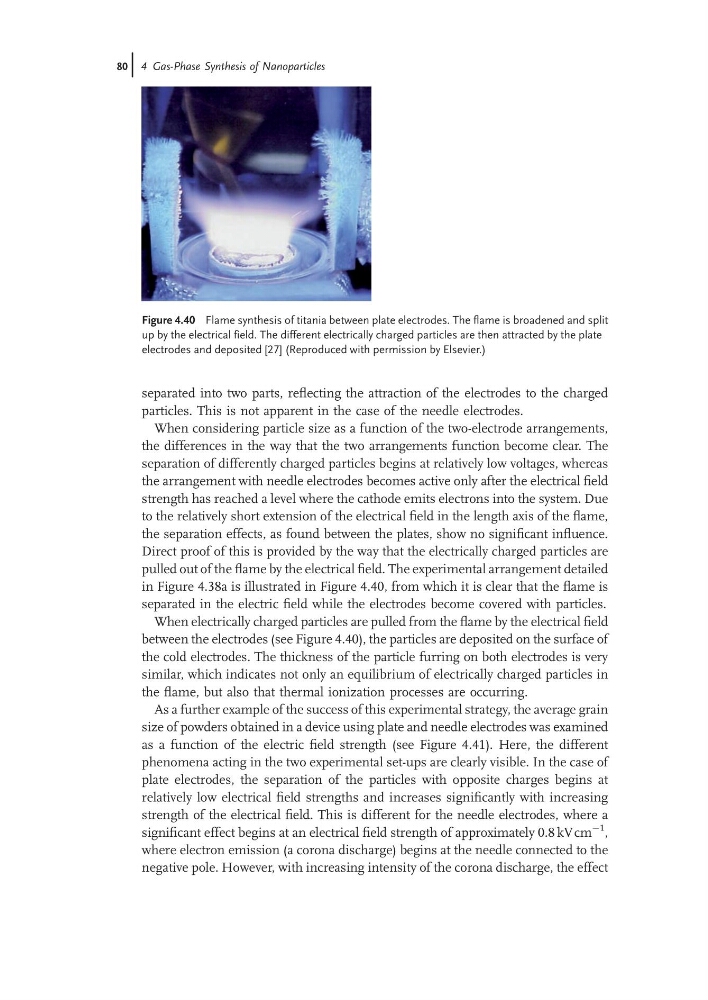
separated into two parts, reflecting the attraction of the electrodes to the charged
particles. This is not apparent in the case of the needle electrodes.
When considering particle size as a function of the two-electrode arrangements,
the differences in the way that the two arrangements function become clear. The
separation of differently charged particles begins at relatively low voltages, whereas
the arrangement with needle electrodes becomes active only after the electrical field
strength has reached a level where the cathode emits electrons into the system. Due
to the relatively short extension of the electrical field in the length axis of the flame,
the separation effects, as found between the plates, show no significant influence.
Direct proof of this is provided by the way that the electrically charged particles are
pulled out of the flame by the electrical field. The experimental arrangement detailed
in Figure 4.38a is illustrated in Figure 4.40, from which it is clear that the flame is
separated in the electric field while the electrodes become covered with particles.
When electrically charged particles are pulled from the flame by the electrical field
between the electrodes (see Figure 4.40), the particles are deposited on the surface of
the cold electrodes. The thickness of the particle furring on both electrodes is very
similar, which indicates not only an equilibrium of electrically charged particles in
the flame, but also that thermal ionization processes are occurring.
As a further example of the success of this experimental strategy, the average grain
size of powders obtained in a device using plate and needle electrodes was examined
as a function of the electric field strength (see Figure 4.41). Here, the different
phenomena acting in the two experimental set-ups are clearly visible. In the case of
plate electrodes, the separation of the particles with opposite charges begins at
relatively low electrical field strengths and increases significantly with increasing
strength of the electrical field. This is different for the needle electrodes, where a
significant effect begins at an electrical field strength of approximately 0.8 kV cm
À1 ,
where electron emission (a corona discharge) begins at the needle connected to the
negative pole. However, with increasing intensity of the corona discharge, the effect
Figure 4.40 Flame synthesis of titania between plate electrodes. The flame is broadened and split
up by the electrical field. The different electrically charged particles are then attracted by the plate
electrodes and deposited [27] (Reproduced with permission by Elsevier.)
80j 4 Gas-Phase Synthesis of Nanoparticles
particles. This is not apparent in the case of the needle electrodes.
When considering particle size as a function of the two-electrode arrangements,
the differences in the way that the two arrangements function become clear. The
separation of differently charged particles begins at relatively low voltages, whereas
the arrangement with needle electrodes becomes active only after the electrical field
strength has reached a level where the cathode emits electrons into the system. Due
to the relatively short extension of the electrical field in the length axis of the flame,
the separation effects, as found between the plates, show no significant influence.
Direct proof of this is provided by the way that the electrically charged particles are
pulled out of the flame by the electrical field. The experimental arrangement detailed
in Figure 4.38a is illustrated in Figure 4.40, from which it is clear that the flame is
separated in the electric field while the electrodes become covered with particles.
When electrically charged particles are pulled from the flame by the electrical field
between the electrodes (see Figure 4.40), the particles are deposited on the surface of
the cold electrodes. The thickness of the particle furring on both electrodes is very
similar, which indicates not only an equilibrium of electrically charged particles in
the flame, but also that thermal ionization processes are occurring.
As a further example of the success of this experimental strategy, the average grain
size of powders obtained in a device using plate and needle electrodes was examined
as a function of the electric field strength (see Figure 4.41). Here, the different
phenomena acting in the two experimental set-ups are clearly visible. In the case of
plate electrodes, the separation of the particles with opposite charges begins at
relatively low electrical field strengths and increases significantly with increasing
strength of the electrical field. This is different for the needle electrodes, where a
significant effect begins at an electrical field strength of approximately 0.8 kV cm
À1 ,
where electron emission (a corona discharge) begins at the needle connected to the
negative pole. However, with increasing intensity of the corona discharge, the effect
Figure 4.40 Flame synthesis of titania between plate electrodes. The flame is broadened and split
up by the electrical field. The different electrically charged particles are then attracted by the plate
electrodes and deposited [27] (Reproduced with permission by Elsevier.)
80j 4 Gas-Phase Synthesis of Nanoparticles