

flame (about 2500 K), it may be assumed that thermal ionization of the particles has
occurred, or at least thermal ionization supported by the electrical field. In either case,
the particles carry electrical charges and, as the energy of the free electrons is relatively
small, an agglomeration at the uncharged particles is possible. Thus, it must be
assumed that the particles are carrying electrical charges of both signs. Particles with
electrical charges of different sign may be separated in the electrical field and move in
the direction of the different electrodes. This reduces the probability of agglomeration,
as particles with electrical charges of equal sign will repel each other. Certainly, an
increasing influence of the electric field with increasing field strength would be
expected and these results have been confirmed experimentally.
A somewhat different mechanism, albeit with similarly good results, would be
expected when using the experimental device shown in Figure 4.38b. Here, a corona
discharge emerges from the tips of the electrodes and the electrons emitted from the
cathode cross the flame. While passing through the flame, the electrons donate
negative charges to the particles such that a large proportion of them carry negative
electric charges that increase with increasing voltage between the two electrodes. As
the charged particles repel each other, particle growth by agglomeration is thwarted;
hence, the particle size of the product decreases in line with the increasing field
strength between the electrodes.
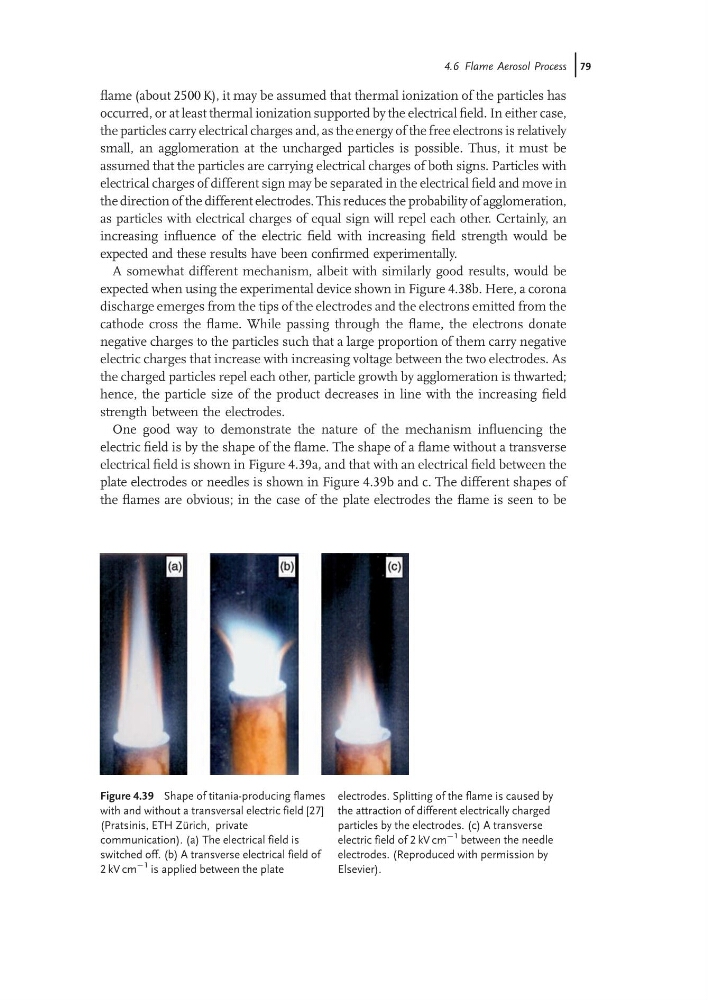
One good way to demonstrate the nature of the mechanism influencing the
electric field is by the shape of the flame. The shape of a flame without a transverse
electrical field is shown in Figure 4.39a, and that with an electrical field between the
plate electrodes or needles is shown in Figure 4.39b and c. The different shapes of
the flames are obvious; in the case of the plate electrodes the flame is seen to be
Figure 4.39 Shape of titania-producing flames
with and without a transversal electric field [27]
(Pratsinis, ETH Zürich, private
communication). (a) The electrical field is
switched off. (b) A transverse electrical field of
2 kV cm
À1 is applied between the plate
electrodes. Splitting of the flame is caused by
the attraction of different electrically charged
particles by the electrodes. (c) A transverse
electric field of 2 kV cm
À1 between the needle
electrodes. (Reproduced with permission by
Elsevier).
4.6 Flame Aerosol Process j79
occurred, or at least thermal ionization supported by the electrical field. In either case,
the particles carry electrical charges and, as the energy of the free electrons is relatively
small, an agglomeration at the uncharged particles is possible. Thus, it must be
assumed that the particles are carrying electrical charges of both signs. Particles with
electrical charges of different sign may be separated in the electrical field and move in
the direction of the different electrodes. This reduces the probability of agglomeration,
as particles with electrical charges of equal sign will repel each other. Certainly, an
increasing influence of the electric field with increasing field strength would be
expected and these results have been confirmed experimentally.
A somewhat different mechanism, albeit with similarly good results, would be
expected when using the experimental device shown in Figure 4.38b. Here, a corona
discharge emerges from the tips of the electrodes and the electrons emitted from the
cathode cross the flame. While passing through the flame, the electrons donate
negative charges to the particles such that a large proportion of them carry negative
electric charges that increase with increasing voltage between the two electrodes. As
the charged particles repel each other, particle growth by agglomeration is thwarted;
hence, the particle size of the product decreases in line with the increasing field
strength between the electrodes.
One good way to demonstrate the nature of the mechanism influencing the
electric field is by the shape of the flame. The shape of a flame without a transverse
electrical field is shown in Figure 4.39a, and that with an electrical field between the
plate electrodes or needles is shown in Figure 4.39b and c. The different shapes of
the flames are obvious; in the case of the plate electrodes the flame is seen to be
Figure 4.39 Shape of titania-producing flames
with and without a transversal electric field [27]
(Pratsinis, ETH Zürich, private
communication). (a) The electrical field is
switched off. (b) A transverse electrical field of
2 kV cm
À1 is applied between the plate
electrodes. Splitting of the flame is caused by
the attraction of different electrically charged
particles by the electrodes. (c) A transverse
electric field of 2 kV cm
À1 between the needle
electrodes. (Reproduced with permission by
Elsevier).
4.6 Flame Aerosol Process j79