

reactor are depicted. Here, air or oxygen was used as the oxidant. The use of air as an
oxidant results in lower maximum temperatures and shorter flame heights as
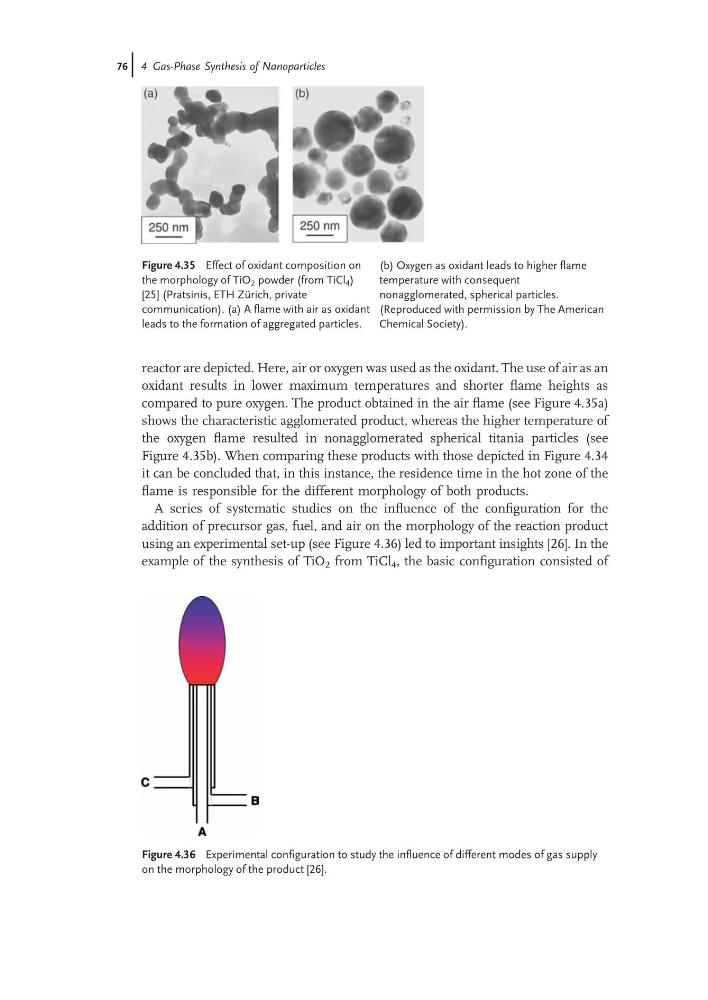
compared to pure oxygen. The product obtained in the air flame (see Figure 4.35a)
shows the characteristic agglomerated product, whereas the higher temperature of
the oxygen flame resulted in nonagglomerated spherical titania particles (see
Figure 4.35b). When comparing these products with those depicted in Figure 4.34
it can be concluded that, in this instance, the residence time in the hot zone of the
flame is responsible for the different morphology of both products.
A series of systematic studies on the influence of the configuration for the
addition of precursor gas, fuel, and air on the morphology of the reaction product
using an experimental set-up (see Figure 4.36) led to important insights [26]. In the
example of the synthesis of TiO 2 from TiCl 4 , the basic configuration consisted of
Figure 4.35 Effect of oxidant composition on
the morphology of TiO 2 powder (from TiCl 4 )
[25] (Pratsinis, ETH Zürich, private
communication). (a) A flame with air as oxidant
leads to the formation of aggregated particles.
(b) Oxygen as oxidant leads to higher flame
temperature with consequent
nonagglomerated, spherical particles.
(Reproduced with permission by The American
Chemical Society).
Figure 4.36 Experimental configuration to study the influence of different modes of gas supply
on the morphology of the product [26].
76j 4 Gas-Phase Synthesis of Nanoparticles
oxidant results in lower maximum temperatures and shorter flame heights as
compared to pure oxygen. The product obtained in the air flame (see Figure 4.35a)
shows the characteristic agglomerated product, whereas the higher temperature of
the oxygen flame resulted in nonagglomerated spherical titania particles (see
Figure 4.35b). When comparing these products with those depicted in Figure 4.34
it can be concluded that, in this instance, the residence time in the hot zone of the
flame is responsible for the different morphology of both products.
A series of systematic studies on the influence of the configuration for the
addition of precursor gas, fuel, and air on the morphology of the reaction product
using an experimental set-up (see Figure 4.36) led to important insights [26]. In the
example of the synthesis of TiO 2 from TiCl 4 , the basic configuration consisted of
Figure 4.35 Effect of oxidant composition on
the morphology of TiO 2 powder (from TiCl 4 )
[25] (Pratsinis, ETH Zürich, private
communication). (a) A flame with air as oxidant
leads to the formation of aggregated particles.
(b) Oxygen as oxidant leads to higher flame
temperature with consequent
nonagglomerated, spherical particles.
(Reproduced with permission by The American
Chemical Society).
Figure 4.36 Experimental configuration to study the influence of different modes of gas supply
on the morphology of the product [26].
76j 4 Gas-Phase Synthesis of Nanoparticles