

As the flame temperatures are high and the product, silica, is not crystallized, the
particles are spherical in shape and this is typical for all products produced by flame
synthesis. However, as the extent by which the flame shortens becomes correlated
with a reduced residence time at high temperature, the probability of forming fractal
agglomerates is increased. This can be clearly seen for the products shown in
Figure 4.33a and b, which consist of spherical particles with a broad size distribution; this contrasts with the particles in Figure 4.33c, which are clearly agglomerated
(typically, these are fractals). The change in synthesis conditions reflected in the
transition from Figure 4.33a to b leads to a reduction in the maximal particle size,
whereby conditions utilizing the largest oxygen supply will lead to small particles of
a uniform size.
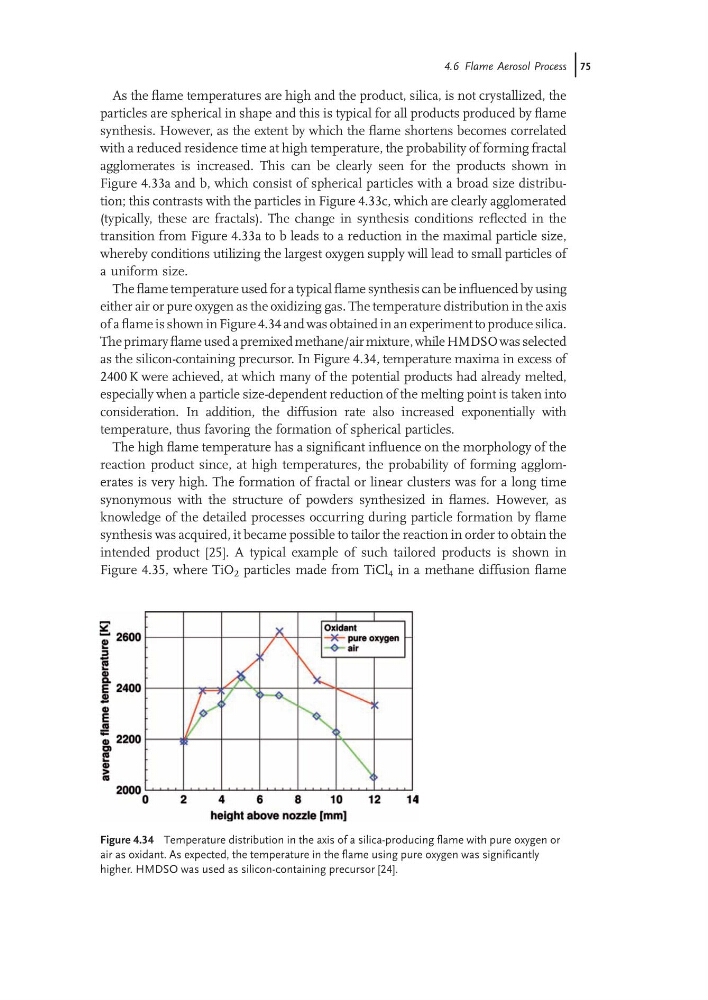
The flame temperature used for a typical flame synthesis can be influenced by using
either air or pure oxygen as the oxidizing gas. The temperature distribution in the axis
of a flame is shown in Figure 4.34 and was obtained in an experiment to produce silica.
The primary flame used a premixed methane/air mixture, while HMDSO was selected
as the silicon-containing precursor. In Figure 4.34, temperature maxima in excess of
2400 K were achieved, at which many of the potential products had already melted,
especially when a particle size-dependent reduction of the melting point is taken into
consideration. In addition, the diffusion rate also increased exponentially with
temperature, thus favoring the formation of spherical particles.
The high flame temperature has a significant influence on the morphology of the
reaction product since, at high temperatures, the probability of forming agglomerates is very high. The formation of fractal or linear clusters was for a long time
synonymous with the structure of powders synthesized in flames. However, as
knowledge of the detailed processes occurring during particle formation by flame
synthesis was acquired, it became possible to tailor the reaction in order to obtain the
intended product [25]. A typical example of such tailored products is shown in
Figure 4.35, where TiO 2 particles made from TiCl 4 in a methane diffusion flame
Figure 4.34 Temperature distribution in the axis of a silica-producing flame with pure oxygen or
air as oxidant. As expected, the temperature in the flame using pure oxygen was significantly
higher. HMDSO was used as silicon-containing precursor [24].
4.6 Flame Aerosol Process j75
particles are spherical in shape and this is typical for all products produced by flame
synthesis. However, as the extent by which the flame shortens becomes correlated
with a reduced residence time at high temperature, the probability of forming fractal
agglomerates is increased. This can be clearly seen for the products shown in
Figure 4.33a and b, which consist of spherical particles with a broad size distribution; this contrasts with the particles in Figure 4.33c, which are clearly agglomerated
(typically, these are fractals). The change in synthesis conditions reflected in the
transition from Figure 4.33a to b leads to a reduction in the maximal particle size,
whereby conditions utilizing the largest oxygen supply will lead to small particles of
a uniform size.
The flame temperature used for a typical flame synthesis can be influenced by using
either air or pure oxygen as the oxidizing gas. The temperature distribution in the axis
of a flame is shown in Figure 4.34 and was obtained in an experiment to produce silica.
The primary flame used a premixed methane/air mixture, while HMDSO was selected
as the silicon-containing precursor. In Figure 4.34, temperature maxima in excess of
2400 K were achieved, at which many of the potential products had already melted,
especially when a particle size-dependent reduction of the melting point is taken into
consideration. In addition, the diffusion rate also increased exponentially with
temperature, thus favoring the formation of spherical particles.
The high flame temperature has a significant influence on the morphology of the
reaction product since, at high temperatures, the probability of forming agglomerates is very high. The formation of fractal or linear clusters was for a long time
synonymous with the structure of powders synthesized in flames. However, as
knowledge of the detailed processes occurring during particle formation by flame
synthesis was acquired, it became possible to tailor the reaction in order to obtain the
intended product [25]. A typical example of such tailored products is shown in
Figure 4.35, where TiO 2 particles made from TiCl 4 in a methane diffusion flame
Figure 4.34 Temperature distribution in the axis of a silica-producing flame with pure oxygen or
air as oxidant. As expected, the temperature in the flame using pure oxygen was significantly
higher. HMDSO was used as silicon-containing precursor [24].
4.6 Flame Aerosol Process j75