

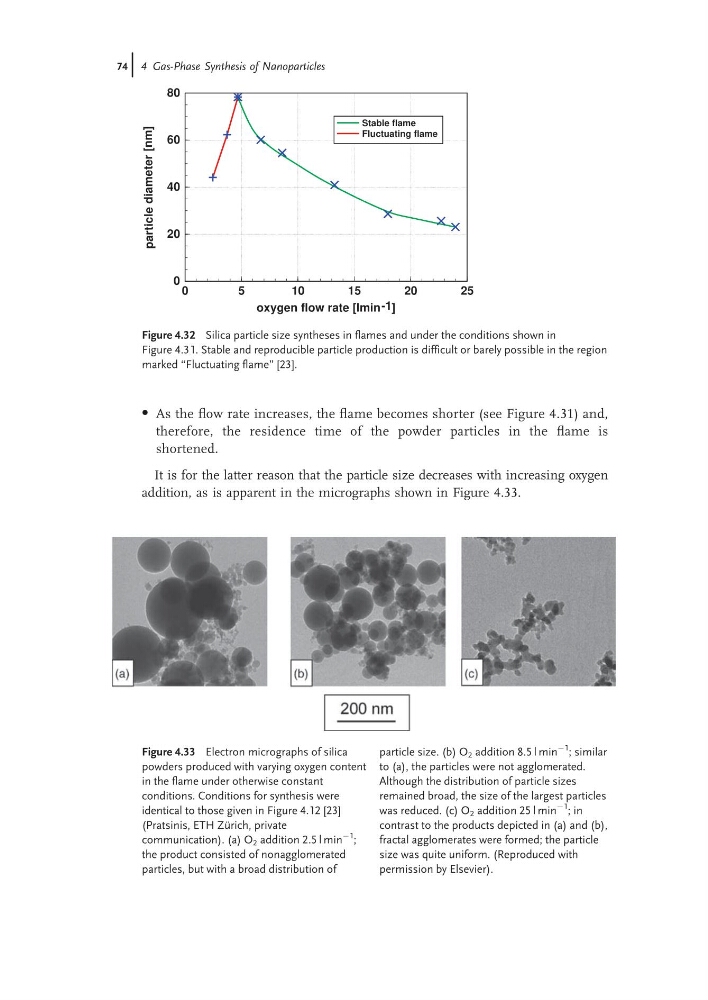
As the flow rate increases, the flame becomes shorter (see Figure 4.31) and,
therefore, the residence time of the powder particles in the flame is
shortened.
It is for the latter reason that the particle size decreases with increasing oxygen
addition, as is apparent in the micrographs shown in Figure 4.33.
0
5
10
15
20
25
oxygen flow rate [lmin -1 ]
0
20
40
60
80
particle
diameter
[nm]
Stable flame
Fluctuating flame
Figure 4.32 Silica particle size syntheses in flames and under the conditions shown in
Figure 4.31. Stable and reproducible particle production is difficult or barely possible in the region
marked “Fluctuating flame” [23].
Figure 4.33 Electron micrographs of silica
powders produced with varying oxygen content
in the flame under otherwise constant
conditions. Conditions for synthesis were
identical to those given in Figure 4.12 [23]
(Pratsinis, ETH Zürich, private
communication). (a) O 2 addition 2.5 l min
À1 ;
the product consisted of nonagglomerated
particles, but with a broad distribution of
particle size. (b) O 2 addition 8.5 l min
À1 ; similar
to (a), the particles were not agglomerated.
Although the distribution of particle sizes
remained broad, the size of the largest particles
was reduced. (c) O 2 addition 25 l min
À1 ; in
contrast to the products depicted in (a) and (b),
fractal agglomerates were formed; the particle
size was quite uniform. (Reproduced with
permission by Elsevier).
74j 4 Gas-Phase Synthesis of Nanoparticles
therefore, the residence time of the powder particles in the flame is
shortened.
It is for the latter reason that the particle size decreases with increasing oxygen
addition, as is apparent in the micrographs shown in Figure 4.33.
0
5
10
15
20
25
oxygen flow rate [lmin -1 ]
0
20
40
60
80
particle
diameter
[nm]
Stable flame
Fluctuating flame
Figure 4.32 Silica particle size syntheses in flames and under the conditions shown in
Figure 4.31. Stable and reproducible particle production is difficult or barely possible in the region
marked “Fluctuating flame” [23].
Figure 4.33 Electron micrographs of silica
powders produced with varying oxygen content
in the flame under otherwise constant
conditions. Conditions for synthesis were
identical to those given in Figure 4.12 [23]
(Pratsinis, ETH Zürich, private
communication). (a) O 2 addition 2.5 l min
À1 ;
the product consisted of nonagglomerated
particles, but with a broad distribution of
particle size. (b) O 2 addition 8.5 l min
À1 ; similar
to (a), the particles were not agglomerated.
Although the distribution of particle sizes
remained broad, the size of the largest particles
was reduced. (c) O 2 addition 25 l min
À1 ; in
contrast to the products depicted in (a) and (b),
fractal agglomerates were formed; the particle
size was quite uniform. (Reproduced with
permission by Elsevier).
74j 4 Gas-Phase Synthesis of Nanoparticles