

particles. Further, this result excludes thermal electron emission as a mechanism to
limit particle size and, therefore, special arrangements must be designed to exploit
this phenomenon. Size limitations by charging the particles are observed for the
microwave plasma process and special variants of the flame synthesis process, both
of which are described later in this chapter.
4.2
Inert Gas Condensation Process
Historically, the most important – and certainly the oldest – process for synthesizing
nanoparticles in the gas phase is that of inert gas condensation [5]. This process
applies thermal evaporation to a metal within a vacuum chamber filled with a small
amount of inert gas. For example, in order to produce gold nanoparticles, gold is
evaporated in a “boat” that is heated to a sufficiently high temperature. The atoms of
gold vapor that emanate from the boat collide with atoms of the inert gas, losing
energy with each collision, and the gold vapor is increasingly thermalized. The
thermalized gold atoms are now able to collide with other atoms of the same type,
leading to nucleation and subsequently to particle formation. The particles formed
in the gas phase drift by thermophoresis (¼ thermal diffusion) to a cold finger,
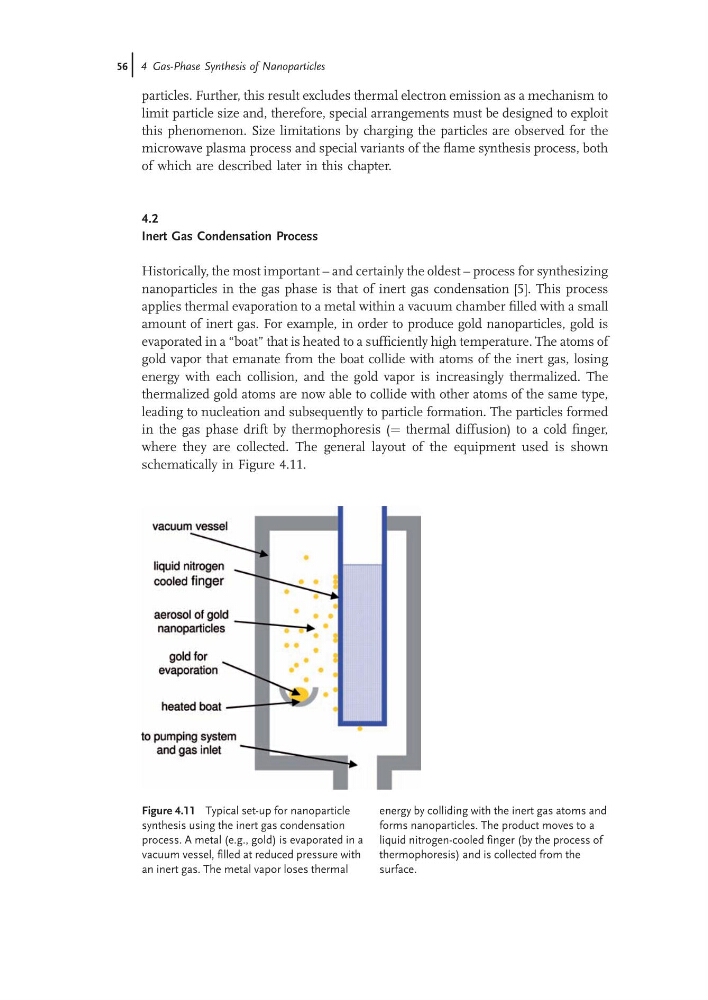
where they are collected. The general layout of the equipment used is shown
schematically in Figure 4.11.
Figure 4.11 Typical set-up for nanoparticle
synthesis using the inert gas condensation
process. A metal (e.g., gold) is evaporated in a
vacuum vessel, filled at reduced pressure with
an inert gas. The metal vapor loses thermal
energy by colliding with the inert gas atoms and
forms nanoparticles. The product moves to a
liquid nitrogen-cooled finger (by the process of
thermophoresis) and is collected from the
surface.
56j 4 Gas-Phase Synthesis of Nanoparticles
limit particle size and, therefore, special arrangements must be designed to exploit
this phenomenon. Size limitations by charging the particles are observed for the
microwave plasma process and special variants of the flame synthesis process, both
of which are described later in this chapter.
4.2
Inert Gas Condensation Process
Historically, the most important – and certainly the oldest – process for synthesizing
nanoparticles in the gas phase is that of inert gas condensation [5]. This process
applies thermal evaporation to a metal within a vacuum chamber filled with a small
amount of inert gas. For example, in order to produce gold nanoparticles, gold is
evaporated in a “boat” that is heated to a sufficiently high temperature. The atoms of
gold vapor that emanate from the boat collide with atoms of the inert gas, losing
energy with each collision, and the gold vapor is increasingly thermalized. The
thermalized gold atoms are now able to collide with other atoms of the same type,
leading to nucleation and subsequently to particle formation. The particles formed
in the gas phase drift by thermophoresis (¼ thermal diffusion) to a cold finger,
where they are collected. The general layout of the equipment used is shown
schematically in Figure 4.11.
Figure 4.11 Typical set-up for nanoparticle
synthesis using the inert gas condensation
process. A metal (e.g., gold) is evaporated in a
vacuum vessel, filled at reduced pressure with
an inert gas. The metal vapor loses thermal
energy by colliding with the inert gas atoms and
forms nanoparticles. The product moves to a
liquid nitrogen-cooled finger (by the process of
thermophoresis) and is collected from the
surface.
56j 4 Gas-Phase Synthesis of Nanoparticles