

Following a production cycle, the metal particles are carefully scraped from the
cold finger; this design allows further processing of the product without breaking the
extremely pure vacuum conditions. In order to obtain oxides, small quantities of
oxygen are introduced into the system before scraping the powder from the cold
finger, such that the metal powder is oxidized very slowly. Care must be taken as
rapid oxidation leads to overheating and sintering of the product. As the formation
of the particles is a purely random process, the inert gas evaporation process typically
leads to a product with a broad particle size distribution.
4.3
Physical and Chemical Vapor Synthesis Processes
The basic principle of the inert gas condensation process leads to many variants, as
the systems employed differ in how the metal is introduced and subsequently
evaporated. One of the most interesting possibilities is heating with an electron
beam [6]. The technical up-scaling of an inert gas condensation process may lead to
the introduction of elements that limit particle size growth. However, two possible
measures exist by which particle size and particle size distribution may be controlled: (i) a reduction of the residence time of the particles in the reaction zone and
(ii) rapid cooling of the particles (“quenching”) after they have left the reaction zone.
For both measures the original diffusion-controlled process as shown in Figure 4.11
is not applicable. Rather, it is necessary to replace transport via thermal diffusion
with transport using a carrier gas. When used as a heat source for mass production,
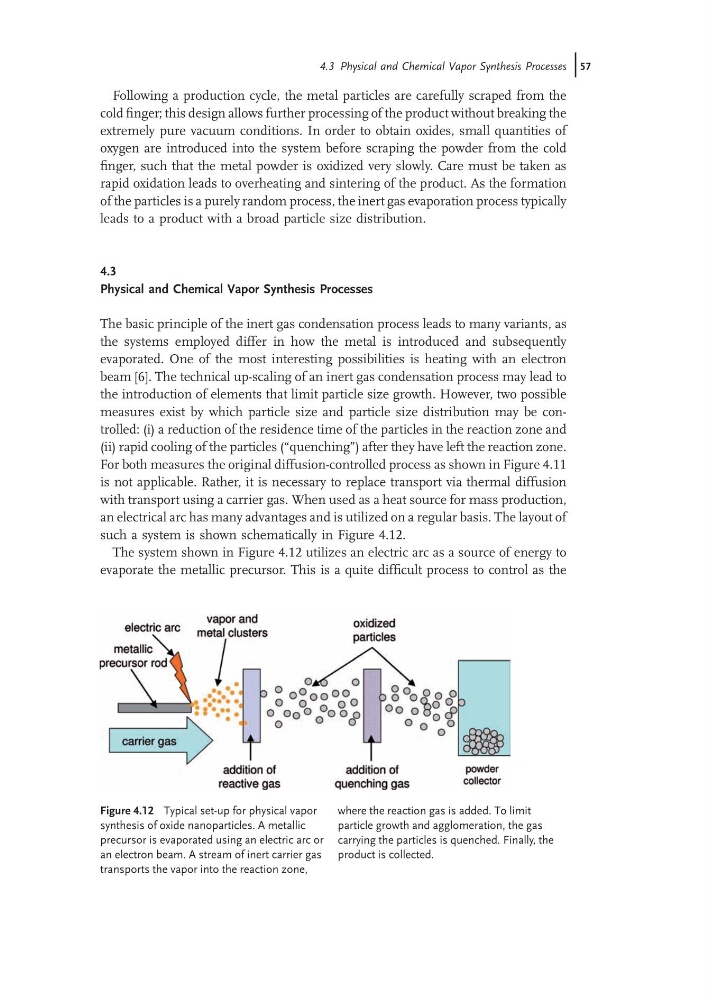
an electrical arc has many advantages and is utilized on a regular basis. The layout of
such a system is shown schematically in Figure 4.12.
The system shown in Figure 4.12 utilizes an electric arc as a source of energy to
evaporate the metallic precursor. This is a quite difficult process to control as the
Figure 4.12 Typical set-up for physical vapor
synthesis of oxide nanoparticles. A metallic
precursor is evaporated using an electric arc or
an electron beam. A stream of inert carrier gas
transports the vapor into the reaction zone,
where the reaction gas is added. To limit
particle growth and agglomeration, the gas
carrying the particles is quenched. Finally, the
product is collected.
4.3 Physical and Chemical Vapor Synthesis Processes j57
cold finger; this design allows further processing of the product without breaking the
extremely pure vacuum conditions. In order to obtain oxides, small quantities of
oxygen are introduced into the system before scraping the powder from the cold
finger, such that the metal powder is oxidized very slowly. Care must be taken as
rapid oxidation leads to overheating and sintering of the product. As the formation
of the particles is a purely random process, the inert gas evaporation process typically
leads to a product with a broad particle size distribution.
4.3
Physical and Chemical Vapor Synthesis Processes
The basic principle of the inert gas condensation process leads to many variants, as
the systems employed differ in how the metal is introduced and subsequently
evaporated. One of the most interesting possibilities is heating with an electron
beam [6]. The technical up-scaling of an inert gas condensation process may lead to
the introduction of elements that limit particle size growth. However, two possible
measures exist by which particle size and particle size distribution may be controlled: (i) a reduction of the residence time of the particles in the reaction zone and
(ii) rapid cooling of the particles (“quenching”) after they have left the reaction zone.
For both measures the original diffusion-controlled process as shown in Figure 4.11
is not applicable. Rather, it is necessary to replace transport via thermal diffusion
with transport using a carrier gas. When used as a heat source for mass production,
an electrical arc has many advantages and is utilized on a regular basis. The layout of
such a system is shown schematically in Figure 4.12.
The system shown in Figure 4.12 utilizes an electric arc as a source of energy to
evaporate the metallic precursor. This is a quite difficult process to control as the
Figure 4.12 Typical set-up for physical vapor
synthesis of oxide nanoparticles. A metallic
precursor is evaporated using an electric arc or
an electron beam. A stream of inert carrier gas
transports the vapor into the reaction zone,
where the reaction gas is added. To limit
particle growth and agglomeration, the gas
carrying the particles is quenched. Finally, the
product is collected.
4.3 Physical and Chemical Vapor Synthesis Processes j57