

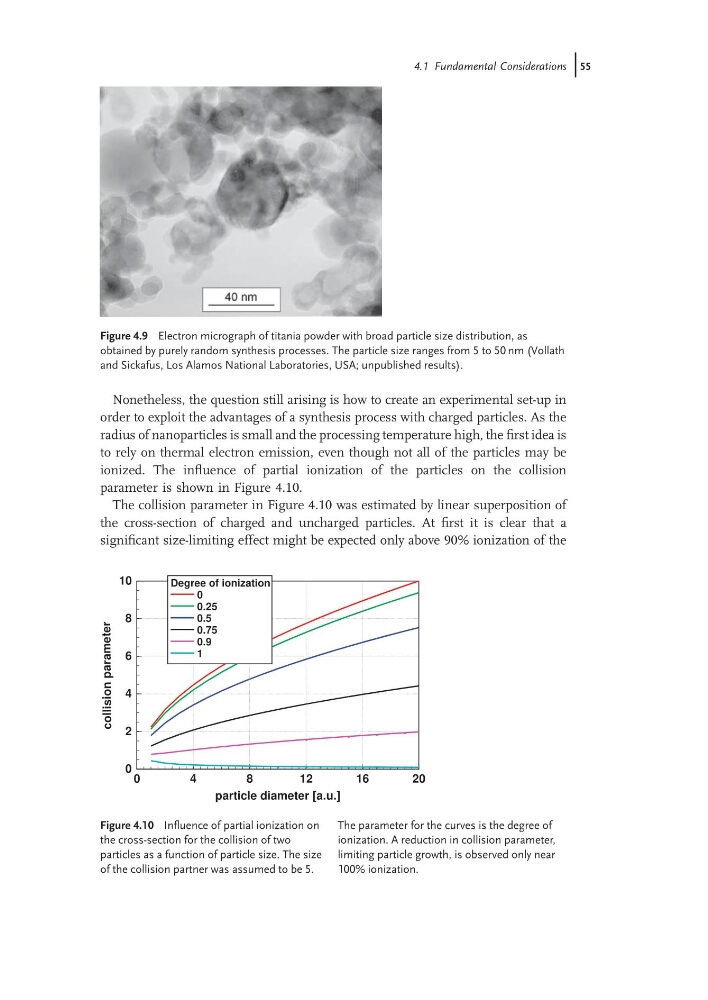
Nonetheless, the question still arising is how to create an experimental set-up in
order to exploit the advantages of a synthesis process with charged particles. As the
radius of nanoparticles is small and the processing temperature high, the first idea is
to rely on thermal electron emission, even though not all of the particles may be
ionized. The influence of partial ionization of the particles on the collision
parameter is shown in Figure 4.10.
The collision parameter in Figure 4.10 was estimated by linear superposition of
the cross-section of charged and uncharged particles. At first it is clear that a
significant size-limiting effect might be expected only above 90% ionization of the
Figure 4.9 Electron micrograph of titania powder with broad particle size distribution, as
obtained by purely random synthesis processes. The particle size ranges from 5 to 50 nm (Vollath
and Sickafus, Los Alamos National Laboratories, USA; unpublished results).
0
4
8
12
16
20
particle diameter [a.u.]
0
2
4
6
8
10
collision
parameter
Degree of ionization
0
0.25
0.5
0.75
0.9
1
Figure 4.10 Influence of partial ionization on
the cross-section for the collision of two
particles as a function of particle size. The size
of the collision partner was assumed to be 5.
The parameter for the curves is the degree of
ionization. A reduction in collision parameter,
limiting particle growth, is observed only near
100% ionization.
4.1 Fundamental Considerations j55
order to exploit the advantages of a synthesis process with charged particles. As the
radius of nanoparticles is small and the processing temperature high, the first idea is
to rely on thermal electron emission, even though not all of the particles may be
ionized. The influence of partial ionization of the particles on the collision
parameter is shown in Figure 4.10.
The collision parameter in Figure 4.10 was estimated by linear superposition of
the cross-section of charged and uncharged particles. At first it is clear that a
significant size-limiting effect might be expected only above 90% ionization of the
Figure 4.9 Electron micrograph of titania powder with broad particle size distribution, as
obtained by purely random synthesis processes. The particle size ranges from 5 to 50 nm (Vollath
and Sickafus, Los Alamos National Laboratories, USA; unpublished results).
0
4
8
12
16
20
particle diameter [a.u.]
0
2
4
6
8
10
collision
parameter
Degree of ionization
0
0.25
0.5
0.75
0.9
1
Figure 4.10 Influence of partial ionization on
the cross-section for the collision of two
particles as a function of particle size. The size
of the collision partner was assumed to be 5.
The parameter for the curves is the degree of
ionization. A reduction in collision parameter,
limiting particle growth, is observed only near
100% ionization.
4.1 Fundamental Considerations j55