

increases. The same argument is valid for the particle size. However, as the velocity
of the particles decreases with increasing particle mass, this increase is less
pronounced than expected intuitively. When considering the probability of the
collision of two particles with diameters d 1 and d 2 , one first seeks the probability of
finding these particles in the time interval Dt in the same volume element:
p 1À2 ¼ p 1 p 2 ¼ k
2 d 1 T
ð
Þ
0:5 d 2 T
ð
Þ
0:5 ¼ k 1 Tðd 1 d 2 Þ
0:5
ð4:5Þ
where k 1 is a constant value. In the following section, constant values that are
independent of essential parameters will be denoted consecutively as k i with i 2 N.
In order to obtain the collision probability, one must multiply the probability defined
with Eq. (4.4) by the concentration of particles with diameters d 1 and d 2 . Clearly, the
term d 1 d 2
ð
Þ
0:5 controls the collision of two particles with different diameters. In a
simplified manner, as this parameter depends only on the geometry of the particles
it is called the “collision parameter.” Equation (4.5) shows that the collision
probability increases linearly with temperature; therefore, in order to obtain nanoparticles – which means minimizing particle growth by coagulation – the temperature must be reduced as much as possible.
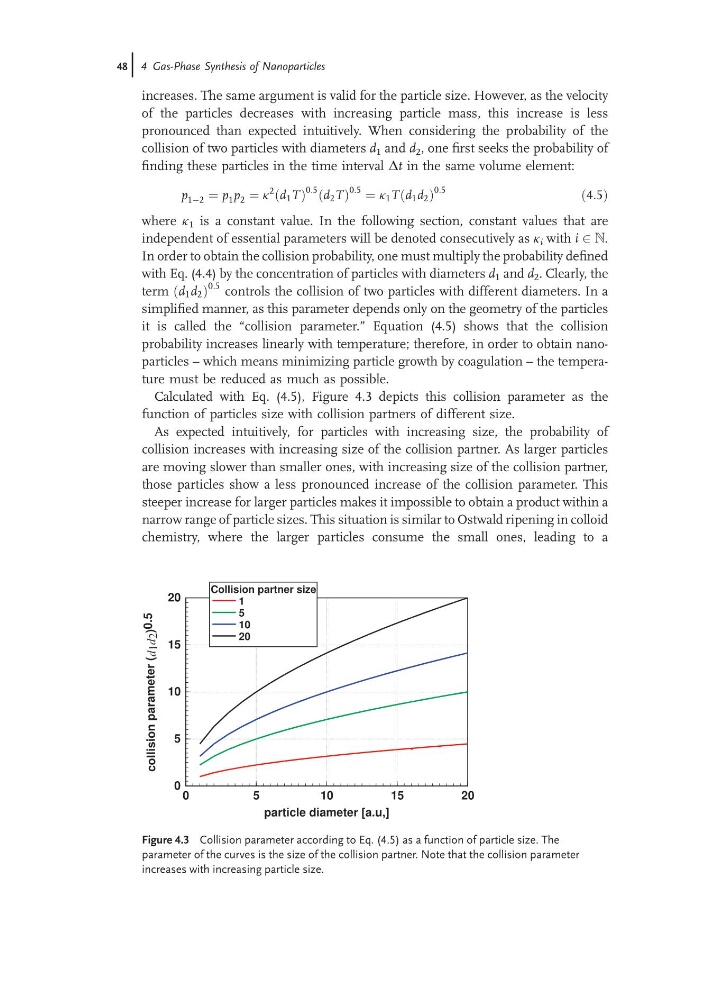
Calculated with Eq. (4.5), Figure 4.3 depicts this collision parameter as the
function of particles size with collision partners of different size.
As expected intuitively, for particles with increasing size, the probability of
collision increases with increasing size of the collision partner. As larger particles
are moving slower than smaller ones, with increasing size of the collision partner,
those particles show a less pronounced increase of the collision parameter. This
steeper increase for larger particles makes it impossible to obtain a product within a
narrow range of particle sizes. This situation is similar to Ostwald ripening in colloid
chemistry, where the larger particles consume the small ones, leading to a
0
5
10
15
20
particle diameter [a.u,]
0
5
10
15
20
collision
parameter
(d 1
d 2
)
0.5
Collision partner size
1
5
10
20
Figure 4.3 Collision parameter according to Eq. (4.5) as a function of particle size. The
parameter of the curves is the size of the collision partner. Note that the collision parameter
increases with increasing particle size.
48j 4 Gas-Phase Synthesis of Nanoparticles
of the particles decreases with increasing particle mass, this increase is less
pronounced than expected intuitively. When considering the probability of the
collision of two particles with diameters d 1 and d 2 , one first seeks the probability of
finding these particles in the time interval Dt in the same volume element:
p 1À2 ¼ p 1 p 2 ¼ k
2 d 1 T
ð
Þ
0:5 d 2 T
ð
Þ
0:5 ¼ k 1 Tðd 1 d 2 Þ
0:5
ð4:5Þ
where k 1 is a constant value. In the following section, constant values that are
independent of essential parameters will be denoted consecutively as k i with i 2 N.
In order to obtain the collision probability, one must multiply the probability defined
with Eq. (4.4) by the concentration of particles with diameters d 1 and d 2 . Clearly, the
term d 1 d 2
ð
Þ
0:5 controls the collision of two particles with different diameters. In a
simplified manner, as this parameter depends only on the geometry of the particles
it is called the “collision parameter.” Equation (4.5) shows that the collision
probability increases linearly with temperature; therefore, in order to obtain nanoparticles – which means minimizing particle growth by coagulation – the temperature must be reduced as much as possible.
Calculated with Eq. (4.5), Figure 4.3 depicts this collision parameter as the
function of particles size with collision partners of different size.
As expected intuitively, for particles with increasing size, the probability of
collision increases with increasing size of the collision partner. As larger particles
are moving slower than smaller ones, with increasing size of the collision partner,
those particles show a less pronounced increase of the collision parameter. This
steeper increase for larger particles makes it impossible to obtain a product within a
narrow range of particle sizes. This situation is similar to Ostwald ripening in colloid
chemistry, where the larger particles consume the small ones, leading to a
0
5
10
15
20
particle diameter [a.u,]
0
5
10
15
20
collision
parameter
(d 1
d 2
)
0.5
Collision partner size
1
5
10
20
Figure 4.3 Collision parameter according to Eq. (4.5) as a function of particle size. The
parameter of the curves is the size of the collision partner. Note that the collision parameter
increases with increasing particle size.
48j 4 Gas-Phase Synthesis of Nanoparticles