

disappearance of the small particle fraction and an extension of the particle size
distribution in the direction of the larger ones. As a consequence, particle size
distribution functions of particles produced by a process of random collisions are
always nonsymmetric functions.
In order to obtain a narrower particle size distribution, it is necessary to influence
the process of particle formation in such a way that the simple collision law as
described by Eq. (4.4) no longer rules the system. One of these possibilities has
already been mentioned, in that one can minimize coagulation by reducing the
temperature and stop the process from forming hard agglomerates by quenching
with cold gas directly after particle formation. A further most elegant method of
reducing the probability of coagulation is to load the particles with electrical charges
of equal sign. In this case, the particles would be expected to repel each other.
In the following considerations on the behavior of electrically charged particles,
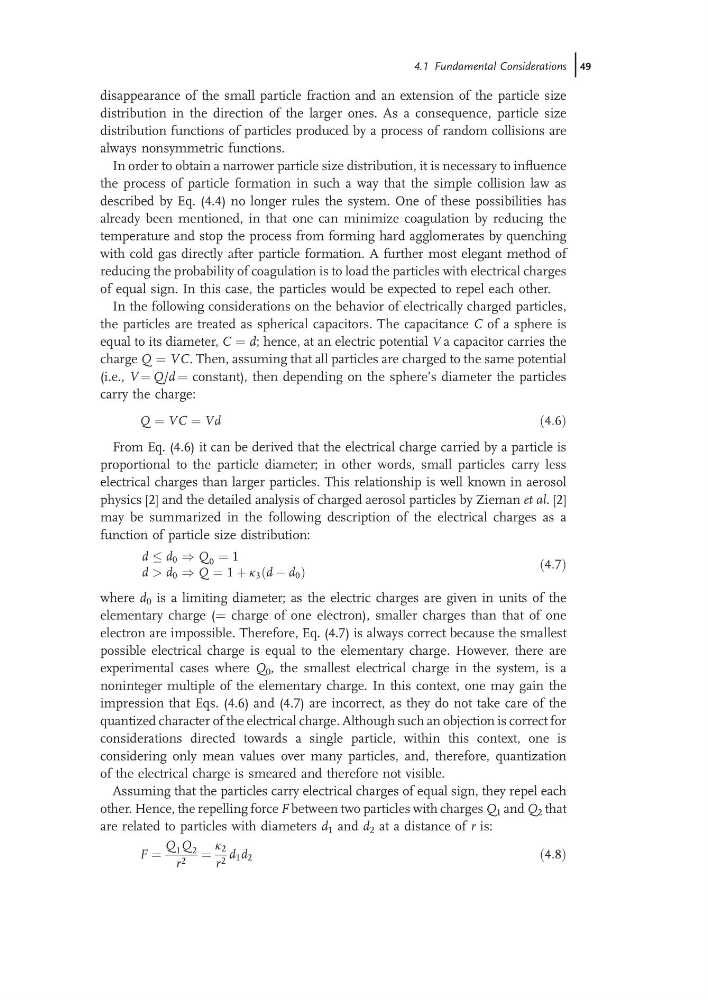
the particles are treated as spherical capacitors. The capacitance C of a sphere is
equal to its diameter, C ¼ d; hence, at an electric potential V a capacitor carries the
charge Q ¼ VC. Then, assuming that all particles are charged to the same potential
(i.e., V ¼ Q/d ¼ constant), then depending on the sphere’s diameter the particles
carry the charge:
Q ¼ VC ¼ Vd
ð4:6Þ
From Eq. (4.6) it can be derived that the electrical charge carried by a particle is
proportional to the particle diameter; in other words, small particles carry less
electrical charges than larger particles. This relationship is well known in aerosol
physics [2] and the detailed analysis of charged aerosol particles by Zieman et al. [2]
may be summarized in the following description of the electrical charges as a
function of particle size distribution:
d d 0 ) Q 0 ¼ 1
d > d 0 ) Q ¼ 1 þ k 3 d À d 0
ð
Þ
ð4:7Þ
where d 0 is a limiting diameter; as the electric charges are given in units of the
elementary charge (¼ charge of one electron), smaller charges than that of one
electron are impossible. Therefore, Eq. (4.7) is always correct because the smallest
possible electrical charge is equal to the elementary charge. However, there are
experimental cases where Q 0 , the smallest electrical charge in the system, is a
noninteger multiple of the elementary charge. In this context, one may gain the
impression that Eqs. (4.6) and (4.7) are incorrect, as they do not take care of the
quantized character of the electrical charge. Although such an objection is correct for
considerations directed towards a single particle, within this context, one is
considering only mean values over many particles, and, therefore, quantization
of the electrical charge is smeared and therefore not visible.
Assuming that the particles carry electrical charges of equal sign, they repel each
other. Hence, the repelling force F between two particles with charges Q 1 and Q 2 that
are related to particles with diameters d 1 and d 2 at a distance of r is:
F ¼
Q 1 Q 2
r 2 ¼
k 2
r 2 d 1 d 2
ð4:8Þ
4.1 Fundamental Considerations j49
distribution in the direction of the larger ones. As a consequence, particle size
distribution functions of particles produced by a process of random collisions are
always nonsymmetric functions.
In order to obtain a narrower particle size distribution, it is necessary to influence
the process of particle formation in such a way that the simple collision law as
described by Eq. (4.4) no longer rules the system. One of these possibilities has
already been mentioned, in that one can minimize coagulation by reducing the
temperature and stop the process from forming hard agglomerates by quenching
with cold gas directly after particle formation. A further most elegant method of
reducing the probability of coagulation is to load the particles with electrical charges
of equal sign. In this case, the particles would be expected to repel each other.
In the following considerations on the behavior of electrically charged particles,
the particles are treated as spherical capacitors. The capacitance C of a sphere is
equal to its diameter, C ¼ d; hence, at an electric potential V a capacitor carries the
charge Q ¼ VC. Then, assuming that all particles are charged to the same potential
(i.e., V ¼ Q/d ¼ constant), then depending on the sphere’s diameter the particles
carry the charge:
Q ¼ VC ¼ Vd
ð4:6Þ
From Eq. (4.6) it can be derived that the electrical charge carried by a particle is
proportional to the particle diameter; in other words, small particles carry less
electrical charges than larger particles. This relationship is well known in aerosol
physics [2] and the detailed analysis of charged aerosol particles by Zieman et al. [2]
may be summarized in the following description of the electrical charges as a
function of particle size distribution:
d d 0 ) Q 0 ¼ 1
d > d 0 ) Q ¼ 1 þ k 3 d À d 0
ð
Þ
ð4:7Þ
where d 0 is a limiting diameter; as the electric charges are given in units of the
elementary charge (¼ charge of one electron), smaller charges than that of one
electron are impossible. Therefore, Eq. (4.7) is always correct because the smallest
possible electrical charge is equal to the elementary charge. However, there are
experimental cases where Q 0 , the smallest electrical charge in the system, is a
noninteger multiple of the elementary charge. In this context, one may gain the
impression that Eqs. (4.6) and (4.7) are incorrect, as they do not take care of the
quantized character of the electrical charge. Although such an objection is correct for
considerations directed towards a single particle, within this context, one is
considering only mean values over many particles, and, therefore, quantization
of the electrical charge is smeared and therefore not visible.
Assuming that the particles carry electrical charges of equal sign, they repel each
other. Hence, the repelling force F between two particles with charges Q 1 and Q 2 that
are related to particles with diameters d 1 and d 2 at a distance of r is:
F ¼
Q 1 Q 2
r 2 ¼
k 2
r 2 d 1 d 2
ð4:8Þ
4.1 Fundamental Considerations j49