

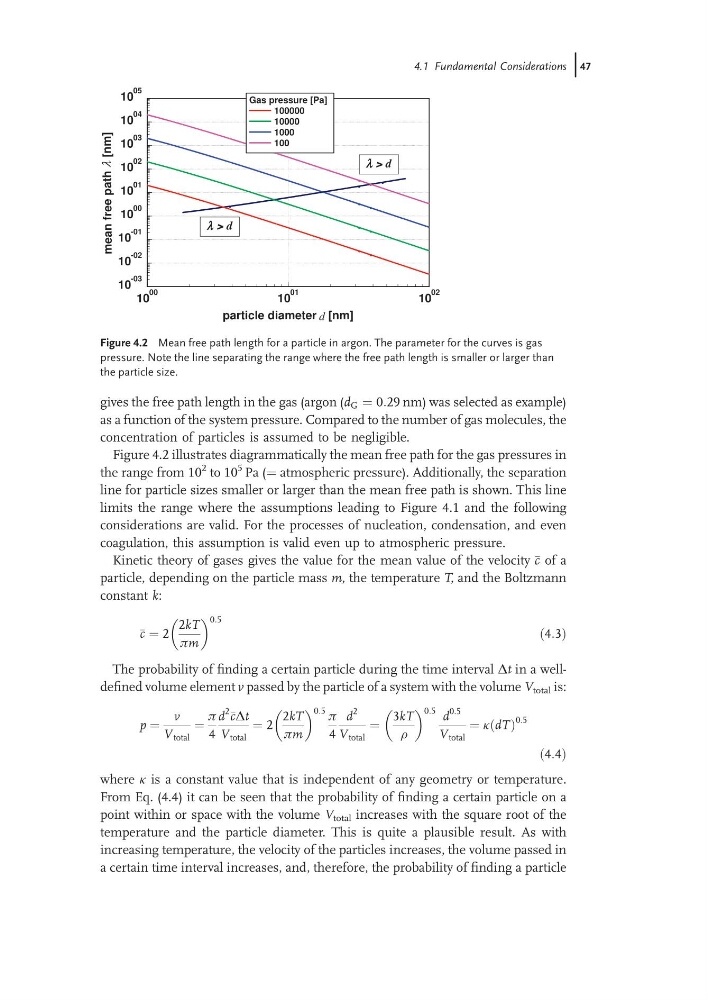
gives the free path length in the gas (argon (d G ¼ 0:29 nm) was selected as example)
as a function of the system pressure. Compared to the number of gas molecules, the
concentration of particles is assumed to be negligible.
Figure 4.2 illustrates diagrammatically the mean free path for the gas pressures in
the range from 10
2 to 10
5 Pa (¼ atmospheric pressure). Additionally, the separation
line for particle sizes smaller or larger than the mean free path is shown. This line
limits the range where the assumptions leading to Figure 4.1 and the following
considerations are valid. For the processes of nucleation, condensation, and even
coagulation, this assumption is valid even up to atmospheric pressure.
Kinetic theory of gases gives the value for the mean value of the velocity c of a
particle, depending on the particle mass m, the temperature T, and the Boltzmann
constant k:
c ¼ 2
2kT
pm
0:5
ð4:3Þ
The probability of finding a certain particle during the time interval Dt in a welldefined volume element v passed by the particle of a system with the volume V total is:
p ¼
v
V total
¼
p
4
d
2 cDt
V total
¼ 2
2kT
pm
0:5 p
4
d
2
V total
¼
3kT
r
0:5 d
0:5
V total
¼ k dT
ð Þ
0:5
ð4:4Þ
where k is a constant value that is independent of any geometry or temperature.
From Eq. (4.4) it can be seen that the probability of finding a certain particle on a
point within or space with the volume V total increases with the square root of the
temperature and the particle diameter. This is quite a plausible result. As with
increasing temperature, the velocity of the particles increases, the volume passed in
a certain time interval increases, and, therefore, the probability of finding a particle
10
00
10
01
10
02
particle diameter d [nm]
10
-03
10
-02
10
-01
10
00
10
01
10
02
10
03
10
04
10
05
mean
free
path
λ [nm]
Gas pressure [Pa]
100000
10000
1000
100
λ > d
λ > d
Figure 4.2 Mean free path length for a particle in argon. The parameter for the curves is gas
pressure. Note the line separating the range where the free path length is smaller or larger than
the particle size.
4.1 Fundamental Considerations j47
as a function of the system pressure. Compared to the number of gas molecules, the
concentration of particles is assumed to be negligible.
Figure 4.2 illustrates diagrammatically the mean free path for the gas pressures in
the range from 10
2 to 10
5 Pa (¼ atmospheric pressure). Additionally, the separation
line for particle sizes smaller or larger than the mean free path is shown. This line
limits the range where the assumptions leading to Figure 4.1 and the following
considerations are valid. For the processes of nucleation, condensation, and even
coagulation, this assumption is valid even up to atmospheric pressure.
Kinetic theory of gases gives the value for the mean value of the velocity c of a
particle, depending on the particle mass m, the temperature T, and the Boltzmann
constant k:
c ¼ 2
2kT
pm
0:5
ð4:3Þ
The probability of finding a certain particle during the time interval Dt in a welldefined volume element v passed by the particle of a system with the volume V total is:
p ¼
v
V total
¼
p
4
d
2 cDt
V total
¼ 2
2kT
pm
0:5 p
4
d
2
V total
¼
3kT
r
0:5 d
0:5
V total
¼ k dT
ð Þ
0:5
ð4:4Þ
where k is a constant value that is independent of any geometry or temperature.
From Eq. (4.4) it can be seen that the probability of finding a certain particle on a
point within or space with the volume V total increases with the square root of the
temperature and the particle diameter. This is quite a plausible result. As with
increasing temperature, the velocity of the particles increases, the volume passed in
a certain time interval increases, and, therefore, the probability of finding a particle
10
00
10
01
10
02
particle diameter d [nm]
10
-03
10
-02
10
-01
10
00
10
01
10
02
10
03
10
04
10
05
mean
free
path
λ [nm]
Gas pressure [Pa]
100000
10000
1000
100
λ > d
λ > d
Figure 4.2 Mean free path length for a particle in argon. The parameter for the curves is gas
pressure. Note the line separating the range where the free path length is smaller or larger than
the particle size.
4.1 Fundamental Considerations j47