

log-normal distribution. However, by quenching or charging the particle with
electrical charges of equal sign, one has the possibility to bias these processes,
to influence the particle size distribution of the product. Although, in the following
sections, some of the most important gas-phase processes used to synthesize
nanoparticles will be described, it is first necessary to recognize how the processes
of condensation and coagulation work.
In order to understand these processes, it is necessary to study the size-dependent
probability of the condensation and coagulation processes [1]. First, one must
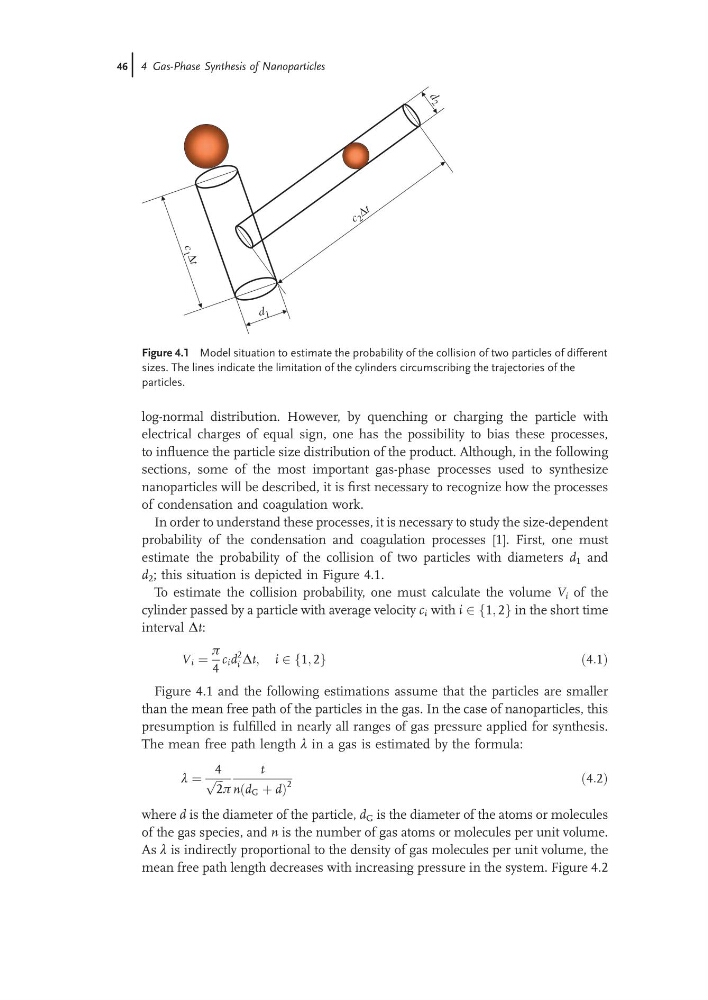
estimate the probability of the collision of two particles with diameters d 1 and
d 2 ; this situation is depicted in Figure 4.1.
To estimate the collision probability, one must calculate the volume V i of the
cylinder passed by a particle with average velocity c i with i 2 1; 2
f gin the short time
interval Dt:
V i ¼
p
4
c i d
2
i Dt; i 2 1; 2
f g
ð4:1Þ
Figure 4.1 and the following estimations assume that the particles are smaller
than the mean free path of the particles in the gas. In the case of nanoparticles, this
presumption is fulfilled in nearly all ranges of gas pressure applied for synthesis.
The mean free path length l in a gas is estimated by the formula:
l ¼
4
ffiffi ffi
2
p p
t
n d G þ d
ð
Þ
2
ð4:2Þ
where d is the diameter of the particle, d G is the diameter of the atoms or molecules
of the gas species, and n is the number of gas atoms or molecules per unit volume.
As l is indirectly proportional to the density of gas molecules per unit volume, the
mean free path length decreases with increasing pressure in the system. Figure 4.2
c 2 Δ t
c1
Δ
t
d 1
d 2
Figure 4.1 Model situation to estimate the probability of the collision of two particles of different
sizes. The lines indicate the limitation of the cylinders circumscribing the trajectories of the
particles.
46j 4 Gas-Phase Synthesis of Nanoparticles
electrical charges of equal sign, one has the possibility to bias these processes,
to influence the particle size distribution of the product. Although, in the following
sections, some of the most important gas-phase processes used to synthesize
nanoparticles will be described, it is first necessary to recognize how the processes
of condensation and coagulation work.
In order to understand these processes, it is necessary to study the size-dependent
probability of the condensation and coagulation processes [1]. First, one must
estimate the probability of the collision of two particles with diameters d 1 and
d 2 ; this situation is depicted in Figure 4.1.
To estimate the collision probability, one must calculate the volume V i of the
cylinder passed by a particle with average velocity c i with i 2 1; 2
f gin the short time
interval Dt:
V i ¼
p
4
c i d
2
i Dt; i 2 1; 2
f g
ð4:1Þ
Figure 4.1 and the following estimations assume that the particles are smaller
than the mean free path of the particles in the gas. In the case of nanoparticles, this
presumption is fulfilled in nearly all ranges of gas pressure applied for synthesis.
The mean free path length l in a gas is estimated by the formula:
l ¼
4
ffiffi ffi
2
p p
t
n d G þ d
ð
Þ
2
ð4:2Þ
where d is the diameter of the particle, d G is the diameter of the atoms or molecules
of the gas species, and n is the number of gas atoms or molecules per unit volume.
As l is indirectly proportional to the density of gas molecules per unit volume, the
mean free path length decreases with increasing pressure in the system. Figure 4.2
c 2 Δ t
c1
Δ
t
d 1
d 2
Figure 4.1 Model situation to estimate the probability of the collision of two particles of different
sizes. The lines indicate the limitation of the cylinders circumscribing the trajectories of the
particles.
46j 4 Gas-Phase Synthesis of Nanoparticles