

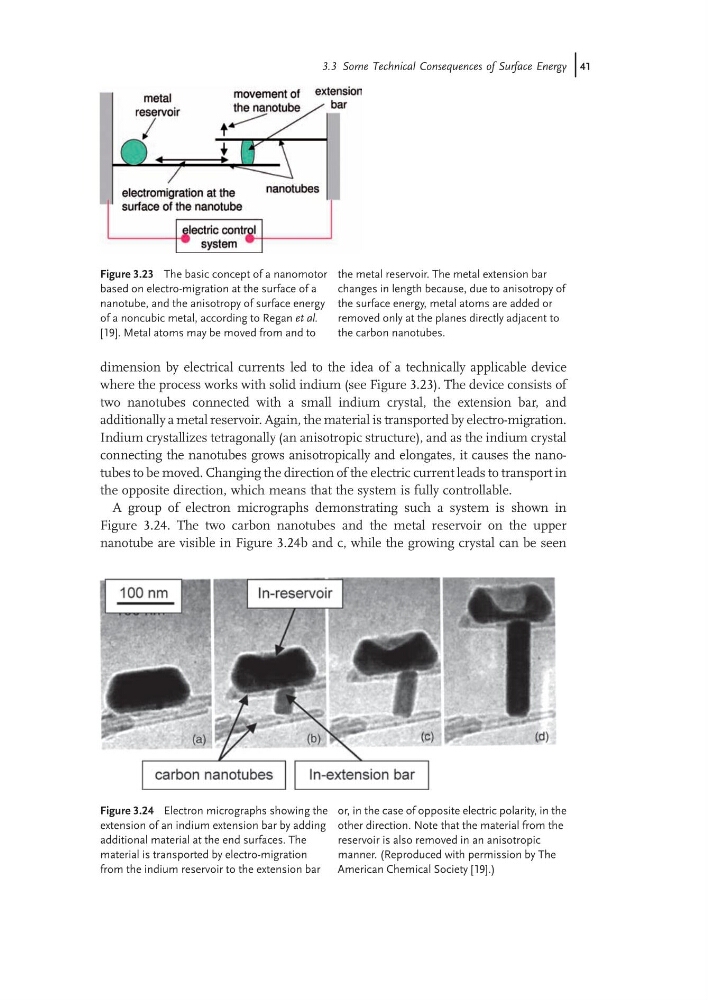
dimension by electrical currents led to the idea of a technically applicable device
where the process works with solid indium (see Figure 3.23). The device consists of
two nanotubes connected with a small indium crystal, the extension bar, and
additionally a metal reservoir. Again, the material is transported by electro-migration.
Indium crystallizes tetragonally (an anisotropic structure), and as the indium crystal
connecting the nanotubes grows anisotropically and elongates, it causes the nanotubes to be moved. Changing the direction of the electric current leads to transport in
the opposite direction, which means that the system is fully controllable.
A group of electron micrographs demonstrating such a system is shown in
Figure 3.24. The two carbon nanotubes and the metal reservoir on the upper
nanotube are visible in Figure 3.24b and c, while the growing crystal can be seen
Figure 3.23 The basic concept of a nanomotor
based on electro-migration at the surface of a
nanotube, and the anisotropy of surface energy
of a noncubic metal, according to Regan et al.
[19]. Metal atoms may be moved from and to
the metal reservoir. The metal extension bar
changes in length because, due to anisotropy of
the surface energy, metal atoms are added or
removed only at the planes directly adjacent to
the carbon nanotubes.
Figure 3.24 Electron micrographs showing the
extension of an indium extension bar by adding
additional material at the end surfaces. The
material is transported by electro-migration
from the indium reservoir to the extension bar
or, in the case of opposite electric polarity, in the
other direction. Note that the material from the
reservoir is also removed in an anisotropic
manner. (Reproduced with permission by The
American Chemical Society [19].)
3.3 Some Technical Consequences of Surface Energy j41
where the process works with solid indium (see Figure 3.23). The device consists of
two nanotubes connected with a small indium crystal, the extension bar, and
additionally a metal reservoir. Again, the material is transported by electro-migration.
Indium crystallizes tetragonally (an anisotropic structure), and as the indium crystal
connecting the nanotubes grows anisotropically and elongates, it causes the nanotubes to be moved. Changing the direction of the electric current leads to transport in
the opposite direction, which means that the system is fully controllable.
A group of electron micrographs demonstrating such a system is shown in
Figure 3.24. The two carbon nanotubes and the metal reservoir on the upper
nanotube are visible in Figure 3.24b and c, while the growing crystal can be seen
Figure 3.23 The basic concept of a nanomotor
based on electro-migration at the surface of a
nanotube, and the anisotropy of surface energy
of a noncubic metal, according to Regan et al.
[19]. Metal atoms may be moved from and to
the metal reservoir. The metal extension bar
changes in length because, due to anisotropy of
the surface energy, metal atoms are added or
removed only at the planes directly adjacent to
the carbon nanotubes.
Figure 3.24 Electron micrographs showing the
extension of an indium extension bar by adding
additional material at the end surfaces. The
material is transported by electro-migration
from the indium reservoir to the extension bar
or, in the case of opposite electric polarity, in the
other direction. Note that the material from the
reservoir is also removed in an anisotropic
manner. (Reproduced with permission by The
American Chemical Society [19].)
3.3 Some Technical Consequences of Surface Energy j41