

evaporation losses, this set-up will oscillate for as long as it is connected to a DC
source.
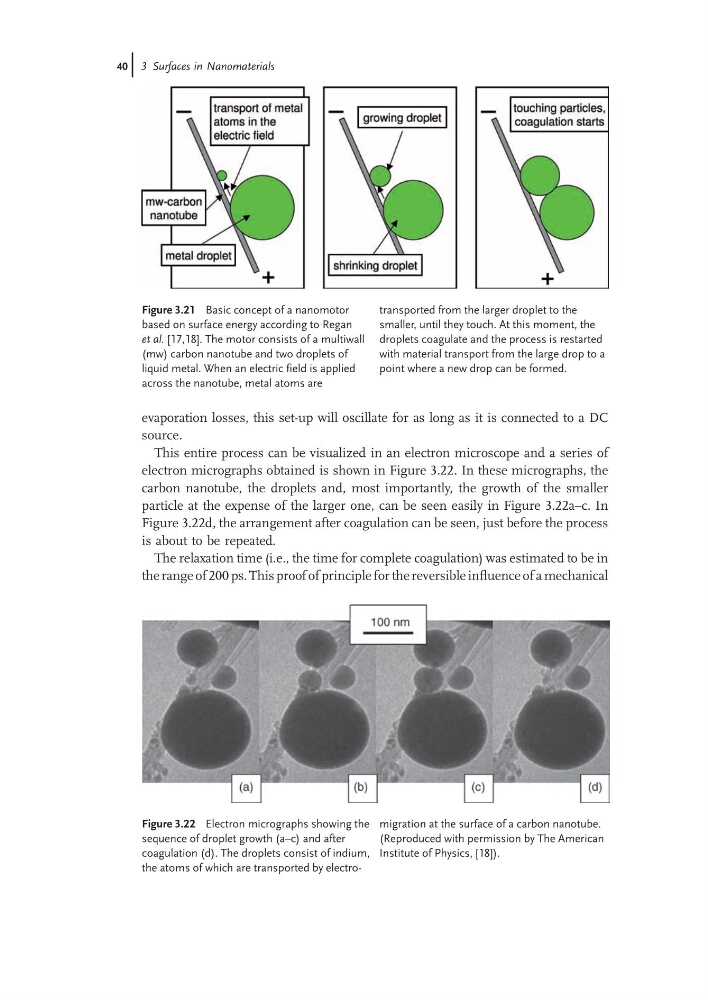
This entire process can be visualized in an electron microscope and a series of
electron micrographs obtained is shown in Figure 3.22. In these micrographs, the
carbon nanotube, the droplets and, most importantly, the growth of the smaller
particle at the expense of the larger one, can be seen easily in Figure 3.22a–c. In
Figure 3.22d, the arrangement after coagulation can be seen, just before the process
is about to be repeated.
The relaxation time (i.e., the time for complete coagulation) was estimated to be in
the range of 200 ps. This proof of principle for the reversible influence of a mechanical
Figure 3.21 Basic concept of a nanomotor
based on surface energy according to Regan
et al. [17,18]. The motor consists of a multiwall
(mw) carbon nanotube and two droplets of
liquid metal. When an electric field is applied
across the nanotube, metal atoms are
transported from the larger droplet to the
smaller, until they touch. At this moment, the
droplets coagulate and the process is restarted
with material transport from the large drop to a
point where a new drop can be formed.
Figure 3.22 Electron micrographs showing the
sequence of droplet growth (a–c) and after
coagulation (d). The droplets consist of indium,
the atoms of which are transported by electromigration at the surface of a carbon nanotube.
(Reproduced with permission by The American
Institute of Physics, [18]).
40j 3 Surfaces in Nanomaterials
source.
This entire process can be visualized in an electron microscope and a series of
electron micrographs obtained is shown in Figure 3.22. In these micrographs, the
carbon nanotube, the droplets and, most importantly, the growth of the smaller
particle at the expense of the larger one, can be seen easily in Figure 3.22a–c. In
Figure 3.22d, the arrangement after coagulation can be seen, just before the process
is about to be repeated.
The relaxation time (i.e., the time for complete coagulation) was estimated to be in
the range of 200 ps. This proof of principle for the reversible influence of a mechanical
Figure 3.21 Basic concept of a nanomotor
based on surface energy according to Regan
et al. [17,18]. The motor consists of a multiwall
(mw) carbon nanotube and two droplets of
liquid metal. When an electric field is applied
across the nanotube, metal atoms are
transported from the larger droplet to the
smaller, until they touch. At this moment, the
droplets coagulate and the process is restarted
with material transport from the large drop to a
point where a new drop can be formed.
Figure 3.22 Electron micrographs showing the
sequence of droplet growth (a–c) and after
coagulation (d). The droplets consist of indium,
the atoms of which are transported by electromigration at the surface of a carbon nanotube.
(Reproduced with permission by The American
Institute of Physics, [18]).
40j 3 Surfaces in Nanomaterials