

the reports of Miedema et al. [14,15], as they provide a consistent set of values for the
surface energy of solid and liquid metals.
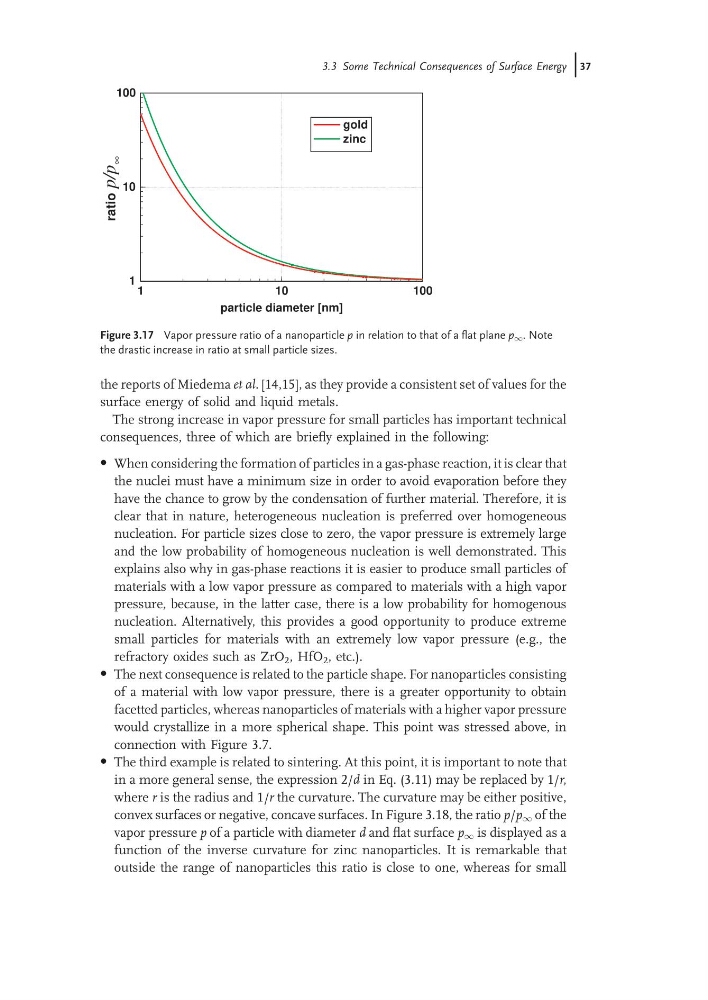
The strong increase in vapor pressure for small particles has important technical
consequences, three of which are briefly explained in the following:
When considering the formation of particles in a gas-phase reaction, it is clear that
the nuclei must have a minimum size in order to avoid evaporation before they
have the chance to grow by the condensation of further material. Therefore, it is
clear that in nature, heterogeneous nucleation is preferred over homogeneous
nucleation. For particle sizes close to zero, the vapor pressure is extremely large
and the low probability of homogeneous nucleation is well demonstrated. This
explains also why in gas-phase reactions it is easier to produce small particles of
materials with a low vapor pressure as compared to materials with a high vapor
pressure, because, in the latter case, there is a low probability for homogenous
nucleation. Alternatively, this provides a good opportunity to produce extreme
small particles for materials with an extremely low vapor pressure (e.g., the
refractory oxides such as ZrO 2 , HfO 2 , etc.).
The next consequence is related to the particle shape. For nanoparticles consisting
of a material with low vapor pressure, there is a greater opportunity to obtain
facetted particles, whereas nanoparticles of materials with a higher vapor pressure
would crystallize in a more spherical shape. This point was stressed above, in
connection with Figure 3.7.
The third example is related to sintering. At this point, it is important to note that
in a more general sense, the expression 2/d in Eq. (3.11) may be replaced by 1/r,
where r is the radius and 1/r the curvature. The curvature may be either positive,
convex surfaces or negative, concave surfaces. In Figure 3.18, the ratio p/p 1 of the
vapor pressure p of a particle with diameter d and flat surface p 1 is displayed as a
function of the inverse curvature for zinc nanoparticles. It is remarkable that
outside the range of nanoparticles this ratio is close to one, whereas for small
1
10
100
particle diameter [nm]
1
10
100
gold
zinc
ratio
p/p
∞
Figure 3.17 Vapor pressure ratio of a nanoparticle p in relation to that of a flat plane p 1 . Note
the drastic increase in ratio at small particle sizes.
3.3 Some Technical Consequences of Surface Energy j37
surface energy of solid and liquid metals.
The strong increase in vapor pressure for small particles has important technical
consequences, three of which are briefly explained in the following:
When considering the formation of particles in a gas-phase reaction, it is clear that
the nuclei must have a minimum size in order to avoid evaporation before they
have the chance to grow by the condensation of further material. Therefore, it is
clear that in nature, heterogeneous nucleation is preferred over homogeneous
nucleation. For particle sizes close to zero, the vapor pressure is extremely large
and the low probability of homogeneous nucleation is well demonstrated. This
explains also why in gas-phase reactions it is easier to produce small particles of
materials with a low vapor pressure as compared to materials with a high vapor
pressure, because, in the latter case, there is a low probability for homogenous
nucleation. Alternatively, this provides a good opportunity to produce extreme
small particles for materials with an extremely low vapor pressure (e.g., the
refractory oxides such as ZrO 2 , HfO 2 , etc.).
The next consequence is related to the particle shape. For nanoparticles consisting
of a material with low vapor pressure, there is a greater opportunity to obtain
facetted particles, whereas nanoparticles of materials with a higher vapor pressure
would crystallize in a more spherical shape. This point was stressed above, in
connection with Figure 3.7.
The third example is related to sintering. At this point, it is important to note that
in a more general sense, the expression 2/d in Eq. (3.11) may be replaced by 1/r,
where r is the radius and 1/r the curvature. The curvature may be either positive,
convex surfaces or negative, concave surfaces. In Figure 3.18, the ratio p/p 1 of the
vapor pressure p of a particle with diameter d and flat surface p 1 is displayed as a
function of the inverse curvature for zinc nanoparticles. It is remarkable that
outside the range of nanoparticles this ratio is close to one, whereas for small
1
10
100
particle diameter [nm]
1
10
100
gold
zinc
ratio
p/p
∞
Figure 3.17 Vapor pressure ratio of a nanoparticle p in relation to that of a flat plane p 1 . Note
the drastic increase in ratio at small particle sizes.
3.3 Some Technical Consequences of Surface Energy j37