

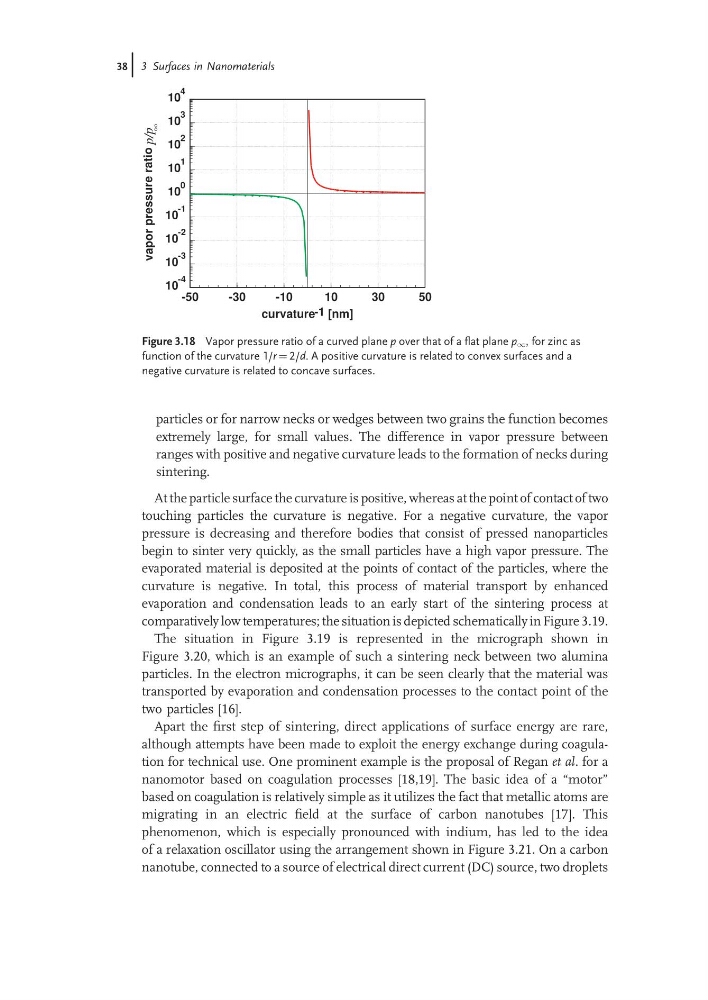
particles or for narrow necks or wedges between two grains the function becomes
extremely large, for small values. The difference in vapor pressure between
ranges with positive and negative curvature leads to the formation of necks during
sintering.
At the particle surface the curvature is positive, whereas at the point of contact of two
touching particles the curvature is negative. For a negative curvature, the vapor
pressure is decreasing and therefore bodies that consist of pressed nanoparticles
begin to sinter very quickly, as the small particles have a high vapor pressure. The
evaporated material is deposited at the points of contact of the particles, where the
curvature is negative. In total, this process of material transport by enhanced
evaporation and condensation leads to an early start of the sintering process at
comparatively low temperatures; the situation is depicted schematically in Figure 3.19.
The situation in Figure 3.19 is represented in the micrograph shown in
Figure 3.20, which is an example of such a sintering neck between two alumina
particles. In the electron micrographs, it can be seen clearly that the material was
transported by evaporation and condensation processes to the contact point of the
two particles [16].
Apart the first step of sintering, direct applications of surface energy are rare,
although attempts have been made to exploit the energy exchange during coagulation for technical use. One prominent example is the proposal of Regan et al. for a
nanomotor based on coagulation processes [18,19]. The basic idea of a “motor”
based on coagulation is relatively simple as it utilizes the fact that metallic atoms are
migrating in an electric field at the surface of carbon nanotubes [17]. This
phenomenon, which is especially pronounced with indium, has led to the idea
of a relaxation oscillator using the arrangement shown in Figure 3.21. On a carbon
nanotube, connected to a source of electrical direct current (DC) source, two droplets
-50
-30
-10
10
30
50
curvature -1 [nm]
10
-4
10
-3
10
-2
10
-1
10
0
10
1
10
2
10
3
10
4
vapor
pressure
ratio p/p ∞
Figure 3.18 Vapor pressure ratio of a curved plane p over that of a flat plane p 1 , for zinc as
function of the curvature 1/r ¼ 2/d. A positive curvature is related to convex surfaces and a
negative curvature is related to concave surfaces.
38j 3 Surfaces in Nanomaterials
extremely large, for small values. The difference in vapor pressure between
ranges with positive and negative curvature leads to the formation of necks during
sintering.
At the particle surface the curvature is positive, whereas at the point of contact of two
touching particles the curvature is negative. For a negative curvature, the vapor
pressure is decreasing and therefore bodies that consist of pressed nanoparticles
begin to sinter very quickly, as the small particles have a high vapor pressure. The
evaporated material is deposited at the points of contact of the particles, where the
curvature is negative. In total, this process of material transport by enhanced
evaporation and condensation leads to an early start of the sintering process at
comparatively low temperatures; the situation is depicted schematically in Figure 3.19.
The situation in Figure 3.19 is represented in the micrograph shown in
Figure 3.20, which is an example of such a sintering neck between two alumina
particles. In the electron micrographs, it can be seen clearly that the material was
transported by evaporation and condensation processes to the contact point of the
two particles [16].
Apart the first step of sintering, direct applications of surface energy are rare,
although attempts have been made to exploit the energy exchange during coagulation for technical use. One prominent example is the proposal of Regan et al. for a
nanomotor based on coagulation processes [18,19]. The basic idea of a “motor”
based on coagulation is relatively simple as it utilizes the fact that metallic atoms are
migrating in an electric field at the surface of carbon nanotubes [17]. This
phenomenon, which is especially pronounced with indium, has led to the idea
of a relaxation oscillator using the arrangement shown in Figure 3.21. On a carbon
nanotube, connected to a source of electrical direct current (DC) source, two droplets
-50
-30
-10
10
30
50
curvature -1 [nm]
10
-4
10
-3
10
-2
10
-1
10
0
10
1
10
2
10
3
10
4
vapor
pressure
ratio p/p ∞
Figure 3.18 Vapor pressure ratio of a curved plane p over that of a flat plane p 1 , for zinc as
function of the curvature 1/r ¼ 2/d. A positive curvature is related to convex surfaces and a
negative curvature is related to concave surfaces.
38j 3 Surfaces in Nanomaterials