

This hydrostatic pressure p in a particle (as depicted in Figure 3.13) causes a
hydrostatic stress s
à and a strain e
à constant in the particle. The strain energy
per particle is e
Ã
s
Ã
n=2 or e
Ã
s
Ã
M= 2r
ð Þ the strain energy per mole. By setting
e
Ã
¼ s
Ã
=K and s
Ã
¼ p ¼ 4s=d (K is the bulk modulus or K ¼ 1=K ¼ E=ð3 1 À 2n
ð
ÞÞ ,
where E is Young’s modulus, n is the Poisson number, and k is compressibility),
one obtains for the strain energy of small spherical particles:
U strain ¼
1
2K
4c
d
2 M
r
¼
3 1 À 2n
ð
Þ
2E
4s
d
2 M
r
ð3:9Þ
In contrast to other formulae describing the influence of surface phenomena on
thermodynamic quanta, the strain energy depends inversely on the square of the
particle size and therefore a significant influence is expected only for very small
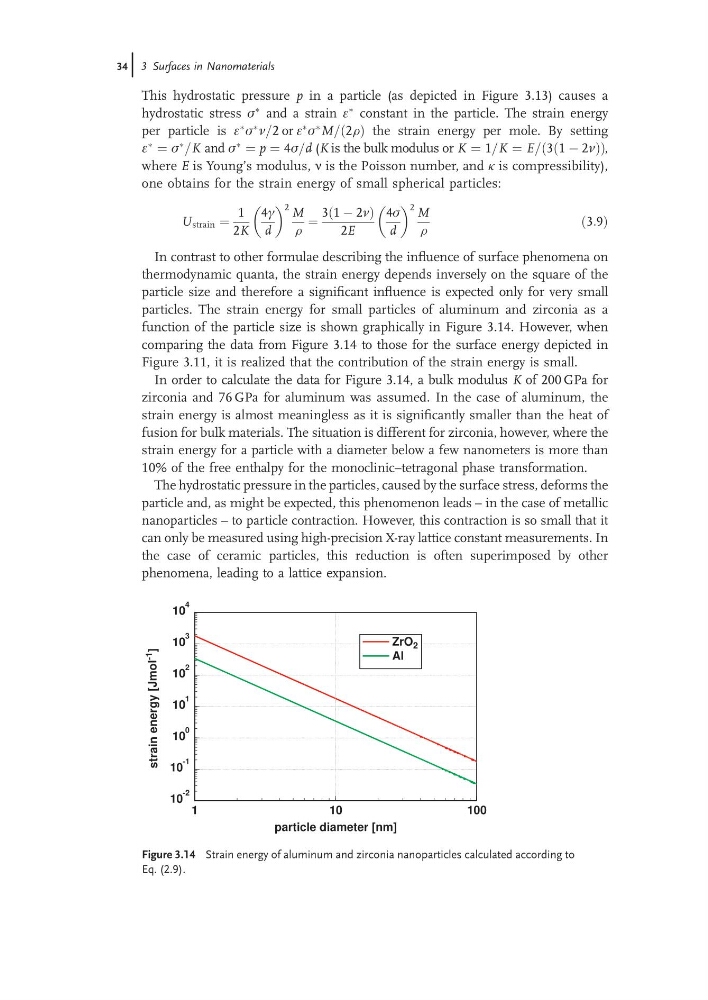
particles. The strain energy for small particles of aluminum and zirconia as a
function of the particle size is shown graphically in Figure 3.14. However, when
comparing the data from Figure 3.14 to those for the surface energy depicted in
Figure 3.11, it is realized that the contribution of the strain energy is small.
In order to calculate the data for Figure 3.14, a bulk modulus K of 200 GPa for
zirconia and 76 GPa for aluminum was assumed. In the case of aluminum, the
strain energy is almost meaningless as it is significantly smaller than the heat of
fusion for bulk materials. The situation is different for zirconia, however, where the
strain energy for a particle with a diameter below a few nanometers is more than
10% of the free enthalpy for the monoclinic–tetragonal phase transformation.
The hydrostatic pressure in the particles, caused by the surface stress, deforms the
particle and, as might be expected, this phenomenon leads – in the case of metallic
nanoparticles – to particle contraction. However, this contraction is so small that it
can only be measured using high-precision X-ray lattice constant measurements. In
the case of ceramic particles, this reduction is often superimposed by other
phenomena, leading to a lattice expansion.
1
10
100
particle diameter [nm]
10
-2
10
-1
10
0
10
1
10
2
10
3
10
4
strain
energy
[Jmol
-1 ]
ZrO 2
Al
Figure 3.14 Strain energy of aluminum and zirconia nanoparticles calculated according to
Eq. (2.9).
34j 3 Surfaces in Nanomaterials
hydrostatic stress s
à and a strain e
à constant in the particle. The strain energy
per particle is e
Ã
s
Ã
n=2 or e
Ã
s
Ã
M= 2r
ð Þ the strain energy per mole. By setting
e
Ã
¼ s
Ã
=K and s
Ã
¼ p ¼ 4s=d (K is the bulk modulus or K ¼ 1=K ¼ E=ð3 1 À 2n
ð
ÞÞ ,
where E is Young’s modulus, n is the Poisson number, and k is compressibility),
one obtains for the strain energy of small spherical particles:
U strain ¼
1
2K
4c
d
2 M
r
¼
3 1 À 2n
ð
Þ
2E
4s
d
2 M
r
ð3:9Þ
In contrast to other formulae describing the influence of surface phenomena on
thermodynamic quanta, the strain energy depends inversely on the square of the
particle size and therefore a significant influence is expected only for very small
particles. The strain energy for small particles of aluminum and zirconia as a
function of the particle size is shown graphically in Figure 3.14. However, when
comparing the data from Figure 3.14 to those for the surface energy depicted in
Figure 3.11, it is realized that the contribution of the strain energy is small.
In order to calculate the data for Figure 3.14, a bulk modulus K of 200 GPa for
zirconia and 76 GPa for aluminum was assumed. In the case of aluminum, the
strain energy is almost meaningless as it is significantly smaller than the heat of
fusion for bulk materials. The situation is different for zirconia, however, where the
strain energy for a particle with a diameter below a few nanometers is more than
10% of the free enthalpy for the monoclinic–tetragonal phase transformation.
The hydrostatic pressure in the particles, caused by the surface stress, deforms the
particle and, as might be expected, this phenomenon leads – in the case of metallic
nanoparticles – to particle contraction. However, this contraction is so small that it
can only be measured using high-precision X-ray lattice constant measurements. In
the case of ceramic particles, this reduction is often superimposed by other
phenomena, leading to a lattice expansion.
1
10
100
particle diameter [nm]
10
-2
10
-1
10
0
10
1
10
2
10
3
10
4
strain
energy
[Jmol
-1 ]
ZrO 2
Al
Figure 3.14 Strain energy of aluminum and zirconia nanoparticles calculated according to
Eq. (2.9).
34j 3 Surfaces in Nanomaterials