

The small difference in surface area in relation to volume change (about 4%)
during phase transformation leads to a change in the surface energy that is
comparable with the free enthalpy of transformation. Thus, it is clear that the
particle size has a significant influence on phase transformation. (This phenomenon
is described in detail in Chapter 7.) To date, the most important studies of the
influence of particle size on phase transformations relate to the melting of metals
and to monoclinic–tetragonal phase transformations in zirconia.
When considering isolated particles, it is important to take care of the hydrostatic
pressure caused by surface stress in the particles. Such hydrostatic pressure p is a
function of the curvature 1/r ¼ 2/d and surface stress s; in the simplest case of
spherical particles:
p ¼ 4
s
d
ð3:8Þ
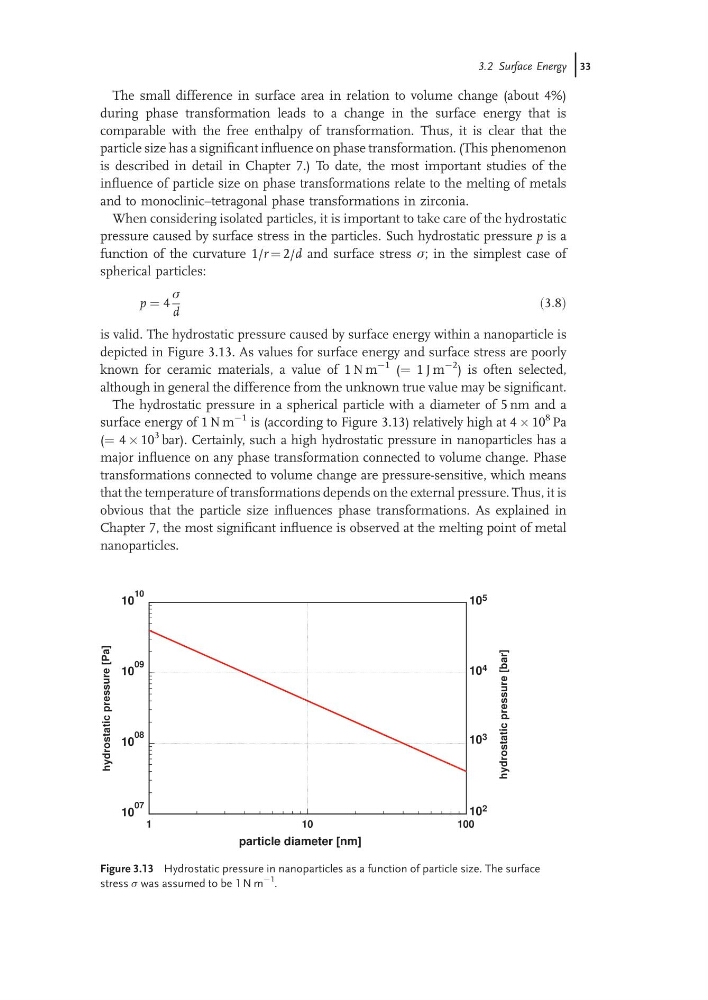
is valid. The hydrostatic pressure caused by surface energy within a nanoparticle is
depicted in Figure 3.13. As values for surface energy and surface stress are poorly
known for ceramic materials, a value of 1 N m
À1 (¼ 1 J m
À2 ) is often selected,
although in general the difference from the unknown true value may be significant.
The hydrostatic pressure in a spherical particle with a diameter of 5 nm and a
surface energy of 1 N m
À1 is (according to Figure 3.13) relatively high at 4 Â 10
8 Pa
(¼ 4 Â 10
3 bar). Certainly, such a high hydrostatic pressure in nanoparticles has a
major influence on any phase transformation connected to volume change. Phase
transformations connected to volume change are pressure-sensitive, which means
that the temperature of transformations depends on the external pressure. Thus, it is
obvious that the particle size influences phase transformations. As explained in
Chapter 7, the most significant influence is observed at the melting point of metal
nanoparticles.
1
10
100
particle diameter [nm]
10
07
10
08
10
09
10
10
hydrostatic
pressure
[Pa]
hydrostatic pressure [bar]
10 5
10 4
10 3
10 2
Figure 3.13 Hydrostatic pressure in nanoparticles as a function of particle size. The surface
stress s was assumed to be 1 N m
À1 .
3.2 Surface Energy j33
during phase transformation leads to a change in the surface energy that is
comparable with the free enthalpy of transformation. Thus, it is clear that the
particle size has a significant influence on phase transformation. (This phenomenon
is described in detail in Chapter 7.) To date, the most important studies of the
influence of particle size on phase transformations relate to the melting of metals
and to monoclinic–tetragonal phase transformations in zirconia.
When considering isolated particles, it is important to take care of the hydrostatic
pressure caused by surface stress in the particles. Such hydrostatic pressure p is a
function of the curvature 1/r ¼ 2/d and surface stress s; in the simplest case of
spherical particles:
p ¼ 4
s
d
ð3:8Þ
is valid. The hydrostatic pressure caused by surface energy within a nanoparticle is
depicted in Figure 3.13. As values for surface energy and surface stress are poorly
known for ceramic materials, a value of 1 N m
À1 (¼ 1 J m
À2 ) is often selected,
although in general the difference from the unknown true value may be significant.
The hydrostatic pressure in a spherical particle with a diameter of 5 nm and a
surface energy of 1 N m
À1 is (according to Figure 3.13) relatively high at 4 Â 10
8 Pa
(¼ 4 Â 10
3 bar). Certainly, such a high hydrostatic pressure in nanoparticles has a
major influence on any phase transformation connected to volume change. Phase
transformations connected to volume change are pressure-sensitive, which means
that the temperature of transformations depends on the external pressure. Thus, it is
obvious that the particle size influences phase transformations. As explained in
Chapter 7, the most significant influence is observed at the melting point of metal
nanoparticles.
1
10
100
particle diameter [nm]
10
07
10
08
10
09
10
10
hydrostatic
pressure
[Pa]
hydrostatic pressure [bar]
10 5
10 4
10 3
10 2
Figure 3.13 Hydrostatic pressure in nanoparticles as a function of particle size. The surface
stress s was assumed to be 1 N m
À1 .
3.2 Surface Energy j33