

particles with the diameter d and that of the coagulated particle with the diameter
d coagulated ¼ 2
1=3
d is:
Du ¼ cD a ¼ c 2pd
2 À pd
2
coagulated
¼ pcd
2 2 À 2
2 =3
ð3: 5Þ
The reduction in surface energy leads, due to dissipation, to an increase in
temperature D T:
DT ¼
Du surface
r c p
6
pd
3 ¼
c
r c p
2 À 2
2 =3
À
Á
d
ð3: 6Þ
If zirconia particles are assumed to have density r ¼ 5.6 g cm
À3 , surface energy
c ¼ 1 J m
À2 (in the literature there are indications that this value may be signi ficantly
larger; however, to avoid exaggerations, this extremely conservative value was
selected), and heat capacity C p ¼ 56.2 J mol
À1 K
À1 , this will cause an increase in
temperature during the adiabatic coagulation process (see Figure 3.8). (For reasons
of simplicity, the materials’ data are those of conventional materials; the surface
energy value is roughly approximated.)
Based on data in Figure 3.8, it can be seen that via the exchange of surface energy a
remarkable temperature flash occurs during the coagulation of two equal-sized
particles. It is this temperature flash that makes coagulation possible, as the rise
in temperature causes the mobility of the atoms to be increased. The strong decrease in
temperature flash with increasing particle size explains the occurrence of odd-shaped
particles in the size range above 3 or 4 nm. This situation is not purely theoretical;
rather, the coagulation of nanoparticles is a phenomenon that makes the production of
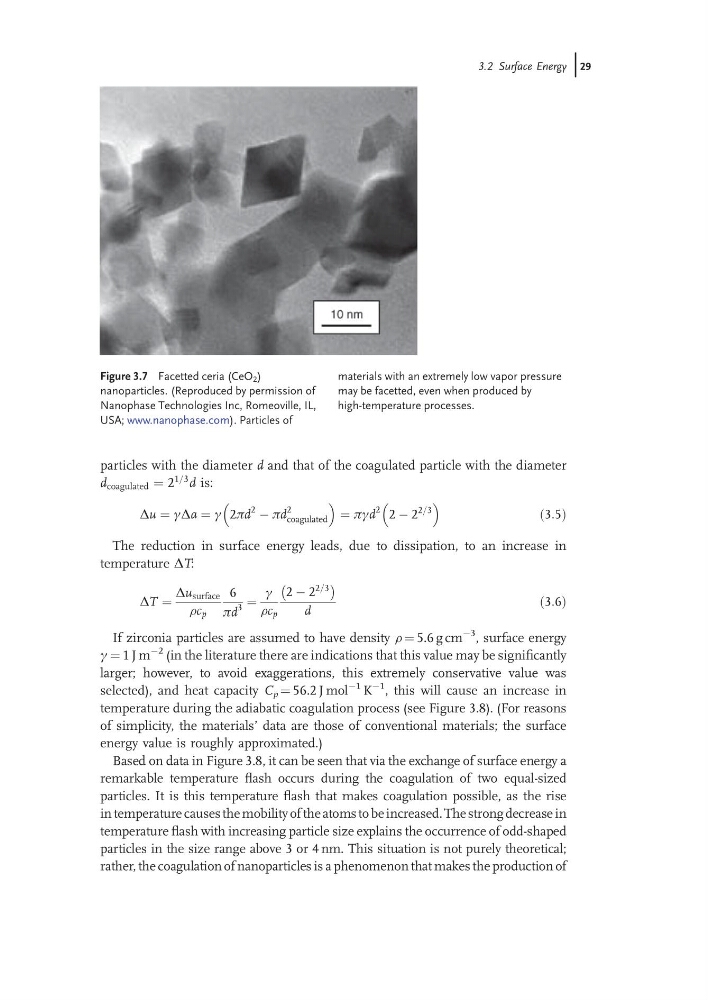
Figure 3.7 Facetted ceria (CeO 2 )
nanoparticles. (Reproduced by permission of
Nanophase Technologies Inc, Romeoville, IL,
USA; www.nanophase.com). Particles of
materials with an extremely low vapor pressure
may be facetted, even when produced by
high-temperature processes.
3.2 Surface Energy j29
d coagulated ¼ 2
1=3
d is:
Du ¼ cD a ¼ c 2pd
2 À pd
2
coagulated
¼ pcd
2 2 À 2
2 =3
ð3: 5Þ
The reduction in surface energy leads, due to dissipation, to an increase in
temperature D T:
DT ¼
Du surface
r c p
6
pd
3 ¼
c
r c p
2 À 2
2 =3
À
Á
d
ð3: 6Þ
If zirconia particles are assumed to have density r ¼ 5.6 g cm
À3 , surface energy
c ¼ 1 J m
À2 (in the literature there are indications that this value may be signi ficantly
larger; however, to avoid exaggerations, this extremely conservative value was
selected), and heat capacity C p ¼ 56.2 J mol
À1 K
À1 , this will cause an increase in
temperature during the adiabatic coagulation process (see Figure 3.8). (For reasons
of simplicity, the materials’ data are those of conventional materials; the surface
energy value is roughly approximated.)
Based on data in Figure 3.8, it can be seen that via the exchange of surface energy a
remarkable temperature flash occurs during the coagulation of two equal-sized
particles. It is this temperature flash that makes coagulation possible, as the rise
in temperature causes the mobility of the atoms to be increased. The strong decrease in
temperature flash with increasing particle size explains the occurrence of odd-shaped
particles in the size range above 3 or 4 nm. This situation is not purely theoretical;
rather, the coagulation of nanoparticles is a phenomenon that makes the production of
Figure 3.7 Facetted ceria (CeO 2 )
nanoparticles. (Reproduced by permission of
Nanophase Technologies Inc, Romeoville, IL,
USA; www.nanophase.com). Particles of
materials with an extremely low vapor pressure
may be facetted, even when produced by
high-temperature processes.
3.2 Surface Energy j29