

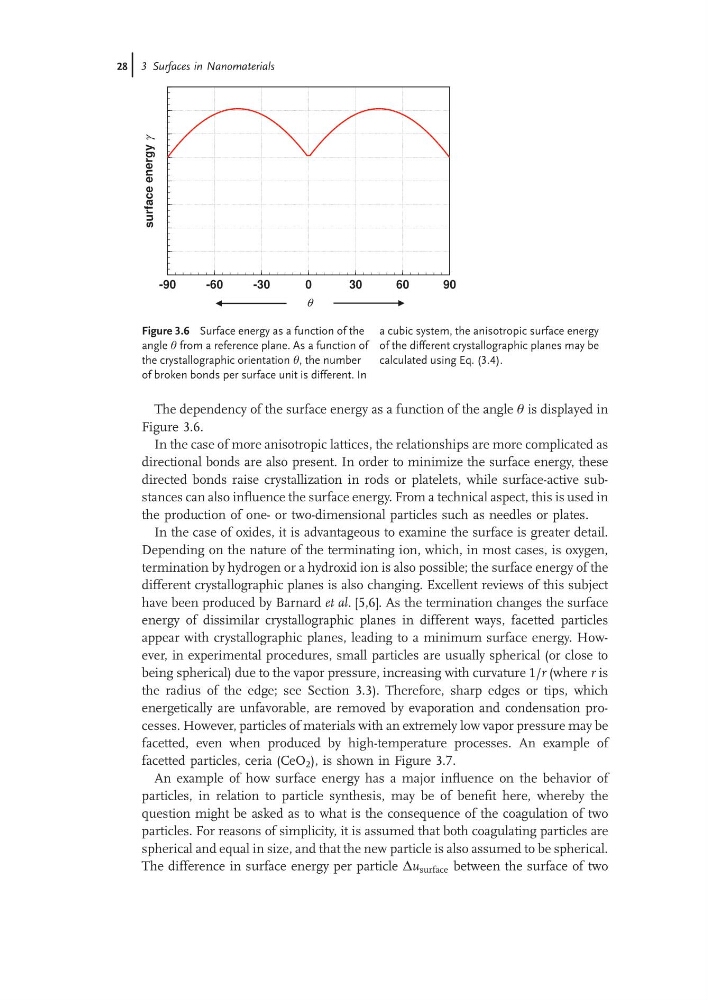
The dependency of the surface energy as a function of the angle q is displayed in
Figure 3.6.
In the case of more anisotropic lattices, the relationships are more complicated as
directional bonds are also present. In order to minimize the surface energy, these
directed bonds raise crystallization in rods or platelets, while surface-active substances can also influence the surface energy. From a technical aspect, this is used in
the production of one- or two-dimensional particles such as needles or plates.
In the case of oxides, it is advantageous to examine the surface is greater detail.
Depending on the nature of the terminating ion, which, in most cases, is oxygen,
termination by hydrogen or a hydroxid ion is also possible; the surface energy of the
different crystallographic planes is also changing. Excellent reviews of this subject
have been produced by Barnard et al. [5,6]. As the termination changes the surface
energy of dissimilar crystallographic planes in different ways, facetted particles
appear with crystallographic planes, leading to a minimum surface energy. However, in experimental procedures, small particles are usually spherical (or close to
being spherical) due to the vapor pressure, increasing with curvature 1/r (where r is
the radius of the edge; see Section 3.3). Therefore, sharp edges or tips, which
energetically are unfavorable, are removed by evaporation and condensation processes. However, particles of materials with an extremely low vapor pressure may be
facetted, even when produced by high-temperature processes. An example of
facetted particles, ceria (CeO 2 ), is shown in Figure 3.7.
An example of how surface energy has a major influence on the behavior of
particles, in relation to particle synthesis, may be of benefit here, whereby the
question might be asked as to what is the consequence of the coagulation of two
particles. For reasons of simplicity, it is assumed that both coagulating particles are
spherical and equal in size, and that the new particle is also assumed to be spherical.
The difference in surface energy per particle Du surface between the surface of two
-90
-60
-30
0
30
60
90
surface
energy
γ
θ
Figure 3.6 Surface energy as a function of the
angle q from a reference plane. As a function of
the crystallographic orientation q, the number
of broken bonds per surface unit is different. In
a cubic system, the anisotropic surface energy
of the different crystallographic planes may be
calculated using Eq. (3.4).
28j 3 Surfaces in Nanomaterials
Figure 3.6.
In the case of more anisotropic lattices, the relationships are more complicated as
directional bonds are also present. In order to minimize the surface energy, these
directed bonds raise crystallization in rods or platelets, while surface-active substances can also influence the surface energy. From a technical aspect, this is used in
the production of one- or two-dimensional particles such as needles or plates.
In the case of oxides, it is advantageous to examine the surface is greater detail.
Depending on the nature of the terminating ion, which, in most cases, is oxygen,
termination by hydrogen or a hydroxid ion is also possible; the surface energy of the
different crystallographic planes is also changing. Excellent reviews of this subject
have been produced by Barnard et al. [5,6]. As the termination changes the surface
energy of dissimilar crystallographic planes in different ways, facetted particles
appear with crystallographic planes, leading to a minimum surface energy. However, in experimental procedures, small particles are usually spherical (or close to
being spherical) due to the vapor pressure, increasing with curvature 1/r (where r is
the radius of the edge; see Section 3.3). Therefore, sharp edges or tips, which
energetically are unfavorable, are removed by evaporation and condensation processes. However, particles of materials with an extremely low vapor pressure may be
facetted, even when produced by high-temperature processes. An example of
facetted particles, ceria (CeO 2 ), is shown in Figure 3.7.
An example of how surface energy has a major influence on the behavior of
particles, in relation to particle synthesis, may be of benefit here, whereby the
question might be asked as to what is the consequence of the coagulation of two
particles. For reasons of simplicity, it is assumed that both coagulating particles are
spherical and equal in size, and that the new particle is also assumed to be spherical.
The difference in surface energy per particle Du surface between the surface of two
-90
-60
-30
0
30
60
90
surface
energy
γ
θ
Figure 3.6 Surface energy as a function of the
angle q from a reference plane. As a function of
the crystallographic orientation q, the number
of broken bonds per surface unit is different. In
a cubic system, the anisotropic surface energy
of the different crystallographic planes may be
calculated using Eq. (3.4).
28j 3 Surfaces in Nanomaterials