

Due to the curvature, and in connection with the surface stress, a hydrostatic
pressure within the particle, and which is comparable to that stemming from a gas
or a liquid at the outside, comes into action. To calculate the hydrostatic pressure
caused by surface stress, s must be applied, the pressure being given by p ¼ 4(s/d).
Even when the situation at the surface can be described by quite plausible physical
and exact mathematical models, the experimental situation is poor. To date, no data
have been reported for the surface energy discriminating between c, c s , and s, and
therefore it is necessary to use published values of the surface energy c for all
applications. Based on the considerations above, it is clear that the determination of
surface energy by measuring interface stress is insufficient as these methods deliver
only c s , whereas calorimetric measurements (e.g., connected to grain growth) result
in a value for c ¼ c 0 þ c s . Lastly, only these values are useful for thermodynamic
considerations.
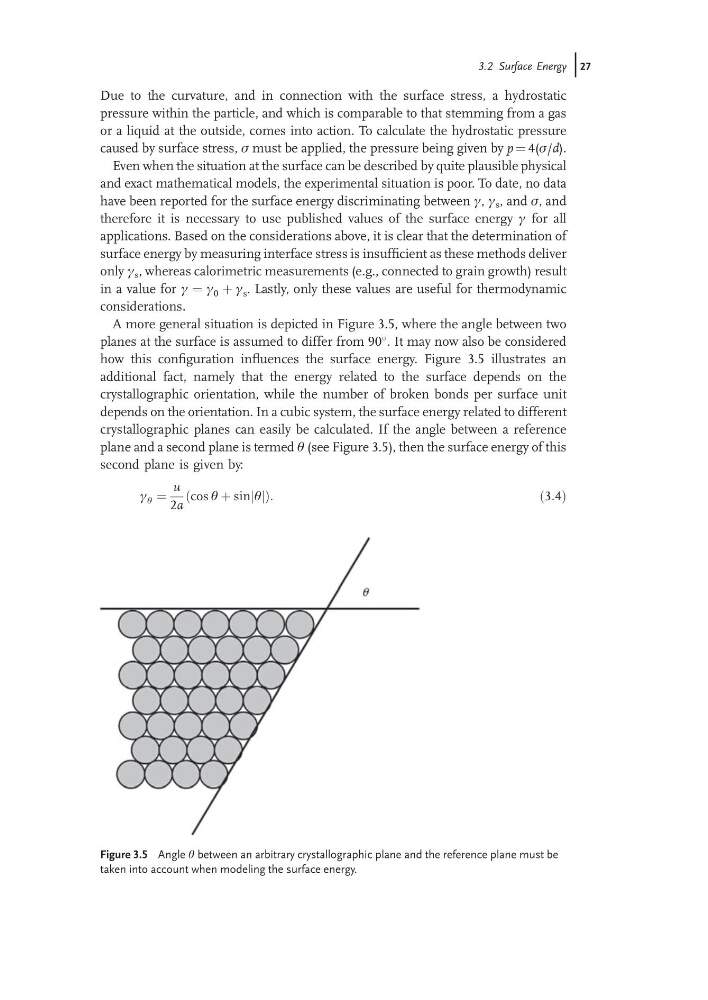
A more general situation is depicted in Figure 3.5, where the angle between two
planes at the surface is assumed to differ from 90
. It may now also be considered
how this configuration influences the surface energy. Figure 3.5 illustrates an
additional fact, namely that the energy related to the surface depends on the
crystallographic orientation, while the number of broken bonds per surface unit
depends on the orientation. In a cubic system, the surface energy related to different
crystallographic planes can easily be calculated. If the angle between a reference
plane and a second plane is termed q (see Figure 3.5), then the surface energy of this
second plane is given by:
c q ¼
u
2a
cos q þ sin q
j j
ð
Þ :
ð3:4Þ
Figure 3.5 Angle q between an arbitrary crystallographic plane and the reference plane must be
taken into account when modeling the surface energy.
3.2 Surface Energy j27
pressure within the particle, and which is comparable to that stemming from a gas
or a liquid at the outside, comes into action. To calculate the hydrostatic pressure
caused by surface stress, s must be applied, the pressure being given by p ¼ 4(s/d).
Even when the situation at the surface can be described by quite plausible physical
and exact mathematical models, the experimental situation is poor. To date, no data
have been reported for the surface energy discriminating between c, c s , and s, and
therefore it is necessary to use published values of the surface energy c for all
applications. Based on the considerations above, it is clear that the determination of
surface energy by measuring interface stress is insufficient as these methods deliver
only c s , whereas calorimetric measurements (e.g., connected to grain growth) result
in a value for c ¼ c 0 þ c s . Lastly, only these values are useful for thermodynamic
considerations.
A more general situation is depicted in Figure 3.5, where the angle between two
planes at the surface is assumed to differ from 90
. It may now also be considered
how this configuration influences the surface energy. Figure 3.5 illustrates an
additional fact, namely that the energy related to the surface depends on the
crystallographic orientation, while the number of broken bonds per surface unit
depends on the orientation. In a cubic system, the surface energy related to different
crystallographic planes can easily be calculated. If the angle between a reference
plane and a second plane is termed q (see Figure 3.5), then the surface energy of this
second plane is given by:
c q ¼
u
2a
cos q þ sin q
j j
ð
Þ :
ð3:4Þ
Figure 3.5 Angle q between an arbitrary crystallographic plane and the reference plane must be
taken into account when modeling the surface energy.
3.2 Surface Energy j27