

the material, but rather leads to stress in the surface plane; surface stress s ¼ f/a,
where a is the area occupied by one atom of the surface. Consequently, a surface
stress that deforms the surface will result in surface stretching, and this allows the
surfaces of particles to be modeled as an elastic material skin. According to Gurtin
et al. [2,3] and Fischer et al. [4] (this paper provides a broad overview on the problems
connected with surface energy), this provides an additional contribution to the
surface-free energy c as a function of the surface stretching e s (much like the
stretching of a rubber skin) and the surface stress s. Consequently, the surface
energy is described by the relationship:
c ¼ c 0 þ c s e s
ð Þ
ð3:3bÞ
where c s is the contribution of the surface stress to the surface energy. The surface
stress s and e s , the corresponding stretch, are assumed to be constant in any
direction of the particle’s tangent plane. It follows that:
s ¼ c þ
@c s
@e s
ð3:3cÞ
In the case of liquids, the second term of Eq. (3.3c) vanishes as c s ¼ 0. This often
raises confusion between c and s, especially as both have the same dimension. In
order to estimate thermal effects, as for example during the coagulation of two
particles, the sum value c from Eq. (3.3b) must be used. For a spherical particle of
limited size and with a radius of curvature r at the surface, the situation is different.
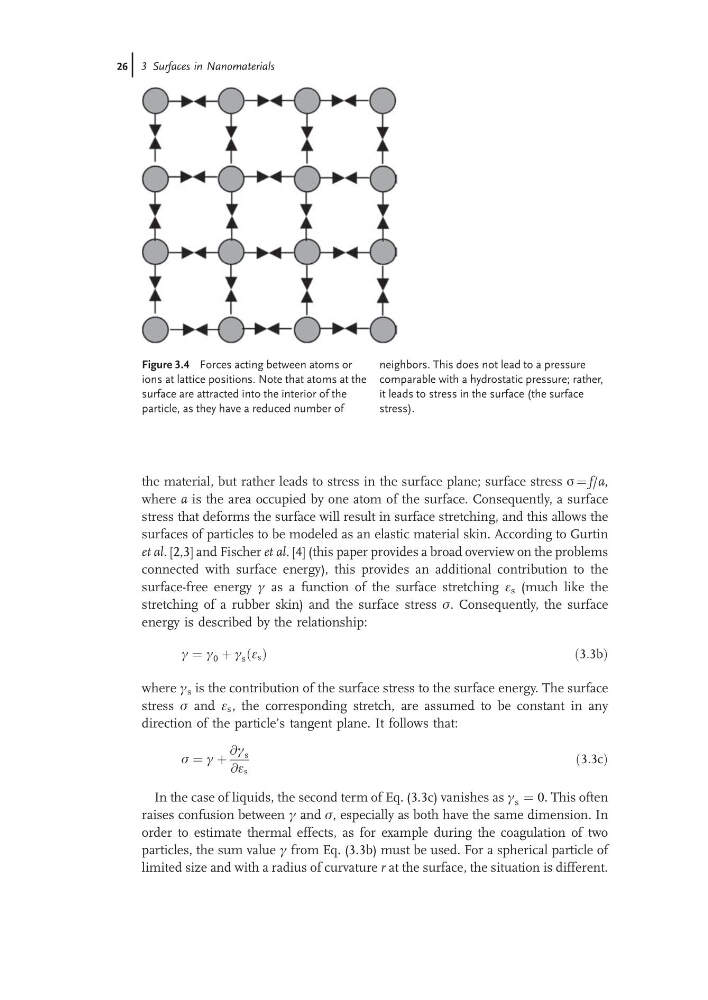
Figure 3.4 Forces acting between atoms or
ions at lattice positions. Note that atoms at the
surface are attracted into the interior of the
particle, as they have a reduced number of
neighbors. This does not lead to a pressure
comparable with a hydrostatic pressure; rather,
it leads to stress in the surface (the surface
stress).
26j 3 Surfaces in Nanomaterials
where a is the area occupied by one atom of the surface. Consequently, a surface
stress that deforms the surface will result in surface stretching, and this allows the
surfaces of particles to be modeled as an elastic material skin. According to Gurtin
et al. [2,3] and Fischer et al. [4] (this paper provides a broad overview on the problems
connected with surface energy), this provides an additional contribution to the
surface-free energy c as a function of the surface stretching e s (much like the
stretching of a rubber skin) and the surface stress s. Consequently, the surface
energy is described by the relationship:
c ¼ c 0 þ c s e s
ð Þ
ð3:3bÞ
where c s is the contribution of the surface stress to the surface energy. The surface
stress s and e s , the corresponding stretch, are assumed to be constant in any
direction of the particle’s tangent plane. It follows that:
s ¼ c þ
@c s
@e s
ð3:3cÞ
In the case of liquids, the second term of Eq. (3.3c) vanishes as c s ¼ 0. This often
raises confusion between c and s, especially as both have the same dimension. In
order to estimate thermal effects, as for example during the coagulation of two
particles, the sum value c from Eq. (3.3b) must be used. For a spherical particle of
limited size and with a radius of curvature r at the surface, the situation is different.
Figure 3.4 Forces acting between atoms or
ions at lattice positions. Note that atoms at the
surface are attracted into the interior of the
particle, as they have a reduced number of
neighbors. This does not lead to a pressure
comparable with a hydrostatic pressure; rather,
it leads to stress in the surface (the surface
stress).
26j 3 Surfaces in Nanomaterials